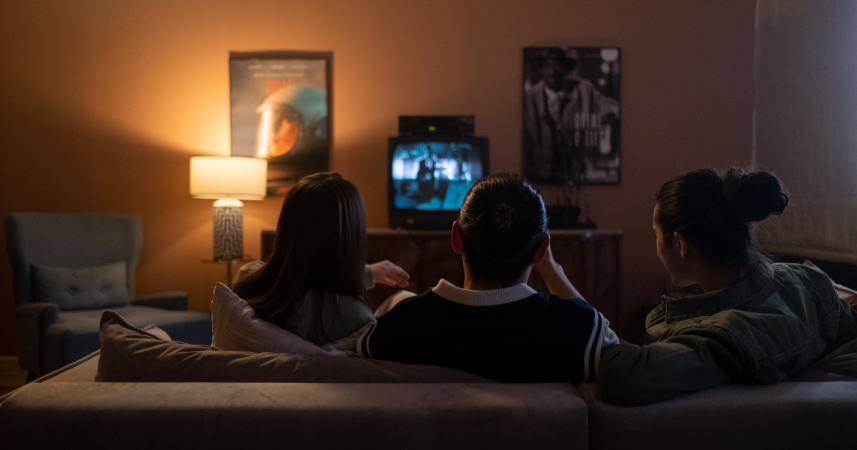
Television taught us that adulthood came with a laugh track and tidy resolutions, but those of us who grew up glued to 1960s sitcoms discovered the hard way that real life didn't follow a Hollywood script.

Add VegOut to your Google News feed. 
Growing up in the 1960s meant spending countless hours in front of our wood-paneled Zenith television, absorbing lessons about what grown-up life would be like.
Between The Brady Bunch and Leave It to Beaver, we thought we had adulthood all figured out. The formula seemed simple: get married, buy a house with a white picket fence, and everything would work out perfectly by the end of each 30-minute episode.
What we didn't know was that television was selling us a version of adulthood that was about as realistic as the canned laughter that punctuated every scene. Those of us who came of age watching these shows walked into our twenties with a roadmap drawn by Hollywood writers who had never met a problem they couldn't solve before the final commercial break.
1. Problems always resolve within 30 minutes
Remember how Ward Cleaver could solve any crisis with a heart-to-heart talk in his study? I certainly did when I found myself at 28, suddenly single with two toddlers clinging to my legs. There was no wise patriarch waiting in a book-lined room to dispense the perfect advice. There was just me, standing in a half-empty house, realizing that some problems don't get wrapped up neatly before bedtime. They stretch on for months, even years, demanding patience and resilience that no sitcom ever taught us to develop.
The television families we grew up with never had to deal with the messy aftermath of their conflicts. Once the lesson was learned and the music swelled, that was it. But real life keeps going after the dramatic moments, through the mundane Tuesday afternoons and the sleepless Wednesday nights when you're wondering how you'll make the mortgage payment.
2. Marriage is the happy ending, not the beginning
How many shows ended with wedding bells? It was the ultimate resolution, the moment when everything fell into place. I was 22 when I walked down the aisle, absolutely certain I was stepping into my happily ever after. Television had taught me that finding the right person was the hard part. Once you said "I do," the rest was supposed to be smooth sailing.
What those shows never depicted was the daily negotiation of sharing a life with another person. They didn't show the arguments over money, the exhaustion of new parenthood, or the slow drift that can happen when two people grow in different directions. The couples on TV were frozen in perpetual honeymoon mode, their biggest conflicts revolving around burnt pot roasts or mixed-up dinner dates.
3. Divorce meant you were the villain
Can you think of a single divorced character from 1960s television who wasn't portrayed as either pitiful or morally questionable? When my marriage ended, I carried that shame like a scarlet letter. In my small Pennsylvania town, being a divorcee in the late 1970s felt like wearing a sign that said "failure." The television moral code we'd absorbed was clear: good people stayed married, no matter what.
It took years to understand that sometimes the bravest thing you can do is admit something isn't working. But television had programmed us to believe that persistence always paid off, that true love conquered all, and that walking away meant you simply hadn't tried hard enough.
4. Fathers know best (and mothers stay home)
The patriarchs of television commanded respect simply by walking through the door. "Wait until your father gets home" was the ultimate threat, and Dad's word was law. Mothers, meanwhile, vacuumed in pearls and had dinner on the table at six sharp. This was the blueprint we internalized, even as the world around us was already changing.
When I became a single mother, I had to be both the disciplinarian and the nurturer, the breadwinner and the homework helper. There was no script for this. The television mothers I'd watched never had to figure out how to fix a leaky faucet or teach their kids about standing up to bullies. They had husbands for that.
5. Your neighborhood is filled with helpful, available friends
Lucy had Ethel. The Brady kids had each other. Everyone had neighbors who dropped by with casseroles and solutions to every problem. We expected adult friendships to be effortless, always available, and conveniently located next door.
Reality check: adult friendships require intentional effort. People have jobs, families, and their own crises to manage. After my divorce, I learned that the friends who show up might not be the ones who live closest. Sometimes support comes from unexpected places, and sometimes you have to explicitly ask for help rather than waiting for someone to notice you're drowning.
6. Money troubles are temporary and easily solved
Did anyone on television ever struggle with money for more than one episode? Financial hardship was always a temporary plot device, resolved by a raise, a contest win, or a mysterious inheritance. Even the "poor" families on TV had spacious homes and never seemed to choose between groceries and gas.
Growing up as the youngest of four sisters, I watched my mailman father stretch every dollar. Yet television had convinced me that money problems in adulthood would be quirky adventures, not grinding daily stress. When I found myself budgeting down to the last penny as a single mother, there was no laugh track to lighten the mood.
7. Children are naturally obedient and respectful
The biggest rebellion we saw on family television was maybe staying out past curfew or sneaking a cookie before dinner. Children on TV respected their elders, learned their lessons immediately, and never talked back without swift consequences and sincere apologies.
Raise your hand if your kids ever responded to your wisdom with the immediate understanding and gratitude of a TV child. I'm still waiting for mine to thank me for those valuable life lessons I tried to impart while they rolled their eyes and slammed their bedroom doors.
8. Success follows a predictable timeline
By 30, television taught us, you should have it all figured out. The house, the career, the family, all of it should fall into place in a logical sequence. There was no room in the TV narrative for starting over, changing directions, or finding yourself at 66, as I did, embarking on a completely new career as a writer.
Television never showed us that success might mean something entirely different than what we imagined at 20, or that some of our greatest achievements might come after what society considers our "prime years."
Final thoughts
Those black-and-white lessons we absorbed from the television screen weren't entirely wrong, just incomplete. They gave us ideals to strive for: strong families, supportive communities, and problems that could be solved with communication and care. What they failed to teach us was that real life is messier, longer, and ultimately richer than anything that could fit into a scheduled time slot.
We learned the hard way that adulthood doesn't come with a script, a laugh track, or guaranteed resolution. But perhaps that's what makes our real stories worth telling, imperfect and ongoing as they are.
What’s Your Plant-Powered Archetype?
Ever wonder what your everyday habits say about your deeper purpose—and how they ripple out to impact the planet?
This 90-second quiz reveals the plant-powered role you’re here to play, and the tiny shift that makes it even more powerful.
12 fun questions. Instant results. Surprisingly accurate.