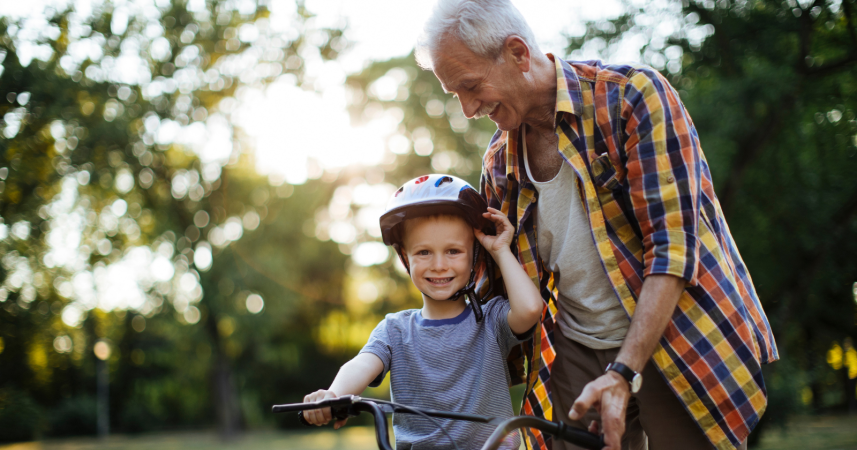
Core memories aren’t made in theme parks—they’re made in kitchens, gardens, and the backseat during a made-up song about traffic.
Some memories don’t fade.
They become anchors—little portals we revisit on tough days, quiet nights, and milestone moments.
When I think about the kinds of memories grandparents create, what stands out isn’t the price tag or the perfect itinerary.
It’s rhythm and repetition.
It’s the smell of cinnamon on a Sunday morning, the creak of a porch swing, the five extra minutes to tell one more story.
Daniel Kahneman once said, “We don’t choose between experiences, we choose between memories of experiences.”
That’s the game here—designing experiences that the remembering self can’t help but hold onto.
Let’s get practical.
Here are nine simple, repeatable ways grandparents can plant lifelong memories.
1. Cooking together
Food is memory glue.
The act of chopping, stirring, tasting—tiny rituals that tell a child, “You belong here.”
When grandparents invite little hands into the kitchen, the kitchen becomes a classroom disguised as a hug.
I still remember learning to make a plant-based banana bread with my grandmother after I went vegan.
We swapped eggs for flaxseed, laughed when we spilled the cinnamon, and wrote our tweaks in the margin.
That recipe card has more smudges than ink now.
But that’s the point—evidence that love happened.
Keep it simple. Pancakes shaped like initials. Rainbow veggie skewers.
A “grandkid spice” that’s really just cinnamon and nutmeg but sounds magical. Name the ritual and repeat it.
Bonus: label a jar with your grandchild’s name and let them add it to everything.
That label becomes a story long after the jar is empty.
2. Unstructured play
“Play is the work of the child,” Maria Montessori said.
Grandparents are uniquely good at protecting that work from adult agendas.
Unstructured play—cards spread on the floor, a blanket fort, chalk on the driveway—lets kids steer the ship.
That sense of agency is where core memories start.
Set the stage and step back. Rotate a small “mystery box” of everyday objects (measuring spoons, clothespins, old postcards) and see what games appear.
Keep clocks out of sight. When time isn’t the boss, imagination shows up.
Later, when your grandchild tells their friends about “the café we ran under the dining table,” you’ll know you got it right.
I’ve mentioned this before but boredom is not the villain; it’s the runway.
Give it space and watch a paper towel tube become a telescope, a microphone, a tunnel for toy cars, and finally a drumstick.
3. Storytelling rituals
Kids don’t just crave stories; they build identity from them.
As Emilie Buchwald put it, ‘Children are made readers on the laps of their parents.’” Swap “parents” for “grandparents,” and the magic holds.
Lap or no lap, the ritual of being read to creates a shared language.
Make it a ritual with a name. “Two-page Tuesdays.” “Stories by flashlight.” “The tale of the day,” told during bath clean-up or dishes.
Record a simple voice memo of you reading their favorite picture book so they can play it on nights you aren’t there. Years later, that audio becomes a time capsule.
I once carried a tiny cassette recorder on road trips with my granddad.
We’d trade off lines for a make-believe mystery series. I can’t tell you the plot, but I can still hear the way he said my name when it was my turn.
That cadence is memory’s signature.
4. Nature walks
Nature is a memory factory with great lighting.
A slow walk with a grandparent calibrates attention. You’re not “exercising.” You’re collecting. Sounds. Leaves. “Cloud of the day.”
The tradition matters more than the trail.
Start a “micro-collection” in a small tin—smooth stones that feel like worry beads, seed pods, tiny shells.
Give each one a nickname together and log it in a pocket notebook with a quick sketch.
That notebook will outlast their shoes and become a museum of childhood.
Photography tip I picked up while learning my way around a camera: teach kids a simple “rule of three”—snap one photo of the big scene, one of a small detail (a ladybug), and one silly shot.
The silly shot is often the one they show everyone later.
5. Creative projects
Kids remember the things they made with you more than the things you bought them.
Grandparents can be the patient co-conspirators who make “Let’s try it” feel safe.
That could be drawing your neighborhood as a comic strip, sewing a patch for a backpack, building a bird feeder from scrap wood, or starting a little “zine” that you staple together every month.
Keep a “studio box” ready—blank paper, tape, glue, a few markers, recycled cardboard.
Limit choice, not creativity.
When a child knows there’s a place where making is expected, they start looking for ideas everywhere.
My musician roots mean I’ll sneak in sound. Invent instruments from the kitchen—rice in a jar, a whisk on a cooling rack, a wooden spoon drum.
Record a 30‑second “grand band” theme song.
It’s goofy. It’s perfect. It’s theirs.
6. Family history
Grandparents are living libraries. Kids don’t need a lecture; they need a map.
Turn family history into bite-sized artifacts. One photo at a time. One recipe at a time. One story at a time.
Pair each with a question the child can ask someone else in the family.
Now the story walks.
Create a “then and now” ritual.
Show a black‑and‑white photo of a street you once lived on, then take a walk on a nearby street and compare.
What’s the same? What’s different? History clicks when it’s anchored to place.
If there are tough chapters in the family book, share them with care and age-appropriate honesty.
Kids don’t need perfection. They need patterns. “In our family, we stick together.” “In our family, we try again.” That’s the kind of narrative that leaves fingerprints on decisions later.
7. Celebrations
Traditions aren’t born; they’re scheduled.
Make small, repeatable celebrations that a child can count on.
First snow day hot cocoa (oat milk works wonders). Start-of-summer picnic at the same park.
The “half-birthday call” where you sing poorly on purpose.
Rituals become landmarks in the mind, and landmarks become the scaffolding of self.
Here’s the psychology piece.
The remembering self prizes peaks and endings.
So add a tiny peak and a clear ending.
Peak: a surprise note under the placemat. Ending: the same short phrase every time—“Same time next year.”
You’re telling the brain, “Save this.”
When kids are included in planning the celebration—choosing the picnic blanket, writing the guest list for teddy bears—the memory deepens because agency deepens.
8. Emotional check-ins
Kids remember how you made room for their feelings.
As the saying goes, “What is most personal is most universal.” I’ve seen it in friendships, creative work, and family life.
When grandparents model naming emotions—“Do you feel mad like thunder or sad like rain?”—they normalize internal weather.
Try a two‑question check‑in. Question one: “What’s one good thing today?” Question two: “What’s one sticky thing?” Over time, the pattern itself is soothing.
It teaches a child that feelings come and go, but the relationship is steady.
This is backed by experts like John Gottman, who has noted that “emotion coaching” helps kids build resilience and better social skills.
You don’t need a degree to do it—just curiosity, patience, and a willingness to listen without fixing.
9. Community service
Nothing rewires a memory like kindness put into motion.
Grandparents can widen the circle of “we” in a way that feels safe and purposeful.
Plant a couple of pollinator‑friendly herbs for the neighborhood (rosemary, lavender, mint).
Bring gently used books to a little free library.
Make simple PB&J (or sunflower butter and jam) sandwiches together for a local shelter and attach a kind note drawn by small hands.
Keep it concrete and brief. Ten minutes of service repeated monthly does more than a once‑a‑year marathon.
Give the ritual a name—“Good Neighbor Saturday”—and snap a photo for a small scrapbook.
That book becomes a mirror: “I’m the kind of person who helps.”
There’s a bonus here. Helping others shifts attention outward, which research often links with higher well‑being. You’re not just making memories; you’re building meaning.
How to make any moment stick
A quick framework I use when I’m trying to turn an everyday moment into a memory:
- Name it. Give the ritual a simple name a child can repeat.
- Repeat it. The calendar is your friend. Predictability is comforting.
- Make it sensory. Smell, sound, touch—choose one to emphasize.
- Give agency. Let the child choose a step, a tool, or a twist.
- Save a token. A photo, a note, a pressed leaf, a spice jar label.
None of this requires perfect craft skills or endless free time. It asks for presence plus pattern.
As you sketch your own set of grandparent rituals—plant‑based brunches, flashlight story hours, garden walks—remember the simple truth I started with.
Memories are the stories we keep telling. Set the scene, repeat the beat, and let love do its quiet work.
Because years from now, when someone asks your grandchild what they remember most, it won’t be the toy that shipped fast.
It’ll be the way cinnamon smelled in your kitchen, the sound of your voice under a blanket fort, and the certainty that they were safe, seen, and deeply loved.
What’s Your Plant-Powered Archetype?
Ever wonder what your everyday habits say about your deeper purpose—and how they ripple out to impact the planet?
This 90-second quiz reveals the plant-powered role you’re here to play, and the tiny shift that makes it even more powerful.
12 fun questions. Instant results. Surprisingly accurate.