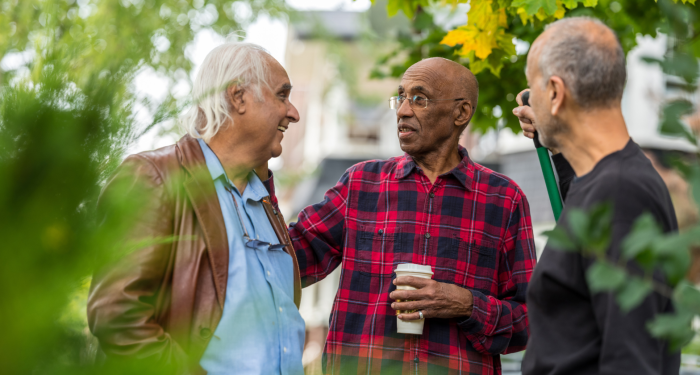
Work just doesn't give us income - it gives us an in-built community.

Add VegOut to your Google News feed. 
The quiet shock no one prepares you for
Most people assume the loneliest part of retirement will be silence.
An empty house.
A quiet morning.
A calendar with too much white space.
But for many people, that’s not the real shock.
The real shock is subtler.
It’s realising that many of your relationships were held together by routine.
By proximity.
By the simple fact that you worked in the same building, attended the same meetings, or shared the same daily rhythm.
And when that rhythm disappears, so do the conversations.
Not because anyone meant to drift away.
But because there was never much holding you together beyond the structure.
That realisation can feel confronting.
Not dramatic.
Just quietly disappointing.
Work doesn’t just give us income — it gives us built-in community
For decades, work does something incredibly powerful.
It creates forced proximity.
You see the same people every day.
You share frustrations.
You solve problems together.
You celebrate wins.
Over time, it can feel like friendship.
And sometimes it is.
But often, it’s situational closeness.
When the situation changes, the closeness thins.
Retirement removes the scaffolding.
No more corridor chats.
No more shared deadlines.
No more Friday rituals.
And suddenly you notice:
If I don’t initiate, nothing happens.
If I don’t text, the phone stays silent.
If I don’t organise, there’s no gathering.
That’s not a failure.
It’s clarity.
Friendship requires more than proximity
There’s a beautiful quote by C. S. Lewis:
“Friendship is born at that moment when one person says to another, ‘What! You too? I thought I was the only one.’”
That kind of friendship isn’t built on convenience.
It’s built on shared curiosity.
Shared vulnerability.
Shared inner worlds.
Work relationships are often built on shared tasks.
Real friendship is built on shared self.
Retirement exposes the difference.
And that exposure can sting.
Because it reveals how little of ourselves we may have actually shared.
When routines disappear, so does accidental connection
Before retirement, connection is often accidental.
You bump into someone.
You overhear something.
You’re invited because you’re “in the loop.”
After retirement, connection becomes intentional.
That shift alone can feel lonely.
Not because you’re unloved.
But because the effort now rests with you.
And here’s something many people don’t expect:
You can be deeply loved by family and still feel socially undernourished.
Adult children have their own lives.
Partners can’t meet every emotional need.
Couples often socialise with other couples.
If your identity revolved around work, your social ecosystem may have been narrower than you realised.
Retirement doesn’t create loneliness.
It reveals it.
What if the loneliness is actually about curiosity?
Here’s a question I gently offer:
How many of your work relationships were based on mutual curiosity?
Not gossip.
Not complaint.
Not updates.
Curiosity.
Did you ask each other about values?
Fears?
Dreams?
Books?
Ideas?
Regrets?
Or did most conversations orbit the agenda of the day?
There’s no blame here.
Work is busy.
But emotional intimacy requires time and openness.
Retirement removes the busyness.
And sometimes it reveals that very few people truly knew you.
That can hurt.
But it can also be liberating.
Because now, you get to choose differently.
The fear of ending up alone
In a recent video, I explored a question many people carry quietly into retirement:
What if I end up alone?
In it, I talk about how connection in retirement doesn’t happen by default.
It has to be designed.
Not in a frantic way.
But in a steady, consistent way.
Belonging grows from showing up regularly.
From shared rituals.
From repeated exposure.
Not from waiting for invitations.
Retirement invites us to move from passive participant to active architect of our social life.
That’s empowering.
But it requires courage.
The difference between being needed and being known
Many of us were needed at work.
We were competent.
Reliable.
Respected.
But being needed is not the same as being known.
You can be highly valued and still emotionally unseen.
Retirement removes the usefulness layer.
And what remains is revealing.
If usefulness was the glue, the relationship may loosen.
If emotional intimacy was the glue, it deepens.
That distinction can feel sobering.
But it’s also clarifying.
You are not too old to build deeper friendships
There’s a cultural myth that deep friendship is something you build in your twenties.
Not true.
In fact, later life can be the richest season for meaningful connection — because you finally have the time and self-awareness to go beyond surface conversation.
The key difference?
Intentionality.
Instead of asking, “How are the grandkids?”
You ask, “What’s been on your mind lately?”
Instead of defaulting to routine updates,
you invite depth.
Instead of waiting for proximity to do the work,
you create shared experiences.
A walking group.
A book discussion.
A class.
A volunteer project.
Not for distraction.
For mutual discovery.
Retirement isn’t the end of your social world — it’s the redesign of it
The loneliest part of retirement isn’t sitting alone at the kitchen table.
It’s realising that much of your previous connection was structural.
But once you see that clearly, you gain something powerful:
Choice.
You can choose to deepen.
Choose to widen.
Choose to be more curious.
Choose to be more open.
Real friendship requires a small risk.
The risk of being seen.
The risk of initiating.
The risk of saying, “Would you like to catch up?”
Some invitations won’t land.
Some connections won’t deepen.
But some will.
And those few can transform your entire experience of this chapter.
Retirement asks a new question
Work asked:
What do you do?
Retirement asks:
Who are you becoming?
And perhaps the deeper question is:
Who do you want to become in relationship with?
Because humans are relational beings.
We grow in connection.
We expand in dialogue.
We discover ourselves in conversation.
Retirement doesn’t remove that need.
It amplifies it.
And I’ll leave you with this:
Loneliness in retirement is not a verdict.
It’s information.
It tells you where depth is missing.
Where curiosity has faded.
Where new connection wants to be built.
Retirement isn’t about shrinking your world.
It’s about choosing the people you want to grow with.
And that choice is still entirely yours.
What’s Your Plant-Powered Archetype?
Ever wonder what your everyday habits say about your deeper purpose—and how they ripple out to impact the planet?
This 90-second quiz reveals the plant-powered role you’re here to play, and the tiny shift that makes it even more powerful.
12 fun questions. Instant results. Surprisingly accurate.