While the loudest voice at your family's dinner table commands attention, watch the quiet one in the corner — they're the one everyone unconsciously looks to when the conversation takes a serious turn.

Add VegOut to your Google News feed. 
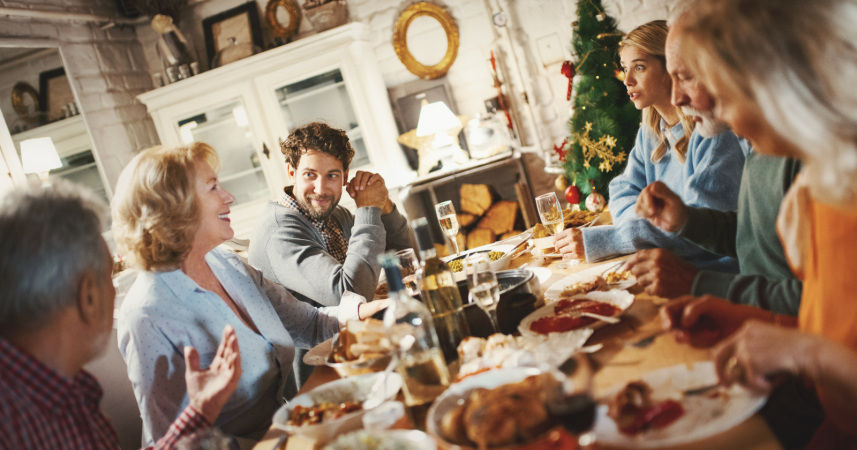
Picture this: the clatter of silverware against ceramic plates, the soft scrape of a chair being pulled back, steam rising from a casserole dish in the center of the table.
Around that table sits a family, and if you watch carefully, really watch, you'll notice something fascinating unfolding. It's not just dinner being served. It's an entire social ecosystem, complete with its own unspoken rules, invisible power dynamics, and a hierarchy as old as families themselves.
I've been observing this phenomenon for decades, first as the youngest of four sisters growing up in Pennsylvania, later as a mother at my own kitchen table, and now as someone who's had the privilege of sitting at countless family tables over the years. What I've noticed might surprise you: the person doing the least talking often holds the most influence in the room.
The architecture of family conversations
Have you ever noticed how family dinners develop their own rhythm? There's usually someone who dominates the airspace, filling every pause with another story, another opinion, another question that doesn't really wait for an answer.
Then there are the supporting players, those who chime in with agreements, gentle corrections, or perfectly timed laughs. And finally, there are the quiet ones, the observers, the ones who seem content to let the conversation flow around them like a river around a stone.
Growing up as the youngest of four sisters, I occupied every one of these roles at different times. But it wasn't until much later that I understood the real dynamics at play.
The sister who talked the most at dinner wasn't necessarily the one whose opinions carried the most weight when important family decisions were being made. In fact, it was often my quietest sister whose subtle nod or gentle "hmm" could shift the entire direction of a family discussion.
Virginia Woolf once wrote about "the cotton wool of daily life," those seemingly insignificant moments that actually hold everything together. Family dinners are woven from this very material, and the patterns they create reveal more about family power structures than any organizational chart ever could.
Why silence speaks volumes
The quiet family member often carries a different kind of authority, one that doesn't need constant reinforcement through words. They're the ones everyone glances at when a controversial topic comes up. They're the ones whose rare contributions to conversation cause everyone to lean in a little closer. Their economy with words gives each one more weight.
I remember a Thanksgiving dinner years ago when my mother, who could usually talk circles around anyone, fell silent during a heated discussion about a family member's life choices. The entire table gradually quieted, waiting for her input. When she finally spoke, it was just one sentence, but it reframed the entire conversation.
That's when I truly understood that sometimes the most powerful position at the table is held by the person who chooses when to speak rather than feeling compelled to fill every silence.
This dynamic plays out in countless ways. The quiet family member often becomes the keeper of secrets, the one others confide in precisely because they don't feel the need to share everything they know. They become the family's emotional barometer, their subtle reactions serving as a gauge for whether something is truly important or just noise.
The burden of being the listener
But here's what we don't often talk about: being the quiet one at the family table comes with its own unique burden. These are often the family members who absorb everyone else's anxieties, who hold space for others' emotions while rarely having their own fully acknowledged. They carry the weight of unspoken family tensions, serving as informal therapists, mediators, and emotional shock absorbers.
During my years in survival mode, juggling work and raising children, I often found myself in this role. I'd sit at family dinners, exhausted, listening to everyone else's dramas while my own struggles remained locked inside.
It wasn't until years later, during one of my standing Sunday phone calls with my daughter, that she told me she always knew when something was wrong because I would go quiet at dinner. "Your silence was louder than anyone else's words," she said.
The quiet ones often carry the family's institutional memory too. They're the ones who remember the exact expression on Dad's face when he heard about a grandchild's achievement, or the way Mom's hands trembled slightly when discussing a difficult topic. They notice the patterns, the repetitions, the slow evolution of family dynamics over years and decades.
When the hierarchy shifts
Family hierarchies aren't static. They shift with life changes, with growth, with loss. A serious falling out with one of my sisters that lasted five years taught me how dramatically these dynamics can change.
When she and I finally reconciled, the entire family dinner dynamic had to recalibrate. The person who had filled the conversational space during her absence had to make room again. The quiet observers had to adjust their watching patterns.
Sometimes a traditionally quiet family member finds their voice later in life, disrupting decades of established patterns. Sometimes the family storyteller grows quieter with age, ceding the floor to the next generation. These shifts can be uncomfortable, even painful, as everyone struggles to find their new place in the conversational ecosystem.
What's particularly interesting is how families often resist these changes, trying to push members back into their familiar roles. "You're being so quiet tonight," someone might say to a usually talkative member who's chosen to listen more.
Or "Since when do you have so much to say?" to someone who's traditionally been reserved. These comments, however well-intentioned, reveal how invested we become in maintaining familiar family dynamics.
Finding your place at the table
Understanding these dynamics doesn't mean you have to accept them unchangingly. If you're always the quiet one, it's okay to claim more conversational space. If you're always filling the silences, it might be worth exploring what happens when you don't. The family system will adjust, though perhaps not without some resistance.
What matters most is recognizing that every position at the family table has value. The storytellers keep family history alive. The questioners draw out those who might otherwise remain silent. The listeners provide the audience that makes sharing possible.
And yes, the quiet ones often serve as the family's emotional anchors, providing stability through their steady, observant presence.
Final thoughts
The next time you sit down to a family dinner, take a moment to observe the dance of conversation around you. Notice who speaks, who listens, who deflects, who probes.
Notice your own role in this intricate ballet. But most importantly, pay attention to the quiet ones. They're often carrying more than their share of the family's emotional weight, holding stories and secrets, providing the silent strength that keeps the family fabric from unraveling.
Their contribution might be less obvious, but it's no less essential. Sometimes, the most profound influence comes not from the voice that fills the room, but from the presence that holds it all together.