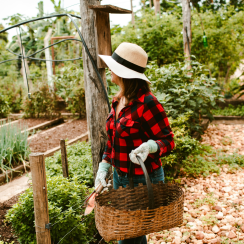
Those endless summer days shaped us in ways we're only now realizing as we watch these fundamental life skills quietly vanish from a generation that may never know the sweet exhaustion of racing the setting sun home.

Add VegOut to your Google News feed. 
Remember that feeling of racing home as the streetlights flickered on, your heart pounding, knowing you'd pushed it right to the edge of curfew?
The smell of cut grass on your sneakers, dirt under your fingernails, and that particular exhaustion that only comes from a day spent entirely outdoors - these weren't just moments from childhood. They were the building blocks of something deeper.
Those of us who grew up in that era, when summer days stretched endlessly and our parents' only tracking device was the dinner bell or the glow of streetlights, developed certain qualities that seem to be fading from our modern world.
We learned things that can't be taught through screens or structured activities. We absorbed lessons from skinned knees, neighborhood adventures, and the simple art of figuring things out for ourselves.
I've been thinking about this lately, especially when I watch children today navigate their more scheduled, supervised worlds. There's nothing wrong with how kids grow up now - times change, and we adapt.
But there's something worth recognizing about the traits we developed back then, qualities that served us well and might be worth preserving, even as the world shifts around us.
1) The ability to entertain yourself without technology
Do you remember the last time you saw someone simply sitting and thinking, without reaching for their phone? When we were kids, boredom wasn't something to be immediately fixed. It was a launching pad for creativity.
We made up elaborate games with nothing but sticks and our imagination. A cardboard box could become a spaceship, a fort, or a time machine, depending on the day. Growing up as the youngest of four sisters, I watched my siblings turn our backyard into everything from fairy kingdoms to detective agencies. We didn't need an app to tell us what to do next; we invented our own entertainment.
This ability to self-entertain without external stimulation is becoming increasingly rare. When I see adults unable to wait in line for five minutes without scrolling through their phones, I think about how we used to spend entire afternoons with nothing but our thoughts and whatever nature provided.
That skill - to be comfortable with ourselves, to find fascination in simple things - it's like a muscle that's atrophying in our society.
2) A natural sense of community and neighborly trust
My father was a mailman who knew everyone in town by name, and that wasn't unusual. Back then, the whole neighborhood was an extended family. If you fell off your bike three streets over, someone's mom would patch you up and send you home with a cookie.
We knew which houses gave out the best Halloween candy, whose dog was friendly, and which neighbor would let you pick apples from their tree.
There was an unspoken network of adults keeping a collective eye on all the kids, not in a helicopter parent way, but in a gentle, communal sense of responsibility.
These days, many people don't even know their neighbors' names. That natural trust, that assumption of goodwill, has been replaced by caution and privacy. While being careful has its place, we've lost something precious in our retreat behind closed doors and security systems.
3) Physical resilience and risk assessment skills
We climbed trees without helmets, rode bikes without knee pads, and somehow learned the difference between manageable risks and genuine danger through experience rather than warnings. When you've fallen out of a tree once, you learn pretty quickly which branches will hold your weight.
This wasn't recklessness - it was education through experience. We developed an intuitive understanding of our physical limits and capabilities. We knew how fast we could run, how high we could jump, and what would happen if we misjudged either.
These lessons, learned through scraped knees and bruised shins, taught us to assess situations quickly and trust our judgment.
4) The patience for slow, unfolding activities
Remember building forts that took all day? Or working on a puzzle for weeks? We had the patience for activities that didn't offer immediate gratification. Summer afternoons weren't divided into hour-long segments of scheduled activities.
Time moved differently then.
I spent entire days reading under a tree, not because I had to, but because I could lose myself completely in a story. We learned to stick with things even when they got difficult or boring, because often the best part came after pushing through that initial resistance.
5) Conflict resolution without adult intervention
When you're playing kickball and someone disagrees about whether the ball was fair or foul, you figure it out. There's no adult referee, no one to appeal to. You learn to negotiate, to compromise, to sometimes accept unfairness and move on.
Growing up sharing a bedroom with two sisters taught me more about diplomacy than any class ever could. We worked out our own systems for who got the top bunk, whose turn it was to choose the radio station, and how to coexist in a small space.
These negotiations, sometimes heated but always resolved, built skills that many young people today struggle to develop.
6) An understanding of true quiet and solitude
Before devices beeped at us constantly, before the background hum of electronics filled every space, we knew real quiet. The kind where you could hear crickets, distant lawnmowers, and your own thoughts without distraction.
Solitude wasn't loneliness; it was a chance to daydream, to process the day, to simply exist without performance or interaction. We'd lie in the grass watching clouds, sit by streams skipping stones, or walk through woods with no destination in mind.
This comfort with solitude, with our own company, seems increasingly rare in our connected world.
7) The ability to navigate without GPS
We knew our neighborhoods by heart - every shortcut, every landmark, every secret path through the woods. We developed mental maps through exploration, wrong turns, and gradually expanding our territory as we grew older.
This spatial awareness, this ability to orient ourselves in physical space without technological assistance, went beyond just finding our way home. It taught us to pay attention to our surroundings, to notice details, to trust our sense of direction.
When I see people unable to navigate their own city without GPS, I wonder what other observational skills we're losing.
8) Respect for meal times and family rituals
When the call for dinner came, you went. No exceptions. Sunday dinners in our house weren't optional, despite our family not having much money. Those meals were sacred time, a chance to reconnect after days spent scattered across the neighborhood.
We learned to show up, to participate in family rituals even when we'd rather be doing something else.
This respect for communal time, for putting aside individual desires for family connection, created bonds that held through decades.
9) The capacity for unstructured play and imagination
Perhaps most importantly, we had hours of unstructured time where anything could happen.
We weren't building specific skills for college applications or following adult-designed activities. We were just... playing. And in that play, we developed creativity, problem-solving abilities, and social skills that no organized sport or class could replicate.
We invented entire worlds, complete with rules, hierarchies, and mythologies. We solved problems as they arose, adapted games on the fly, and learned to include different aged kids with varying abilities.
This kind of imaginative, child-directed play shaped our ability to think creatively and work collaboratively in ways that still serve us today.
Final thoughts
These traits aren't completely gone, of course. I see glimpses of them in young people who put down their phones to help a stranger, in families who still gather for meals, in children who still know the joy of a good stick found on a walk.
But they're becoming rarer, these qualities forged in freedom and benign neglect. As I have coffee with my neighbor every Thursday morning, a tradition spanning 15 years now, I'm reminded that these connections, these slower rhythms, these ways of being in the world - they're still possible.
They just take more intention now, more conscious choice to step away from the constant connectivity and remember what it feels like to be present, patient, and truly engaged with the physical world around us.
What’s Your Plant-Powered Archetype?
Ever wonder what your everyday habits say about your deeper purpose—and how they ripple out to impact the planet?
This 90-second quiz reveals the plant-powered role you’re here to play, and the tiny shift that makes it even more powerful.
12 fun questions. Instant results. Surprisingly accurate.