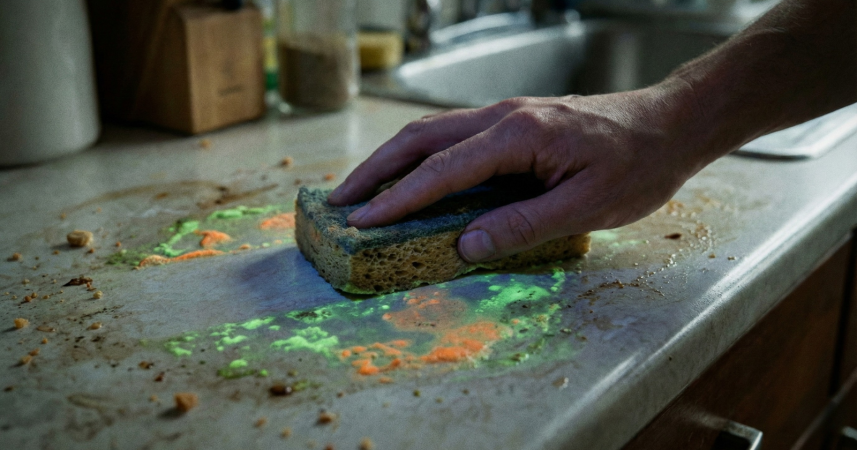
That innocent kitchen sponge you've been using for years contains 200 times more bacteria than your toilet seat—and you're spreading it across your counters with every wipe.

Add VegOut to your Google News feed. 
Remember that moment when you realize you've been doing something wrong your entire adult life? I had mine standing in a Michelin-starred kitchen in Paris, watching the head chef absolutely lose it over a junior cook wiping down the prep station with a sponge.
"You might as well be spreading disease!" he shouted in French, before launching into a ten-minute lecture about proper sanitation that changed how I viewed kitchen hygiene forever.
At the time, I thought he was being dramatic. Classic French chef behavior, right? But after a decade working in luxury hospitality and seeing how the best kitchens in the world maintain their standards, I get it now. That sponge sitting next to your kitchen sink? It's basically a petri dish with a handle.
And here's the thing: most of us are using them to "clean" our counters multiple times a day.
Your sponge is dirtier than you think
Let's talk science for a second. Research has found that kitchen sponges can harbor up to 54 billion bacteria per cubic centimeter. To put that in perspective, your toilet seat typically has only about 50 bacteria per square inch.
Yeah, let that sink in.
The problem isn't just that sponges collect bacteria. It's that they create the perfect environment for bacteria to thrive. Think about it: they're constantly moist, full of tiny spaces where microorganisms can hide, and loaded with food particles from all that wiping and scrubbing. Research published in Nature Chemical Biology found that sponges provide the ideal physical architecture for bacterial communities, offering the perfect combination of compartments of varying sizes.
Every time you wipe your counter with that sponge, you're not cleaning. You're basically giving bacteria a free ride across your entire food prep surface. It's like using a dirty mop to clean your floors and wondering why they still look grimy.
During my time working in high-end restaurants, I learned that cross-contamination is one of the biggest food safety risks in any kitchen. And sponges? They're cross-contamination central. You wipe up some raw chicken juice, rinse the sponge, then use it to clean where you're about to make a sandwich. Studies confirm that kitchen sponges are a major source of cross-contamination as they can transfer foodborne pathogens to food contact surfaces. See the problem?
The microwave trick doesn't actually work
I know what you're thinking. "But I microwave my sponge! That kills the germs, right?"
Not exactly. While microwaving a wet sponge can reduce some bacteria in the short term, research published in Scientific Reports showed that regularly sanitized sponges did not contain fewer bacteria than uncleaned ones. Worse, the bacteria that survive tend to be the tougher, more potentially pathogenic varieties that rapidly recolonize the sponge tissue.
It's like taking antibiotics but not finishing the course. You kill off the weak bacteria and leave the strong ones to multiply.
Plus, let's be honest. How often do you actually remember to microwave that sponge? Once a week? Once a month? Most of us grab it, give it a quick rinse, and call it good enough.
The other popular "solution" is throwing sponges in the dishwasher. Same problem. It helps, but it's not enough. And between washes, that sponge is still sitting there, breeding bacteria like it's going out of style.
What the pros use instead
So what do professional kitchens use if not sponges? When I worked in fine dining, we had a simple system that's surprisingly easy to replicate at home.
First up: microfiber cloths. These things are game changers. Unlike sponges, microfiber cloths can actually trap bacteria in their fibers rather than just pushing them around. Research has shown that microfiber cloths are effective at removing both viruses and bacteria from nonporous surfaces. They dry quickly, which means bacteria don't have that moist environment they love. And here's the kicker: you can toss them in the washing machine with hot water and actually get them clean.
The key is having multiple cloths in rotation. In restaurant kitchens, we'd go through dozens in a single service. At home, I keep about ten in my kitchen drawer. Use one for a day, toss it in the laundry, grab a fresh one. Simple.
But here's what really opened my eyes during my time in Bangkok. I noticed that many Thai home cooks didn't use sponges at all. They used these thin, quick-drying dishcloths that they'd hang up immediately after use. The tropical heat would dry them in minutes, giving bacteria no chance to multiply.
The paper towel solution
For quick cleanups and anything involving raw meat, paper towels are your best friend. Yeah, I know. Not the most environmentally friendly option. But hear me out.
When you're dealing with raw chicken juice or ground beef drippings, you want something you can throw away immediately. No washing, no sanitizing, no risk of cross-contamination. One and done.
I keep a roll of paper towels specifically for these high-risk situations. Everything else gets the microfiber treatment. It's about using the right tool for the right job.
If you're concerned about waste, look into bamboo paper towels. They're more sustainable and can sometimes be composted. Or use them sparingly, just for the really messy stuff that poses a genuine health risk.
Making the switch without losing your mind
Look, I get it. Change is hard, especially when it comes to daily habits. You've probably been using the same sponge system since you moved into your first apartment. But making this switch doesn't have to be complicated.
Start by buying a pack of microfiber cloths. They're cheap, especially if you buy in bulk. Designate a small bin or section of a drawer for clean ones, and have a designated spot for dirty ones heading to the laundry.
The color coding system we used in restaurants works great at home too. Blue cloths for general cleaning, white for dishes, red for anything that touched raw meat. It becomes second nature after a week or two.
And here's a pro tip from my hotel days: keep a spray bottle with a simple cleaning solution handy. Equal parts water and white vinegar works great for most surfaces. Spray, wipe with your microfiber cloth, and you're done. No need to constantly rinse and wring out a gross sponge.
Final thoughts
After all those years in professional kitchens, I've learned that good hygiene isn't about being paranoid. It's about building better habits. The sponge might seem like a small thing, but it's these small things that add up to make a real difference in your health and the health of anyone eating in your kitchen.
Making the switch from sponges to microfiber cloths and paper towels isn't just about following what the pros do. It's about taking control of your kitchen's cleanliness in a way that actually works. No more spreading bacteria around while thinking you're cleaning. No more that weird sponge smell that never quite goes away.
Trust me, once you make the switch, you'll wonder why you ever thought that nasty sponge was doing you any favors. Your counters will actually be clean, not just wet. And that peace of mind? That's worth way more than the convenience of that familiar old sponge.