
My wife's ninety-second drift into sleep isn't a gift — it's a mirror held up to everything my body refuses to release.

Add VegOut to your Google News feed. 
Margaret falls asleep the way a candle goes out in wind. One breath she's murmuring something about the neighbor's new fence, and by the next breath, she's gone. Ninety seconds, maybe less. I know because I've counted. I lie there beside her, sixty-eight years old, body perfectly still, jaw unclenched (I think), and my mind convenes a meeting I never scheduled. The agenda is everything. The minutes are kept by nobody. The motion to adjourn never comes. I've been doing this for decades, and only recently have I started to understand that the exhaustion I carry into each morning has roots that reach far deeper than the hours I spend horizontal.
The Committee Nobody Called
Here's what happens when Margaret's breathing shifts into that slow, steady rhythm. My thoughts, which I'd managed to keep in some kind of order all day, suddenly lose their filing system. The property tax bill. A conversation I had with my son in 2014 that ended wrong. Whether I locked the back door. Whether I've been a good enough husband. The sound of the furnace cycling on. A fragment of a song I haven't heard since college. All of it arrives simultaneously, like attendees at a conference who wandered into the wrong ballroom and decided to stay anyway.
I've read that sleep disorders vary widely from person to person, that some people experience disrupted sleep while others simply cannot cross the threshold into it. I fall into the second category. My body cooperates beautifully. I'm still. I'm comfortable. Margaret bought us a good mattress seven years ago, the kind with zones. My muscles have no complaints. But behind my closed eyes, the committee is in full session, and they've just discovered there's no quorum requirement.
Margaret, meanwhile, operates on a different biological clock entirely. Some people have what researchers call advanced sleep phase patterns, where their circadian rhythms tilt toward earlier sleep. Margaret has always been like this. She doesn't try to fall asleep. She just does. And I've spent years resenting it the way you resent someone who can eat whatever they want and stay thin. Quietly, and with great specificity.
The Tiredness That Sleep Can't Fix
For most of my sixties, I assumed the problem was straightforward. Not enough sleep equals tiredness. Fix the sleep, fix the tiredness. So I tried melatonin. I tried chamomile tea, which made me feel like a cliché more than it made me drowsy. I tried the white noise machine my daughter bought me, which sounded like being trapped inside a dishwasher. Nothing worked, and the tiredness kept accumulating, showing up not at night but at two in the afternoon, right when I'd sit down to read or try to focus on anything more demanding than watching birds through the kitchen window.
I started thinking about this differently after watching a breakdown of gut-brain science from VegOut that challenged nearly everything I'd assumed about fatigue. The central argument stopped me: that the afternoon fog, the heaviness, the feeling of running through mud by mid-day, often has almost nothing to do with sleep at all. The real mechanism involves the vagus nerve, a direct highway between the gut and the brain, and the bacteria that populate the intestinal tract. Research suggests that the majority of serotonin, a chemical involved in mood and well-being, is produced in the gut. When certain bacterial strains dominate (fed by processed foods, refined sugar, and preserved meats), they may produce inflammatory compounds that trigger a low-grade exhaustion response. Not illness. Just fog.
The video lays out the science with a precision that made me sit with my cold coffee and reconsider thirty years of dietary habits:
I watched it twice. The second time, I wrote things down on the back of an envelope because I'm sixty-eight and that's what we do.

What My Gut Has Been Telling My Brain
Here's what landed hardest. The video describes research showing that specific gut bacterial shifts can produce inflammatory compounds that may cause constant fatigue without any diagnosable illness. That description matched my life so precisely I felt accused. Seven hours of sleep (when I can get it), two cups of coffee by ten, no diagnosed condition, and yet by early afternoon my brain feels like it's wading through something thick.
I started cataloguing what I eat. Not with an app (I don't trust apps that want to know my weight), but in a small notebook. The pattern was damning. Ultra-processed foods made up a significant portion of my diet. Not because I'm careless, but because I'm a retired man living in a routine. The same frozen meals. The same packaged crackers with cheese. Deli turkey on white bread three or four times a week. I ate the same breakfast every morning for so long it became a personality trait rather than a choice. Writers on this site have explored how daily rituals shape our closest relationships, and I'd argue they shape our internal biology just as powerfully.
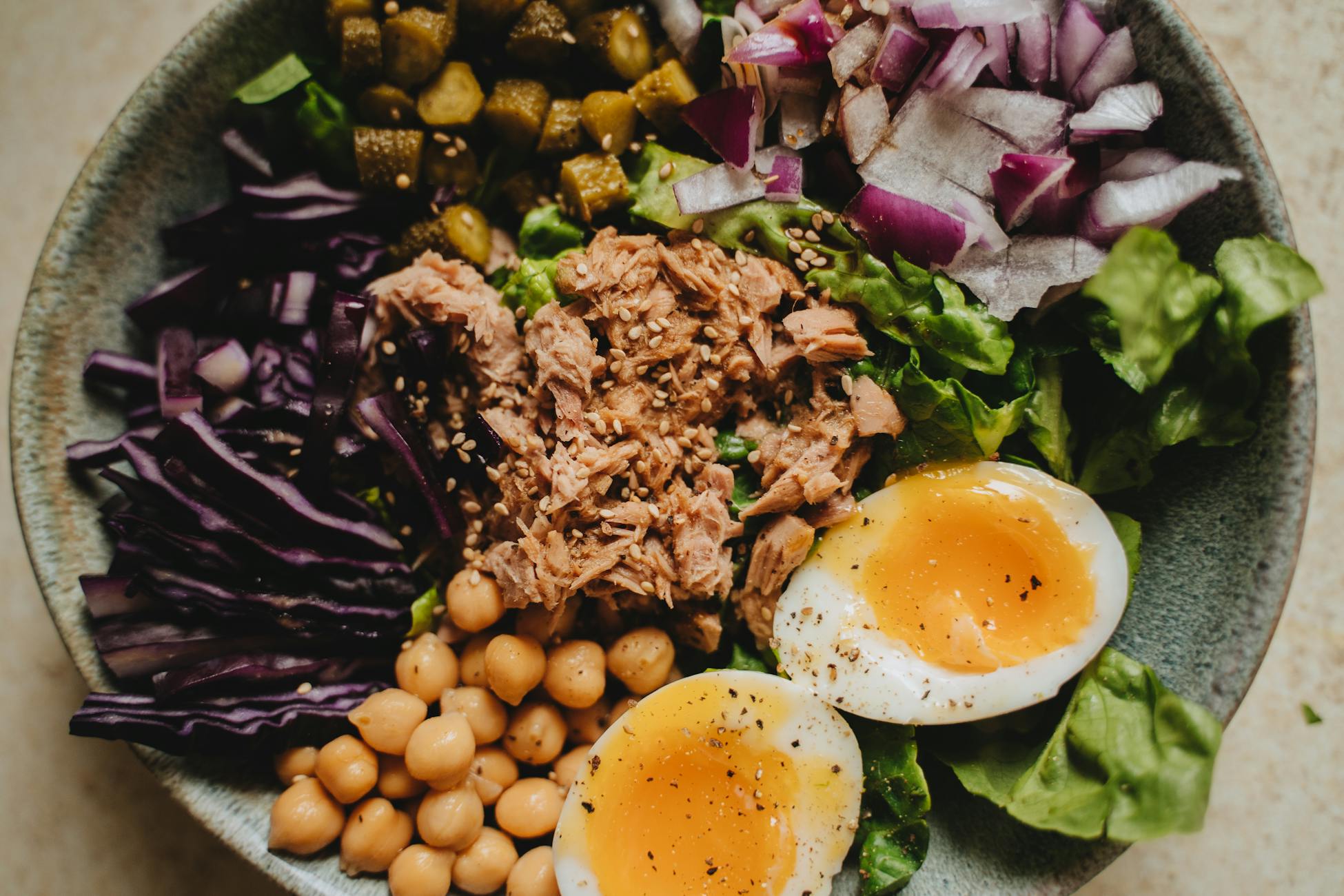
The video makes a case for dietary fiber from whole plant foods as an effective lever for changing gut composition. The target number: thirty different plant foods per week. When I first heard that, I laughed out loud in my kitchen. Thirty? I could barely name fifteen plants I'd eaten in the last month. But then the video demonstrated how quickly they add up. A banana, an apple, blueberries, oats, flax seed, mixed greens, tomato, cucumber, chickpeas, rice, beans, peppers, corn, almonds, an orange. Fifteen before dinner. The math is friendlier than the number suggests.
Three Weeks of Trying
I want to be honest about what happened next, because I'm not someone who transforms. I'm someone who adjusts, grudgingly, and then pretends I meant to all along.
Week one, I added variety without subtracting much. Berries in the morning instead of just toast. A handful of walnuts. Lentil soup from a recipe my daughter texted me (she seemed suspicious of my sudden interest in legumes). I kept the deli turkey but ate it less often. I bought sweet potatoes for the first time in years and roasted them with olive oil and something called za'atar that the woman at the grocery store recommended.
By the end of that first week, I slept no better. The committee still met nightly. But something shifted in the afternoons. The fog didn't lift entirely, but it thinned. I could read for forty-five minutes instead of twenty before my focus dissolved. This aligns with what the video describes: meaningful shifts in gut bacteria composition can happen relatively quickly with dietary change.
Week two was harder, because novelty wears off and I am fundamentally a creature of habit. But I kept a running count of different plant foods on a sticky note on the refrigerator, and something about seeing the number climb (twenty-three by Thursday) activated a stubbornness in me that I usually reserve for arguments with my brother about politics.
Week three, Margaret noticed. She didn't say I looked different or seemed more energetic, because we've been married forty-one years and that kind of observation requires a specific vulnerability neither of us traffics in regularly. What she said was: "You haven't fallen asleep in the chair after lunch in a while." Which, from Margaret, constitutes a standing ovation.
The Committee Meets Less Often Now
I want to be careful here. I still don't fall asleep in ninety seconds. I probably never will. Margaret's ability to lose consciousness that quickly remains a biological marvel I observe with a mixture of admiration and gentle envy. My mind still convenes its evening session, still reviews old grievances and half-remembered song lyrics and the question of whether I've been a good enough father.
But the sessions are shorter. And I think I understand why.
What the gut-brain research suggests, and what I've experienced in my own limited experiment, is that the mind's nighttime restlessness feeds on daytime inflammation. When my body spent every afternoon fighting a low-grade inflammatory response from processed food and sugar-fed bacteria, it arrived at bedtime already agitated beneath the surface. The committee wasn't meeting because I had unresolved psychological trauma (though who among us doesn't, at sixty-eight). The committee was meeting because my gut was sending alarm signals up the vagus nerve all day, and by nighttime, my brain had been marinating in those signals for hours.
Research has confirmed that bed partners experience sleep differently, their individual sleep architectures responding to distinct biological inputs even in the same environment. Margaret isn't better at sleeping than I am. Her body simply arrives at the pillow in a different biochemical state. And while I can't replicate her biology, I can stop poisoning mine with food that turns my gut into a factory for fatigue.
What I Actually Changed
For anyone lying next to their own Margaret, their own effortless sleeper, here's what I did, plainly: I stopped eating the same ten foods on rotation. I added plants, not as a moral position but as a mechanical one, the way you'd add oil to an engine that's been grinding. I didn't eliminate anything entirely, because I'm sixty-eight and life is already full of eliminations. I just added. Variety. Fiber. Color on the plate where there used to be beige.
The afternoons got clearer. The evenings got shorter. The committee still meets, but lately the agenda has fewer items, and sometimes, maybe once or twice a week, the chair (whoever that is in the metaphor of my own skull) calls the meeting early due to lack of quorum.
Margaret still falls asleep in ninety seconds. I fall asleep in something closer to forty-five minutes now, down from three hours. I'll take it. At sixty-eight, you learn that improvement doesn't have to be dramatic to matter. Sometimes it just has to be enough to let you close your eyes and hear, for a few quiet moments, nothing at all.