I spent three years treating a sleep problem that vanished the moment I wasn't alone, and the real diagnosis had nothing to do with my circadian rhythm.

Add VegOut to your Google News feed. 
How many nights have you lain in bed, eyes open, convinced something is physically wrong with you, only to fall asleep effortlessly on the couch with a rerun playing and a warm body curled against your leg? I'm 68 years old. I spent three years, two sleep studies, and one prescription for zolpidem before a therapist asked me a question that stopped me cold: "Do you have trouble sleeping, or do you have trouble being alone in the dark with nothing between you and your own mind?"
I sat there in her office with my hands in my lap, and I couldn't answer. Because the answer was obvious, and it had been obvious the whole time. I slept perfectly well during afternoon naps. I slept fine with the television murmuring. I slept like a stone when my dog Biscuit was pressed against my ribs. The common denominator was never melatonin or sleep hygiene or blue light exposure. The common denominator was whether or not I was alone with silence.
The Misdiagnosis I Built Around Myself
After my husband Frank died in 2019, I started having what I called insomnia. I told my doctor I couldn't sleep. She believed me. Why wouldn't she? I was a 64-year-old widow reporting fatigue, brain fog, and nights where I stared at the ceiling until three in the morning. I fit the profile. She gave me sleep hygiene handouts, suggested I cut caffeine after noon, recommended blackout curtains. I did all of it. Nothing changed.
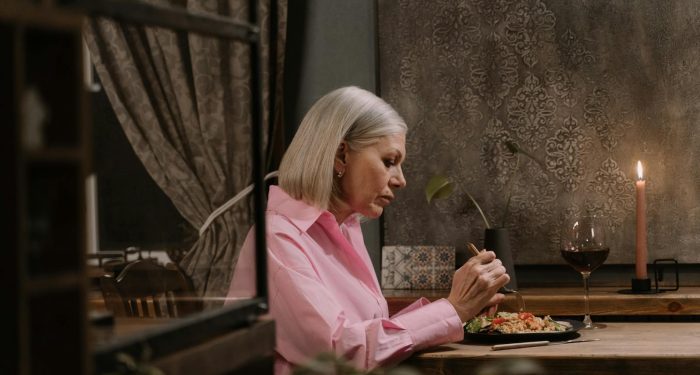
What I didn't tell her, because I didn't realize it mattered, was that I could fall asleep in a movie theater. I could nap in a waiting room full of strangers. I could drift off in the passenger seat of my daughter's car within ten minutes. Sleep wasn't the problem. Being the only conscious person in a dark, quiet house at eleven o'clock at night was the problem.
Psychologists describe rumination as the repetitive, circular replaying of thoughts, regrets, and fears that intensifies in the absence of distraction. Worry looks forward. Rumination looks backward. And lying alone in a bedroom that used to hold two people is an almost perfect incubator for it.
I wasn't failing to sleep. I was failing to tolerate the quiet, because the quiet was where Frank's absence became a physical presence, where every unresolved thing I'd ever pushed aside during the busy daytime hours came filing into the room like uninvited guests.

The Body Keeps Score (Even at 2 PM)
Here's what made this harder to untangle: the fatigue was real. The brain fog was real. I was genuinely exhausted, all day, every day. And because I was exhausted, it was easy to believe the story that my sleep was broken.
But exhaustion has more than one source. A recent VegOut video breaks down how persistent tiredness often has roots far outside the bedroom, tracing the connection between gut health, inflammation, and that heavy, mud-brained feeling that settles in by mid-afternoon. Research suggests that serotonin, a chemical involved in regulating mood and wakefulness, is largely produced in the gut, and when the microbiome shifts, the result can be a low-grade fatigue that mimics sleep deprivation.
That hit close to home. After Frank died, my eating changed completely. I went from shared dinners (he was the cook, I was the sous chef, that was our rhythm for 37 years) to standing at the counter eating crackers and deli meat at odd hours. Packaged snacks. Frozen meals. Things that required nothing of me emotionally. The ultra-processed food wasn't just filling a gap in my diet. It was filling a gap in my evening, replacing the ritual of cooking together with something that asked nothing and gave nothing back.
The video explains how ultra-processed foods can affect beneficial gut bacteria, how refined sugar may impact microbial diversity, and how the resulting inflammatory compounds can contribute to persistent tiredness. Studies have indicated that people eating a wide variety of plant foods have more diverse gut bacteria, and that diversity is associated with better energy and mood.
I watched that and thought about my refrigerator. At the time, in 2021, it contained string cheese, white bread, three cans of ginger ale, and a bag of baby carrots I'd bought to feel responsible. I wasn't eating 30 different plant foods per week. I was eating maybe seven different foods total, and most of them came from a package.
Two Problems Wearing the Same Mask
What my therapist helped me understand, slowly, over months, was that I had two separate issues masquerading as one. The first was grief-driven rumination that made nighttime unbearable. The second was an inflammatory fatigue pattern driven by how I'd stopped nourishing myself after losing the person I used to nourish myself alongside. Both produced tiredness. Both worsened sleep. And both had been invisible to me because I'd collapsed them into a single word: insomnia.
Research has found that loneliness is a bigger predictor of sleep disturbance than screen time. That finding landed on me like a brick. I had blamed my phone. I had blamed caffeine. I had blamed aging. I had never blamed the fact that I was profoundly lonely and that the loneliness concentrated itself in the dark hours like sediment settling to the bottom of a glass.
And studies have shown that ruminating about loneliness is more closely linked to depression than the loneliness itself. Read that again. The aloneness wasn't destroying me. The thinking about the aloneness, in circles, at midnight, in a bed that was too wide, was what was doing the damage.

What Actually Helped
My therapist didn't fix my sleep. She helped me stop pretending sleep was what needed fixing.
The first thing that changed was the nighttime ritual. I stopped trying to lie in a dark, silent room and force myself unconscious. I let the TV stay on, quietly, and I stopped feeling guilty about it. I know the sleep hygiene people would be horrified. But sleep hygiene advice is built for people whose primary obstacle is stimulation. My obstacle was the absence of it, the void that filled with every difficult thought I'd managed to outrun during the day. Writers on this site have explored what it means when people keep the TV on for reasons that have nothing to do with entertainment, and I recognized myself in every word.
The second thing was food. Slowly, reluctantly, I started cooking again. Not elaborate meals. A pot of lentil soup. Rice and beans with whatever vegetables I had. Oatmeal with actual fruit in the morning instead of a granola bar eaten over the sink. I wasn't following the 30-plant-foods-per-week protocol consciously at first, but variety crept back in as cooking became something I did for myself rather than something I'd lost along with Frank. Within a few weeks, the afternoon fog started thinning. I had more energy by two o'clock than I'd had in years. The connection between simple whole foods and genuine nourishment turned out to be something no supplement or wellness retreat could replicate.
The third thing, and I think this was the real turning point, was naming what was actually happening at night. My therapist taught me to say it plainly: "I am afraid of being alone with my thoughts in the dark." No clinical language. No euphemism. Just the bald, embarrassing truth of a 66-year-old woman who had raised children, buried a husband, managed a household for decades, and was terrified of silence.
Naming it didn't make it disappear. But it stopped me from chasing the wrong solution. I stopped asking my doctor for stronger sleep medication. I stopped buying weighted blankets and lavender sprays and white noise machines. I started sitting with the fear during the daytime, in therapy, in my journal, on walks with Biscuit, where it was smaller and more manageable. And gradually the nighttime hours became less loaded.
The Thing Nobody Tells You About Tiredness After Loss
There is a specific kind of tiredness that belongs to people who spent their lives doing the work. It doesn't respond to sleep. It responds to being seen. I think that's what I was really experiencing in those three years of so-called insomnia. A tiredness that had layers: the grief layer, the nutritional layer, the isolation layer, the identity layer of no longer being someone's wife, someone's dinner companion, someone whose evening had a shape.
I'm 68 now. I still sleep with the TV on sometimes. Biscuit still presses against my ribs. I eat lentil soup most weeks, and I've added enough variety to my meals that I've stopped counting because the counting started to feel like another form of control, and I've had enough of that. Some nights the rumination still arrives, and I let it sit in the room with me instead of wrestling it. Some nights it doesn't come at all.
I never had insomnia. I had a life that had been rearranged so fundamentally that my nervous system couldn't figure out how to power down without the presence of another heartbeat in the room. I had a gut that had been stripped of the bacteria it needed because grief had turned cooking from an act of love into a reminder of loss. I had a mind that treated silence the way some people treat deep water: as something that could pull you under if you stopped moving.
My therapist didn't cure anything. She pointed at what was already visible and asked me to look at it. The TV, the dog, the afternoon nap. All the evidence was there. I just needed someone to help me read it.