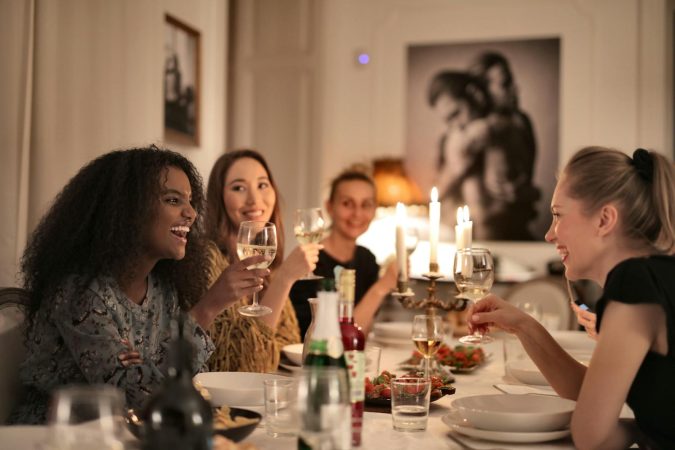
Priya moved to a new city after her divorce and found belonging not in a church or a gym or a support group, but around a table of strangers who never once asked her to justify her presence.

Add VegOut to your Google News feed. 
Add VegOut to your Google News feed.
Priya didn't set out to find community at a vegan potluck in Portland. She set out to find something, anything, after her divorce finalized in March — some kind of foothold in a city where she knew exactly three people, none of them close enough to call at midnight. The potluck was a last-minute decision, sparked by an Instagram post she almost scrolled past. She almost didn't go. But the thing about being newly alone in a new place is that almost-decisions become actual decisions faster than they should.
She brought a cashew cream pasta dish and no expectations. She wore a sweater she'd worn a hundred times before, but it felt different on her skin — like wearing someone else's armor. When she arrived at the community garden space where twenty or so people had gathered, she did what she'd learned to do everywhere else in the past six months: prepare for explanation.
The Explanation Trap
Before the potluck, Priya had tried the usual routes toward belonging. She'd joined a yoga studio, where she felt compelled to mention — unprompted — that she'd just moved here. She'd attended her office's happy hours, where she found herself over-justifying why she was eating only the hummus and vegetables. At church, where she'd grown up going, she felt the weight of questions about where her husband had gone, why there was no wedding ring, what the timeline was for getting "back out there."
"I was exhausting myself," Priya told me, nearly three years after that first potluck. We were sitting at a coffee shop near Venice Beach — I'd flown up to Portland to meet her but she happened to be visiting L.A. that week, so we ended up talking in my neighborhood instead. "Every interaction required a preamble. I felt like I had to hand someone a fact sheet about my divorce, my move, my dietary choices, my current mental state — before I could actually just, like, exist near them."
I knew the feeling. Not from divorce — I've never been married — but from a hundred other moments where I found myself pre-explaining who I was before anyone had even asked. When I went vegan eight years ago, the first year was basically an apology tour. Every dinner out, every holiday gathering, every time my partner and I had friends over, I'd catch myself launching into the "why" before someone even finished looking at my plate. It was exhausting, and it was entirely self-imposed, and it took me years to realize I could just... stop.
This is what psychologists call the "need to belong" theory, first formalized by Roy Baumeister and Mark Leary in 1995. Their research found that humans have a fundamental psychological need for belonging — not as a nice-to-have, but as a basic requirement for mental and physical health, on par with food and safety. What makes belonging particularly fragile, though, is what comes before it: the constant negotiation of who you are supposed to be in order to fit somewhere.
The irony was that Priya had spent her twenties and thirties in communities built around explanation. Her family wanted to know why she wasn't having kids yet. Her former workplace wanted to know why she was suddenly more introverted after the separation. Her gym wanted her to commit to a class schedule, to justify her presence through consistency. Every space demanded that she make sense — to translate herself into terms that felt palatable.
What Actually Happened at the Potluck
The vegan potluck was different in a way that wasn't immediately visible. People asked her name. They asked if she'd brought something to share, and when she said yes, they thanked her. No one asked why she was vegan. No one asked where she was from originally, or if she was seeing anyone, or what her long-term goals were. Someone asked her about the pasta dish — what was in the sauce, did she use nutritional yeast or cashew cream — and she answered, and that was the entire conversation.
"I remember standing there thinking, 'This is insane,'" Priya said. "It was a simple question about food, and I felt like someone had actually seen me. Not seen-seen, like romantically. But seen like I was allowed to just be a person who made a cashew pasta dish, without having to unpack my whole life story first."
Hearing her describe that moment hit me somewhere I wasn't expecting. I remember having a nearly identical experience at a plant-based cooking class in Santa Monica — maybe five or six years ago — where someone just asked me what I thought about their miso glaze, and I realized it was the first food-related conversation I'd had in weeks where nobody was debating my choices. It was just two people geeking out about umami. That's it. And I felt more connected in that five-minute exchange than I had at any number of dinners where I'd spent the whole meal defending why I wasn't eating the steak.
The research backs this up, though the language is more clinical. A 2019 National Academies report on social isolation and loneliness found that communities built around shared identity — particularly ones that don't demand constant self-justification — provide measurable protective health benefits. Loneliness and social isolation increase mortality risk, and that risk rivals smoking, obesity, and physical inactivity. The mechanism isn't mysterious: when you don't have to explain yourself constantly, your nervous system doesn't live in a state of perpetual vigilance.
Priya began going to the potlucks regularly. Then she started organizing some of them herself. Then she went to a vegan cooking class that someone in the group recommended. Then she had friends — not acquaintances, but actual people who texted her without occasion, who knew her without her having to perform.
The Secondary Nature of the Food
What's interesting about Priya's story is how little the actual food matters to the punch line. This isn't a "veganism saved me" narrative. It's a "not having to explain veganism" narrative. She could have found similar belonging in a board game meetup, or a hiking group, or a book club. The plant-based community just happened to be where she landed — and it happened to be a community built on acceptance as a baseline assumption.
"The food was almost irrelevant," she said. "I mean, it wasn't irrelevant — everyone was genuinely interested in cooking and eating well. But the point wasn't to convert me or convince me or ask me why I'd made the choice. It was just accepted. And in that acceptance, I realized I'd been compensating for non-acceptance everywhere else."
This echoes what long-term vegans often discover about community: that after a certain point, the dietary practice becomes almost invisible, replaced by something sturdier. I've experienced this myself over the past eight years. Somewhere around year three or four, I stopped thinking of "vegan" as the headline of my identity and started thinking of it as just... the way I eat. The way I cook. The baseline. And once that happened, the people I'd found through plant-based spaces became something much more than fellow vegans. They became my actual community — the people I call when something good happens, or when something bad happens, or when nothing happens at all and I just want to talk to someone who gets it.
My partner isn't vegan, and that's fine — we figured that out early and it works for us. But there's a specific kind of ease I feel with people who don't need me to explain or defend the choice. It's not that my partner demands explanation; it's that the absence of any need for it, in a whole room of people, creates a different kind of atmosphere. You can actually relax into being yourself.
Priya wasn't even sure she wanted to be vegan when she started attending the potlucks. She'd eaten mostly plant-based for years, loosely, without ideology attached. But in the company of people who weren't demanding she defend or explain the choice, she found she actually wanted to go deeper into it — to cook better, to learn more, to belong more securely to this community. The food became a vehicle for something else entirely.
The Cost of Constant Translation
There's a specific exhaustion that comes from living in communities where you're always translating yourself into acceptability. Priya had been doing it unconsciously for so long that she'd internalized it as normal. The yoga studio required a version of herself that was serene and committed. The office required a version that was professional and uncomplicated. The church required a version that was still intact, still hopeful, still following a script.
She wasn't dishonest in any of these spaces. She was just editing. Constantly.
I think about this kind of editing a lot, actually. I used to run an indie music blog — years ago, before I started writing about food and community — and one thing I noticed in that world was how much energy people spent performing the right kind of taste. You had to like the right bands, dismiss the right bands, have the right take at the right moment. It was community, sure, but it was community with a constant entrance exam. When I eventually drifted away from that scene and toward plant-based spaces, the relief was physical. I could feel it in my shoulders.
This is what psychologists call "stereotype threat" and "identity threat" — the stress of managing how you're perceived in environments where some part of your identity might be questioned or pathologized. Over time, this stress literally changes your health markers. Blood pressure rises. Cortisol stays elevated. You stop sleeping well.
Priya described the relief of the potluck community this way: "I didn't have to translate. Someone asked me a question and I could answer it without preparing a justification first. It sounds like such a small thing, but it rewired something in my brain. My nervous system stopped waiting for the other shoe."
This connects to something else research has documented: that people who feel genuinely seen and accepted in their communities experience measurable improvements in health outcomes, immune function, and longevity. A study published in JAMA found that strong social connections have health benefits comparable to other major health interventions. Priya's health improved not because she was eating differently — she was already mostly plant-based — but because she was being differently: fully, without explanation.
On Social Media and the Illusion of Connection
Interestingly, Priya's experience also illuminates something about the gap between online community and actual community. She had found that community hashtag on Instagram, yes, but the real shift came when she moved from scrolling to showing up. When she could be fully present, unedited, in a room with people who didn't need her to be anything other than someone with a pasta dish.
"I was so deep in social media circles about vegan life, plant-based nutrition, divorce recovery," she said. "I had hundreds of followers, or I was following hundreds of accounts. And I felt completely alone. Then I went to a community garden on a Tuesday night with twenty people, and I felt less alone in an hour than I had in months of online connection."
I've been there. Venice Beach is full of people performing wellness online — the smoothie bowl photos, the sunset yoga reels, the captions about gratitude that feel more like résumés than reflections. And look, I'm not above it. I've posted my share of perfectly lit grain bowls. But the moments that have actually sustained me over the past eight years have been decidedly uninstagrammable. They've been messy potlucks in someone's backyard. They've been a friend texting me "hey, made too much soup, want some?" They've been sitting in a kitchen at 11 p.m. with people I met through a vegan cooking class, talking about nothing in particular, needing to explain nothing at all.
What Peace Looks Like
Nearly three years later, Priya is still involved in the plant-based community in Portland. She's organized over a hundred potlucks. She knows people by name, by their food preferences, by stories they've shared over shared meals. Her life doesn't look dramatically different from the outside — she still works the same job, still lives in the same neighborhood, still has the same therapist she started seeing after the divorce.
But internally, something has settled. She described it as a kind of peace that isn't about having everything figured out, but about finally being okay with uncertainty in the presence of people who don't require you to pretend certainty.
"I'm still divorced. I'm still kind of figuring out who I am post-marriage," she said. "But I'm doing it around people who don't need me to have it solved. That's the thing no one tells you about community — you don't need to arrive at it already whole. You just need to arrive."
The Real Ingredient
What saved Priya's life, then, wasn't the vegan diet. It wasn't even the plant-based community specifically — it was the structure of acceptance that community happened to provide. It was the absence of demand for explanation. It was people asking about cashew cream instead of asking about her marriage. It was belonging as a baseline, not something to be earned through constant justification and self-editing.
The research on this is clear: loneliness and social isolation are public health crises because belonging is not optional. We need it the way we need oxygen. And when we finally find spaces where we can show up without translation, without armor, without the exhausting work of explaining ourselves — those spaces quite literally save our lives.
I think about this every time I show up somewhere and don't have to explain. Every time I walk into a room and someone just hands me a plate and asks what I think of their new recipe. Every time my partner, who still eats meat, watches me head out to a potluck and says "have fun" without any of it being a thing. The freedom to just exist — to just be a guy who makes a pretty decent black bean chili and doesn't need to tell you why — that's not a small gift. It's everything.
Priya will probably never be able to separate the plant-based community from the healing it provided her. That's fine. The specific container doesn't matter as much as the contents: people, acceptance, the freedom to exist without explanation. Those are the real nutrients. Everything else — the cashew pasta, the nutritional yeast, the shared meal on a Tuesday night — is just delicious proof that you've found your people.