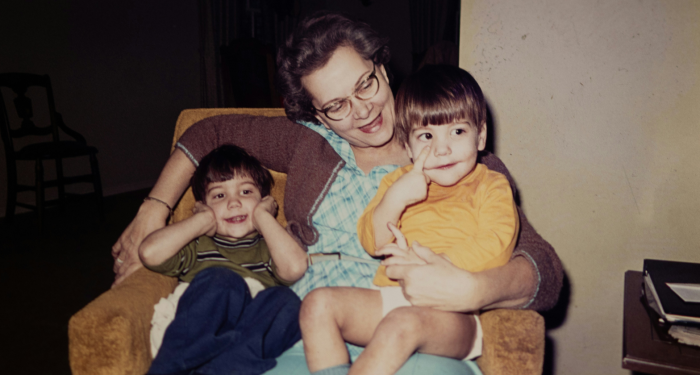
The kid who held it all together at eight years old became the adult who can't text a friend back when they're drowning, because somewhere along the way needing something from someone started to feel like a moral failure.

Add VegOut to your Google News feed. 
Add VegOut to your Google News feed.
A friend of mine got food poisoning a few months ago. Bad enough that she couldn't get off the bathroom floor. She lives alone, and her sister is a twenty-minute drive away. She told me later that she lay there for three hours before calling anyone, and when she finally did, she opened with, "I'm so sorry to bother you, I know you're busy, and honestly I'm probably fine." She was not fine. She was dehydrated, shaking, and running a fever. But the apology came before the ask. It always does, with people like her.
People like me, too, if I'm being honest.
My friend grew up as the oldest of four in a household where both parents worked opposite shifts. She packed lunches. She walked her siblings to the bus stop. She figured out the laundry situation by age nine. She was, by every measure, the responsible one. And she carried that designation like a title she never asked for but couldn't seem to put down.
A therapist I spoke with recently told me something that stopped me cold: people who were the responsible child in their family often struggle with one specific thing as adults. They cannot allow themselves to need something from someone without feeling like a burden. The word "burden" is important here, because it goes beyond simple discomfort. It triggers something closer to shame. A deep, body-level conviction that your needs are an imposition on other people's lives.
Where the Wiring Begins
Childhood roles get assigned early, and they get assigned quietly. Nobody sits a seven-year-old down and says, "You're the responsible one now." The assignment happens through a thousand micro-moments: a parent sighing when you ask for help, a sibling melting down while you hold yourself together, the unspoken understanding that someone has to keep this household running, and that someone is you.
Psychologists have a term for this phenomenon. It's called parentification, and it describes what happens when a child takes on emotional or logistical responsibilities that belong to the adults in the home. Sometimes the parentification is instrumental (cooking, cleaning, managing younger siblings). Sometimes it's emotional (becoming a parent's confidant, mediating fights, absorbing someone's anxiety so the household can function).
Either way, the child learns a specific equation: I am valuable when I am useful. My presence is justified when I am helping. The moment I stop producing, I become dead weight.
That equation doesn't dissolve when you turn eighteen. It follows you into friendships, partnerships, workplaces. It follows you into the moments where you most need to reach out and ask for something.

What This Looks Like in Adulthood
The responsible child grows into an adult who over-functions in every relationship. They're the friend who organizes the group trip, remembers the allergies, sends the follow-up text after a hard conversation. They're the partner who notices the energy bill is overdue before anyone else does. They're the coworker who checks on everyone else but deflects every inquiry about their own state with a quick "I'm good."
And here's the thing: most of them are genuinely good at these roles. They've been practicing since childhood. The competence is real. But underneath the competence is a belief so deeply installed that they rarely question it: asking for help means you've failed.
I recognized this pattern in myself during my time living in Bangkok. I got dengue fever, which, if you've never had it, feels like someone filled your bones with wet cement and then set them on fire. I needed someone to bring me water, check on me, maybe sit with me for an hour. I had friends nearby. Close ones. And I couldn't bring myself to call any of them. I ordered water delivery from my phone instead. I lay in bed composing and deleting text messages for two days before the fever broke.
Looking back, I realize the fever wasn't the hard part. The hard part was the sentence I couldn't make myself type: Can you come over? I need help.
The Cost of Self-Sufficiency as Identity
When you build your identity around being the one who holds things together, asking for help feels like an identity crisis. You're pulling a thread from the very fabric of who you believe yourself to be. And your nervous system responds accordingly, with a flood of anxiety, guilt, sometimes even nausea.
Research on adults who were parentified as children has found that they don't just struggle with boundaries. They struggle to receive kindness without immediately scanning for what it will cost them. Someone offers to cook them dinner, and their first thought is calculation: what will they owe in return? Someone says "I'm here for you," and the responsible child's brain immediately starts running a cost-benefit analysis of whether accepting that offer will tip the relational balance too far.
This looks like independence from the outside. From the inside, it's exhausting. It's a constant performance of having it all together, and the loneliest part is that the performance usually works. People believe you. They stop checking in. They assume you're fine because you've made it so easy to assume.
If that sounds familiar, you might recognize the pattern We wrote about in a piece on people who never get asked if they're okay. The performance of togetherness becomes so convincing that checking on them feels unnecessary to everyone around them.

The Shame Underneath the Silence
There's a difference between choosing not to ask for help and feeling unable to. The responsible child didn't choose self-reliance the way you choose a philosophy. They adapted to an environment that punished need, or at least failed to meet it. The adaptation was brilliant, actually. It kept them safe. It kept the family stable. It earned them praise.
But brilliant adaptations become invisible prisons when the environment changes and the behavior doesn't.
Now you're thirty-five, or forty-two, or fifty-seven, and you have people in your life who genuinely want to show up for you. A partner who asks what you need and means it. A friend who would drop everything. And you still can't do it. You still rehearse the conversation in your head and talk yourself out of it. You still say "I'm fine" before anyone even asks. You still feel a hot wave of something like humiliation at the thought of being the person in the room who needs something.
Research on how early family relationships shape adult attachment patterns has shown that the relational templates we form as children continue to influence our capacity for interdependence well into adulthood. The responsible child often develops what's described as an avoidant or self-reliant attachment pattern, one that looks like strength but may be a response to unmet emotional needs in childhood.
The Vegan Table and the Practice of Receiving
I started thinking about this differently when I got more involved in plant-based community dinners here in Austin. There's a potluck I attend where everyone brings a dish, and the whole evening is structured around giving and receiving. Simple, right? Except I noticed that I always showed up with the most elaborate contribution and took the smallest plate for myself. Every single time.
Someone pointed it out to me once, gently. "You always bring enough to feed twelve people and then eat like you're apologizing for being here." I laughed it off. But it sat with me for weeks. Because she was right. Even at a table surrounded by people who wanted to feed me, I was still performing the role of the person who provides and never consumes.
The conscious living spaces I've found in the vegan community have been unexpectedly healing for this particular wound. There's an ethos of mutual care that doesn't keep score. You bring tempeh one week, someone else brings the cashew cheese the next. Nobody's tracking. Nobody's calculating. And slowly, in these small, low-stakes moments, I've been relearning that accepting something from someone can be a form of connection rather than a failure of self-sufficiency.
What Healing Looks Like (and What It Doesn't)
Healing from this pattern isn't a dramatic transformation. You don't wake up one morning suddenly comfortable with vulnerability. It's more like a series of small, uncomfortable experiments.
Partner content
There's a part of you that drives how you love, fight, and heal — your wild soul archetype. The Vessel built a short quiz to uncover it.
You let someone carry the grocery bags. You say "actually, yes" when a friend offers to drive you to the airport instead of taking a rideshare. You text back honestly when someone asks how you're doing, instead of defaulting to the automatic "good, you?" You sit with the discomfort of being helped and notice that the world doesn't end, that the other person doesn't resent you, that the relationship doesn't collapse under the weight of your one small need.
The therapist I talked to put it this way: for the responsible child, the work isn't learning how to be strong. They already know how to be strong. The work is learning that strength and need can coexist. That you can be capable and still deserve care. That you can be the person who holds things together and the person who sometimes falls apart.
Both things. At the same time.
Unlearning the Equation
The hardest part, for me, has been questioning the equation I absorbed as a kid. The one that said my value was tied to my usefulness. Because once you start pulling at that thread, you have to confront a terrifying question: if I'm not the helpful one, the reliable one, the one who never needs anything, then who am I?
I don't have a clean answer. I'm still working on it. Some days I catch myself over-functioning in relationships and I can pause, notice the pattern, choose differently. Other days I'm ordering water delivery from my phone when I could just call a friend. Old wiring runs deep.
But I know this much. The kid who learned to read the room before they could read a book deserves to sit at a table where someone else fills their plate. The adult who still carries the weight of that early role deserves to put it down sometimes, even if it means tolerating the strange, unfamiliar sensation of being cared for.
You were never a burden. You were a child doing a job that wasn't yours. And the fact that you did it so well that nobody noticed the cost doesn't mean the cost wasn't real.
It was real. And you're allowed to stop paying it.
What’s Your Plant-Powered Archetype?
Ever wonder what your everyday habits say about your deeper purpose—and how they ripple out to impact the planet?
This 90-second quiz reveals the plant-powered role you’re here to play, and the tiny shift that makes it even more powerful.
12 fun questions. Instant results. Surprisingly accurate.
What’s Your Plant-Powered Archetype?
Ever wonder what your everyday habits say about your deeper purpose—and how they ripple out to impact the planet?
This 90-second quiz reveals the plant-powered role you’re here to play, and the tiny shift that makes it even more powerful.
12 fun questions. Instant results. Surprisingly accurate.