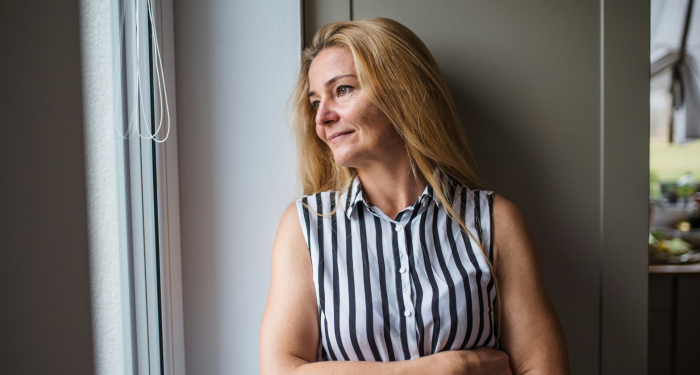
From the outside, it looks like the life you worked for - full, peaceful, complete. But on the inside, it can feel like the story already ended, and you’re just living in the quiet after it.
Nobody warns you about the quiet part. They warn you about the money, the healthcare, the boredom. But nobody sits you down and says: one Tuesday morning about four months in, you are going to make yourself a cup of tea, look out the window at a perfectly ordinary day, and feel like a ghost in your own life.
I know because that Tuesday happened to me.
I retired at 64, after 32 years of teaching high school English. I had a garden waiting, grandchildren nearby, a stack of novels I'd been promising myself since 1997. By every external measure, I had landed exactly where I was supposed to be. And yet. There was this low hum underneath it all, a feeling I couldn't quite name at first. Like I was watching my life through a window rather than living it from the inside.
It took me a while to understand what that hum was. It was grief. Quiet, socially unacceptable, entirely invisible grief.
The Identity Nobody Talks About Losing
For most of our working lives, we answer the question "Who are you?" with what we do. I was a teacher. Not just someone who taught, but someone whose entire daily rhythm, sense of usefulness, and social world was organized around that identity. The bell schedules. The students who needed me. The colleagues who knew me by name and by reputation. When that stopped, it wasn't just a schedule that disappeared. It was a self.
NIH research on meaning in the retirement transition confirms what I felt but couldn't articulate: because work is an important source of meaning for many people, retirement presents multiple challenges, including the loss of meaningful roles, identity, and sense of purpose attached to work. Researchers describe retirement as "a psychosocial process of identity transition and search for meaning." That framing helped me. It said: what you're experiencing has a name, and it is not a character flaw.
The hardest part isn't the busyness you lose. It's the sense of being needed. I had thirty-two years of students who needed me to show up, to be sharp, to care. That kind of being-needed shapes you from the inside out. Without it, you don't just feel purposeless. You feel like a sentence that trails off mid-thought.
Disappointment and dissatisfaction can arise in the early phases of retirement as people struggle to figure out what it means for them to be retired by rediscovering meaning and purpose in life. Notice the word "struggle." Not "discover." Not "enjoy." Struggle. That's honest. That's what nobody says at your retirement party.
The Loneliness That Creeps In Sideways
Here is something I was not prepared for: I had plenty of people in my life. My daughter Grace, my son Daniel, four grandchildren, a garden full of neighbors who stop and chat over the fence. I was not isolated, not by any stretch. And yet I was lonely in a way I'd never experienced before, a specific loneliness that comes from no longer mattering to a room full of people on a daily basis.
Research backs this up in striking ways. A large longitudinal study published in The Lancet Psychiatry followed more than 4,000 adults aged 50 and older for 12 years and found that higher loneliness scores were consistently associated with higher depression symptom severity, with the link persisting for up to 12 years after the initial loneliness was experienced. Twelve years. The study estimated that up to one in five cases of depression in older adults could be prevented simply by reducing loneliness. That is not a small finding. That is a public health emergency we keep treating like a personal failing.
There is a particular cruelty to retirement loneliness: it shows up dressed as freedom. You have all the time in the world. You can have lunch with anyone on any day. And somehow, that abundance of possibility makes the loneliness feel worse, not better, because there's no longer a built-in reason for people to need you in their calendar.
What the Research Gets Right, and What It Misses
I want to be fair here. Not everyone experiences retirement as a loss. Harvard Business School research found, in a nationally representative panel of over 8,000 American adults, that retirement can actually produce a sizable increase in sense of purpose, particularly among people who retired from dissatisfying jobs. For someone who hated going to work, walking away can feel like finally being able to breathe.
But those of us who loved what we did? Who found meaning and community and daily purpose in our careers? We are the ones the studies quietly call "at higher risk." We are the ones who built such a strong bond between who we were and what we did that the separation feels like, as researchers put it, the same psychological mechanism as grieving a death or a divorce. A disruption to the ongoing narrative of who you believe yourself to be.
That resonated with me deeply. I have known real grief. I lost my second husband to Parkinson's. I lost my oldest sister. I know the particular weight of that kind of loss. What surprised me about retirement was discovering that it carried its own version of that weight, smaller but real, and made more confusing by the fact that nobody gives you permission to mourn it.
Growing Larger Around the Loss
There is a thing I learned when my husband was sick, something I came to think of as the central truth about grief: it doesn't shrink. You just grow larger around it. The same turns out to be true of the grief that comes with leaving a career you loved.
You do not get over losing a self. You build a new one alongside it.
For me, that building happened slowly, in small rooms. I started writing personal essays at 66, two years after I retired. I started volunteering at a women's shelter, teaching resume writing. I know, I know, a retired English teacher finding her way back to a classroom of sorts. My daughter teased me about it mercilessly. But there it is. I needed to be useful. I needed someone to need what I knew.
Research from NIH on meaning-making in retirement found that actively seeking new sources of purpose, especially through contribution to others, is one of the most consistent factors in successful adjustment. You don't find your new identity by waiting for it to arrive. You find it, a little awkwardly, by doing things that feel slightly too small for what you used to be, until one day they feel exactly right for who you're becoming.
The garden helped. It always has. There is something about putting your hands in actual dirt, tending something that doesn't know or care what your job title used to be, that brings you very cleanly back to the present tense. My cottage garden is thirty years old now. Some of those roses have outlasted two marriages and several heartbreaks. They are not interested in my resume.
If you are in that quiet, disorienting space right now, the one that looks like success from the outside and feels like waiting from the inside, I want you to know something. You are not ungrateful. You are not failing at retirement. You are navigating one of the least-acknowledged losses in adult life, and you are doing it without a roadmap, because nobody thought to draw one.
The question worth sitting with, over your own cup of tea on your own quiet Tuesday morning, is not what you have lost. That's clear enough already. The question is: what are you being freed up to become? Because those are different questions. And the second one, I have found, leads somewhere worth going.