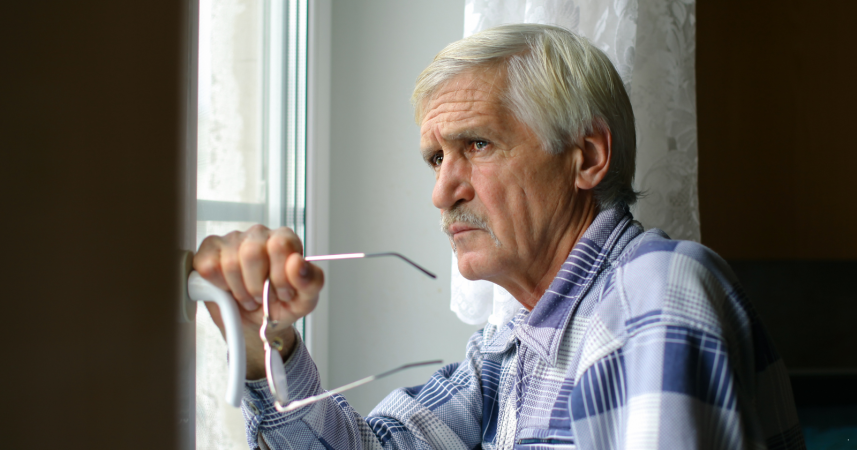
It can look like resilience on the surface—but for many boomers, that “toughness” was learned early as a way to survive without being seen or supported. What gets praised as strength is often a lifetime of unspoken strain, where enduring quietly became the only acceptable way to cope.

Add VegOut to your Google News feed. 
They do not complain. They do not call in sick unless they physically cannot stand. They do not talk about their feelings, and if you ask them directly how they are doing, they say "fine" with a certainty that closes the conversation. They got through divorces, layoffs, health scares, and the deaths of people they loved without ever once falling apart in front of anyone.
And we call that strength.
But the research tells a different story. What looks like emotional toughness in the boomer generation is, in many cases, the visible surface of a psychological pattern that was trained into them from childhood. A pattern that served them well in certain contexts and quietly damaged them in others. A pattern that psychologists now have a name for.
The training
The children who grew up in the 1950s and 60s were raised inside a set of emotional rules that were so pervasive they did not need to be spoken. Boys do not cry. Girls do not make a fuss. You do not burden other people with your problems. You handle things. You move on. You do not dwell.
Research on normative male alexithymia describes exactly how this training works. Psychologist Ronald Levant coined the term to describe a mild-to-moderate difficulty with identifying and expressing emotions that results from gender-based socialization influenced by the traditional masculine norm of restrictive emotionality. The research shows that while boys begin life more emotionally expressive than girls, that tendency wanes as they get older. By age 2, boys are less verbally expressive than girls. By 4, they are less expressive facially. Mothers expose baby girls to a wider range of emotions than baby boys. Fathers begin socializing their toddlers along gender lines at around 13 months, verbally roughhousing their sons and talking in more emotional terms with daughters. Peer groups cement the pattern by punishing boys who violate emotional norms.
This was not an accident. It was a cultural curriculum. And the boomers were its most thorough students.
What the training produced
The product of this training is a person who can absorb enormous amounts of hardship without visible distress. They can work through grief, push through pain, maintain composure under pressure, and keep functioning when everything around them is falling apart. From the outside, this looks like resilience. From the inside, it often feels like numbness.
Research on masculine norms, alexithymia, and internalizing symptoms found that the masculine norms of emotional control, self-reliance, and primacy of work were significantly and moderately associated with internalizing symptoms through their sequential connections with alexithymia and emotion regulation difficulties. In plain language: the rules that taught them to suppress emotion did not eliminate the emotion. They eliminated the person's ability to process it. The feelings are still there. They just have no pathway out.
This is why so many boomer men, and many boomer women who absorbed the same cultural messages through different channels, report chronic anger they cannot explain, physical symptoms with no clear medical cause, marriages that function but do not connect, and a persistent sense of isolation even when surrounded by people who love them. The emotions they were trained to suppress did not disappear. They converted into something else: irritability, withdrawal, rigidity, or a low-grade depression that looks like personality rather than pathology.
The cost nobody talks about
A systematic review of traditional masculinity norms and men's mental health found that adherence to norms emphasizing emotional stoicism, self-reliance, and toughness significantly impacts mental health. These norms contribute to emotional suppression and a heightened stigma around seeking help, leading men to underreport mental health issues and avoid professional support. The review found that men turned to substance abuse as a means of avoiding emotional expression, leading to a cycle of destructive behaviors, and that binge drinking and drug use contributed not only to worsening mental health but to increased mortality.
The boomer generation has the highest rates of alcohol use disorder of any current age group. They have disproportionately high rates of completed suicide, particularly among men. They are the generation least likely to seek mental health treatment and most likely to stigmatize those who do. These are not signs of strength. They are the downstream consequences of a generation trained to carry everything silently.
The wound that looks like a feature
Research on masculinity norms and depression found that conforming to masculine gender role norms may restrict emotional expressiveness in men, which in turn may contribute to depression and somatization symptoms. But here is the finding that matters most: the relationship between masculinity and depression was moderated by psychological flexibility. When psychological flexibility was low, masculinity was positively associated with depression. When psychological flexibility was moderate or high, the association disappeared.
Psychological flexibility means the ability to be present with difficult emotions without being controlled by them, to hold your thoughts lightly rather than rigidly, and to act according to your values even when it is uncomfortable. It is, in essence, the opposite of the stoic suppression the boomers were taught. The boomers were trained to be psychologically rigid, to lock down their emotions and power through. And that rigidity, which looks like strength, is the precise mechanism through which the damage accumulates.
What younger generations see and what they miss
Younger generations look at the boomers and see people who handled hardship without falling apart. And there is something genuine to admire in that capacity. The ability to function under pressure, to keep going when things are difficult, to not collapse at the first sign of discomfort, these are real skills. But the admiration misses the cost.
The boomer who never cried at his father's funeral is not tougher than the millennial who did. He is more practiced at suppression. And that suppression has been sitting in his body for decades, showing up as the heart condition his doctor cannot fully explain, the marriage that works on paper but feels empty, the grandchildren he loves but cannot connect with emotionally, the retirement that was supposed to be peaceful but feels hollow instead.
The American Psychological Association's reporting on normative male alexithymia noted that older men raised in more traditional ways are expected to score higher on measures of alexithymia, while younger men brought up with more flexible gender roles are expected to score lower. The generational pattern is real. But it is not a story of one generation being stronger than another. It is a story of one generation being trained to absorb pain in a way that looked like strength and felt like silence.
The reframe
The boomers are not weak for carrying this. They did what they were trained to do, and they did it extraordinarily well. But the thing they were trained to do was not healthy. It was functional. There is a difference. Functional means it kept them going. Healthy means it allowed them to thrive. And the research is clear that emotional suppression is functional in the short term and damaging in the long term.
If you are a boomer reading this, the point is not that your toughness was fake. The point is that it cost you more than you were ever allowed to acknowledge. And if you are a younger person reading this, the point is not that the boomers were wrong. The point is that what you are looking at when you see their composure is not the absence of pain. It is the presence of a wound they were never given permission to treat.
Sixty years is a long time to carry something you were never allowed to put down. The fact that they carried it at all is not evidence that they should have had to.
If You Were a Healing Herb, Which Would You Be?
Each herb holds a unique kind of magic — soothing, awakening, grounding, or clarifying.
This 9-question quiz reveals the healing plant that mirrors your energy right now and what it says about your natural rhythm.
✨ Instant results. Deeply insightful.

Marlene Martin
Marlene is a retired high school English teacher and longtime writer who draws on decades of lived experience to explore personal development, relationships, resilience, and finding purpose in life’s second act. When she’s not at her laptop, she’s usually in the garden at dawn, baking Sunday bread, taking watercolor classes, playing piano, or volunteering at a local women’s shelter teaching life skills.
More Articles by Marlene