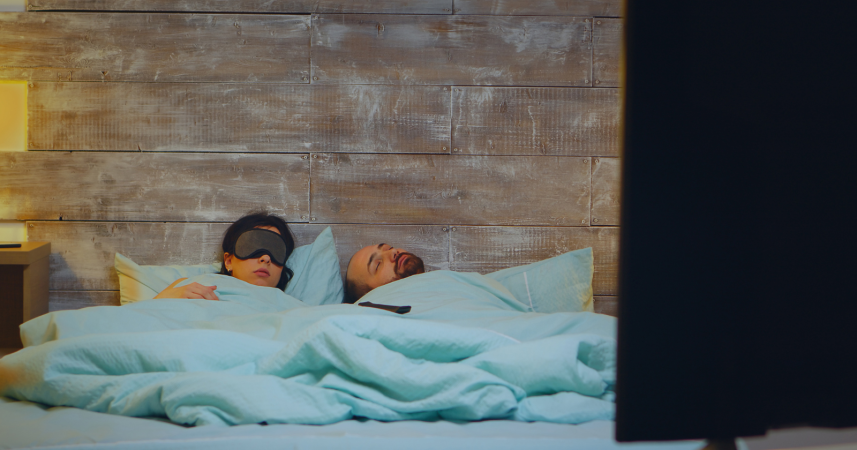
Falling asleep to the hum of the TV isn’t just a habit—it’s a psychological signal. Here’s what it reveals about how your mind copes with stress, silence, and sleep.

Add VegOut to your Google News feed. 
Most nights, millions of people drift off with the screen still glowing in the corner of the bedroom. Surveys suggest that well over half of American adults—and roughly 70 % of adults globally—keep a TV or other device on as they nod off, despite a near-unanimous chorus of sleep experts warning against it.
Why? Psychologists say the habit isn’t random; it clusters around a recognizable set of emotional and behavioral traits.
Below are eight of the most common—and what science says about each one.
1. They use distraction to silence a “busy brain”
If your mind starts replaying every awkward conversation of the past decade the moment the lights go out, you’re not alone.
Clinical psychologist Dr. Chivonna Childs notes that for many clients, “the TV is soothing…almost like white noise,” because it pulls attention away from racing thoughts.
Cognitive-behavioral research shows that external distraction can temporarily reduce rumination, the repetitive negative thinking linked to insomnia and depression.
The screen’s steady narrative acts like a cognitive pacifier, giving the pre-frontal cortex something low-stakes to chew on so the rest of the brain can down-shift.
Why it matters: While distraction can help you fall asleep faster, it rarely stops the underlying mental chatter; it simply postpones it. Over time, people may feel unable to fall asleep without any background stimulus, reinforcing the habit.
2. They’re prone to loneliness and seek “parasocial” company
Several studies tie heavy nighttime viewing—and especially binge-watching—to feelings of loneliness and unmet social needs.
Poor sleepers report turning on serial TV to “keep them company,” effectively importing chatty, predictable characters into an otherwise silent room.
Psychologists call this a parasocial relationship: one-sided but emotionally comforting.
Why it matters: While fictional friends feel warm in the moment, they don’t deliver the oxytocin hit we get from real-life contact. The habit can mask social deficits instead of motivating healthier connection.
3. They have higher baseline anxiety or anxious-attachment traits
People with anxious or preoccupied attachment styles frequently use television as a coping tool when they feel emotionally unsettled.
Research on binge-watching finds significant correlations with social-interaction anxiety, depressive symptoms, and emotion-focused coping motives.
The predictable structure of episodic TV (conflict resolved in ~22 minutes, laugh track included) provides a low-risk emotional environment—something anxious brains crave.
Why it matters: Dependence on external regulation (the TV) can keep people from developing internal calming skills such as breathwork, meditation, or cognitive reframing. Over time, the screen becomes a necessary crutch rather than an optional aid.
4. They’re hypersensitive to unpredictable noises
You might assume people who “need noise” are insensitive sleepers, but the opposite is often true.
Neuroscience work on white noise shows that a continuous auditory blanket masks sudden environmental sounds that would otherwise trigger micro-arousals.
For sound-sensitive individuals, a TV at low volume creates a steady auditory floor, preventing the startle response that comes with every barking dog or creaking pipe.
Why it matters: White-noise benefits don’t require a back-lit screen or dramatic plot twists. Dedicated sound machines (or even a fan) can offer the same signal-to-noise smoothing without blue-light exposure.
5. They’ve slipped into a screen-dependent bedtime routine
Habit strength is psychology’s silent giant. The Sleep Foundation reports that technology in the bedroom delays bedtime, stimulates the brain, and fragments sleep—but most adults keep the devices anyway.
In behavioral terms, the TV becomes a conditioned cue: turn it on, feel sleepy. Eventually the absence of the cue triggers mild withdrawal—a restless feeling that “something is missing.”
Why it matters: Conditioned cues are rewritable. Replacing the TV with a consistent, lower-stimulus ritual (reading a paperback under warm light, gentle stretching, or an audio-only story) can unlink sleep from screen time in about 2–3 weeks.
6. Their circadian rhythms are already disrupted (and their health may pay for it)
Light at night—particularly the broad-spectrum glow of modern TVs—suppresses melatonin, shifts circadian phase, and, according to new large-cohort data from Flinders Health & Medical Research Institute, predicts up to a 56 % higher risk of major cardiovascular events.
People who rely on the TV’s glow might already be “night owls” fighting social jet-lag (staying up late, waking early for work). The screen extends wakefulness further, deepening the misalignment between internal clocks and external schedules.
Why it matters: Chronic circadian disruption doesn’t just leave you groggy; it elevates blood pressure, impairs glucose regulation, and increases inflammatory markers—factors that add silent risk even in otherwise healthy adults.
7. They use media as an emotion-regulation tool (escape & mood management)
A 2022 Journal of Sleep Research study found that poor sleepers binge-watch to cope with negative emotions significantly more than good sleepers.
The bedtime slot, when other distractions fade, is primetime for unresolved feelings to surface. Television offers both escape (immersing in someone else’s story) and mood priming (choosing comedy over true-crime to end the day on a lighter note).
Why it matters: Using TV as emotional Novocain can prevent people from processing real stressors—like financial worries or relationship conflict—during daylight hours, perpetuating a cycle of late-night avoidance.
8. They crave constant cognitive stimulation—even during rest transitions
Many night-time TV sleepers describe silence as “boring” or “eerie.” Studies on white-noise and attention show that continuous stimulation keeps the brain’s default-mode network from wandering too far, which some people experience as uncomfortable mind-wandering.
In personality research, this overlaps with sensation seeking—a trait linked to both fast-paced entertainment and difficulty with stillness.
Why it matters: True rest requires toggling out of stimulation mode. Training the nervous system to tolerate quiet—through mindfulness, progressive muscle relaxation, or even listening to low-intensity natural sounds—can expand cognitive flexibility and resilience.
Pulling the threads together
While each of the eight behaviors differs, they often weave into the same nightly loop:
-
Anxious thoughts or loneliness sparks the urge for distraction.
-
The TV goes on, supplying steady noise and social surrogates.
-
Blue light delays melatonin, pushing sleep later.
-
Morning fatigue reinforces evening screen dependence.
Over months or years, the loop can solidify into learned insomnia—sleep that feels impossible without digital sedation. Yet psychology’s silver lining is neuroplasticity: habits that were learned can be un-learned.
Practical ways to break the cycle (if you choose)
-
Step down, don’t pull the plug. Replace TV with an audio-only version of the same show for a week; then fade to a podcast or dedicated white-noise track.
-
Set a “screens-off” alarm. A phone chime 45 minutes before target bedtime helps separate “wind-down” from “lights-out.”
-
Use warm-tone, dim lighting after sunset. Even a 40-watt amber bulb beats the spectral spike from a 4K display.
-
Cultivate a five-minute mindfulness check-in. Let intrusive thoughts surface before you hit the pillow by journaling or a brief breathing exercise.
-
Consider social substitutes in daytime. If nighttime loneliness drives the habit, scheduling mid-week coffees or video calls can reduce the evening void.
Final thoughts
Falling asleep to late-night sitcom reruns isn’t a moral failing—but it is a behavioral fingerprint. It hints at an over-busy mind, an under-satisfied social life, or a chronically stimulated nervous system. Knowing the pattern empowers you to decide: keep the TV glow, swap it for softer sounds, or retrain your brain for true darkness and quiet.
Whatever you choose, remember that sleep is less about forcing unconsciousness and more about creating the conditions where your brain feels safe letting go. Replace the artificial safety of a flickering screen with habits that address the root cause—anxiety, loneliness, or sensory sensitivity—and you may find that real, restorative sleep no longer needs a remote control.
If You Were a Healing Herb, Which Would You Be?
Each herb holds a unique kind of magic — soothing, awakening, grounding, or clarifying.
This 9-question quiz reveals the healing plant that mirrors your energy right now and what it says about your natural rhythm.
✨ Instant results. Deeply insightful.

Jordan Cooper
Jordan Cooper is a pop-culture writer and vegan-snack reviewer with roots in music blogging. Known for approachable, insightful prose, Jordan connects modern trends—from K-pop choreography to kombucha fermentation—with thoughtful food commentary. In his downtime, he enjoys photography, experimenting with fermentation recipes, and discovering new indie music playlists.
More Articles by Jordan