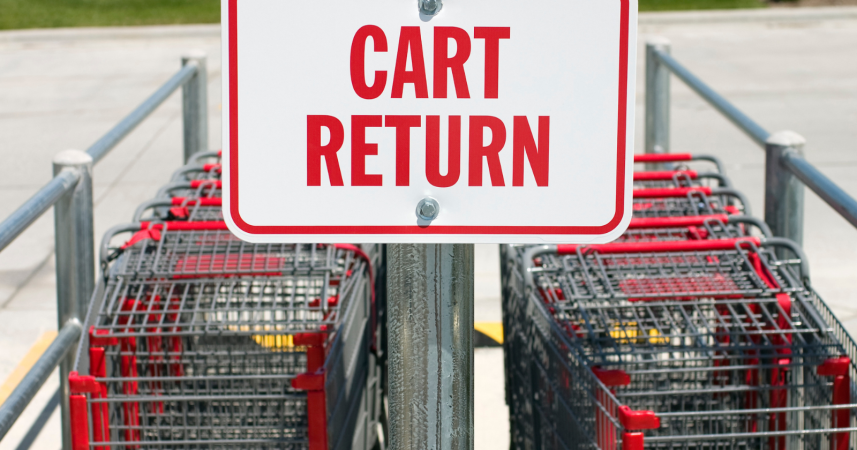
Psychologists love tiny behaviours that reveal big personality patterns, and research confirms that consistent cart-returners tend to score high on several pro-social traits

Add VegOut to your Google News feed. 
A small, unglamorous ritual plays out every day in supermarket carparks: some shoppers wheel their empty trolley back to the nearest cart bay, while others abandon it beside the car and drive away. On the surface it looks trivial, but the internet’s now-famous “shopping-cart theory” argues that this moment is a mini-ethics test: nobody will punish you for deserting the cart, yet you do the right thing anyway—or you don’t.
Psychologists love tiny behaviours that reveal big personality patterns, and research confirms that consistent cart-returners tend to score high on several pro-social traits. Here are five of the most robust.
1. Conscientiousness: the disciplined backbone of “doing the right thing”
The Big-Five personality model describes conscientiousness as a blend of self-discipline, orderliness, reliability, and a strong sense of duty. Large cross-national studies show that people high in conscientiousness are more likely to follow rules, finish tasks without supervision, and engage in “civic virtue” behaviours such as voting, donating, or—yes—tidying shared spaces.
Returning a cart ticks every conscientiousness box:
-
Task completion. The errand isn’t over until the cart is parked.
-
Orderliness. Loose trolleys clutter bays and ding bumpers; a neat corral prevents chaos.
-
Self-discipline. You add an extra 30-second walk even when it’s raining or you’re tired.
In laboratory settings, conscientious participants routinely resist shortcuts that would inconvenience others, mirroring the micro-sacrifice of walking a trolley back.
Over time these small acts compound into a reputation for reliability—the friend who always shows up on time, the colleague whose spreadsheets are immaculate. Cart returners rarely trumpet their diligence; their behaviour speaks for itself.
2. Empathy-driven prosocial orientation: “Someone else will need this cart”
Empathy is the capacity to feel—or at least accurately imagine—another person’s emotions. A sweeping meta-analysis of twin studies finds that higher dispositional empathy predicts a wide range of helping behaviours, from donating blood to comforting a stranger.
When you re-stow your trolley you spare the next shopper a frustrating hunt and save an employee a retrieval trip across the lot. That perspective-taking (“How would I feel if every cart were scattered?”) is classic empathic reasoning. Cultural anthropologist Krystal D’Costa notes that cart return is governed less by formal rules and more by social norms—unwritten expectations enforced by our desire not to burden others.
Empathic people are exceptionally sensitive to such norms. They anticipate knock-on effects and act upstream to prevent inconvenience. In practice, this means:
-
sliding your trolley fully into the bay rather than blocking the entrance;
-
securing the child seat flap so the next parent doesn’t struggle;
-
picking up an orphaned cart someone else abandoned.
Each choice whispers, I see you, stranger, and I’ve got you covered.
3. An internal locus of control: guided by your own compass, not outside policing
Personality research distinguishes between an internal and external locus of control. Internals believe outcomes hinge on their own actions; externals attribute results to luck, fate, or authority figures. Studies show that a stronger internal locus predicts lower moral disengagement—the mental gymnastics that let us excuse selfish choices.
No security guard fines you for orphaning a trolley, and the supermarket rarely rewards you for parking it properly. Internals act anyway because their self-image depends on personal standards, not external carrots or sticks. That same mindset shows up elsewhere:
-
finishing a project before a deadline even if the boss forgets to check;
-
recycling when there’s no audit;
-
following traffic rules on an empty road at 2 a.m.
Psychologists call this self-governance—the ability to regulate behaviour in line with internalised ethics. Cart corrals are essentially self-governance arenas: externals ask, “What’s the penalty?”; internals ask, “What’s the right thing?”
4. Future orientation and delayed gratification: trading a moment’s ease for long-term order
The landmark Stanford marshmallow experiment popularised delayed gratification: children who resisted a single marshmallow to earn two later went on to score higher on measures of academic and social success. Modern replications across 22 countries confirm that resisting immediate convenience correlates with better long-term outcomes and greater societal cooperation.
Hauling an empty cart back is a real-world marshmallow test. The immediate reward for leaving it loose is getting into your air-conditioned car faster; the delayed reward is a tidy lot and fewer dents in everyone’s vehicles. Future-oriented individuals value the collective, down-the-road benefit more than the fleeting comfort of skipping the walk.
Researchers have linked this “future self” mindset to:
-
financial prudence (saving for retirement),
-
health behaviours (skipping fast food today for long-term fitness),
-
environmental stewardship (sorting recyclables, reducing single-use plastics).
Cart corralling is a micro-expression of the same cognitive trade-off: a tiny cost now, a cleaner environment—literally—for everyone later.
5. Civic-mindedness and respect for social norms: investing in the commons
Sociologists describe civic-mindedness as a sense of responsibility toward community welfare and a willingness to cooperate on public-good projects. Voting studies even use the phrase sense of civic duty to explain why people cast ballots despite the negligible impact of one vote. Personality research consistently finds that civic duty correlates with traits like conscientiousness and agreeableness.
Returning the cart is a textbook public-good action: the benefit (an orderly lot) is non-excludable—everyone enjoys it whether they contributed or not—so the temptation to “free-ride” is high. Cart returners resist that temptation. They see themselves as stewards of shared spaces, and small rituals reinforce that identity:
-
stacking dishes at a café instead of leaving a messy table,
-
wiping gym equipment after use,
-
closing a gate you found open on a hiking trail.
Each act signals I’m part of this place, and I care how we leave it.
Bringing the traits together
These five characteristics are not isolated silos; they overlap and reinforce each other. Empathy amplifies conscientiousness (“I feel bad if someone else suffers because I’m sloppy”), while an internal locus of control powers delayed-gratification decisions (“I choose the harder right over the easier wrong”). Civic-mindedness ties them together, turning private virtues into public benefits.
Researchers sometimes worry that the shopping-cart meme over-simplifies morality, because circumstances—injury, extreme weather, childcare emergencies—can trump even the best intentions. Yet the pattern holds: over dozens of daily forks in the road, cart returners choose effort over ease more often than chance would predict.
Practical ways to strengthen your “cart-return” muscles
Even if you occasionally succumb to trolley-laziness (we all do), psychology offers hacks to cultivate these traits:
-
Micro-diligence drills. Set a tiny rule—always push your chair in when you leave a table—and treat it as non-negotiable. Small victories wire the conscientiousness circuit.
-
Perspective prompts. Before abandoning an item, picture the specific person who will deal with the mess. Empathy spikes when the “victim” feels real.
-
Internal rule-setting. Write a two-sentence personal code (e.g., “I leave shared spaces better than I found them”). Post it where you see it daily.
-
Future-self journaling. Spend five minutes visualising long-term payoffs of small actions. Studies show that vivid imagery reduces present bias and boosts delayed-gratification choices.
-
Join a community-cleanup day. Acting alongside others solidifies civic identity and makes the prosocial loop fun.
Conclusion
A returned shopping trolley is hardly heroic, yet it whispers volumes about the person behind the handle. Conscientious self-discipline, empathy for strangers, an internal moral compass, future-oriented self-control, and a deep sense of civic duty converge in that 30-second walk back to the corral.
In an age where grandstanding often masquerades as virtue, the quiet act of tidying a cart bay reminds us that character is built in the moments no one is watching. The next time you nudge your trolley into its slot, take a breath and notice the ripple: smoother carparks, lighter workloads for staff, and—research suggests—a steady strengthening of the psychological muscles that make communities thrive. It’s not just about the cart; it’s about the kind of person who cares where it ends up.