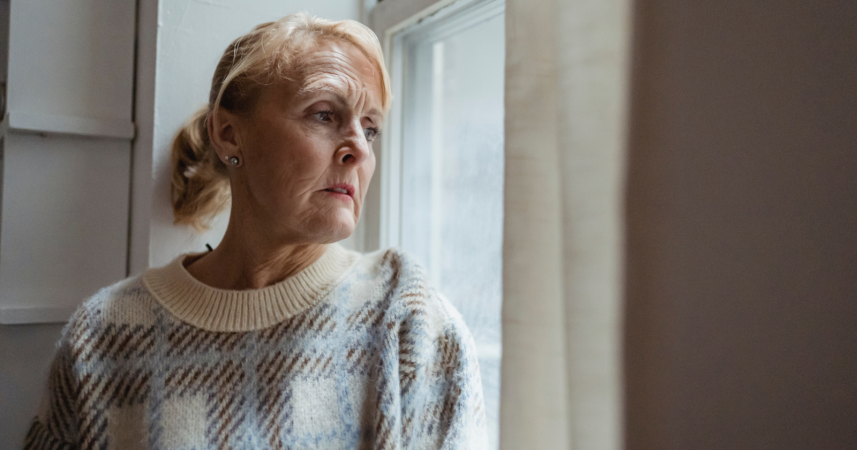
She's the one who's been everyone else's safety net for decades — until the morning she realizes that being indispensable has made her invisible, and the quiet crisis in her kitchen is actually the beginning of her most important transformation.
I was standing in my kitchen last Thursday, making my third cup of tea for the day, when my daughter called. She was crying. Not the dramatic tears of her teenage years, but the quiet, exhausted weeping of a 42-year-old woman who'd just been passed over for another promotion. "Mom," she said, "I've done everything right. I raised my kids while working full-time. I never missed a deadline at work. And now I'm invisible. Nobody sees me anymore."
I knew exactly what she meant. Not because I'd read about it or studied it, but because I'd lived it. That particular brand of invisibility that descends on women in their forties and fifties. Women who've been the backbone of everyone else's life for so long that when they finally look up from all that holding and tending, they realize the world has stopped looking back.
The weight of being everyone's anchor
You know her. She's your neighbor who raised three kids while finishing her nursing degree at night. She's your sister who took care of your mother while managing her department at work. She's the woman in line at the coffee shop who looks tired at 8 AM, not because she partied last night, but because she's been up since 5 AM making lunches, checking homework she helped finish at midnight, and answering emails from her boss who assumes she's always available.
She learned early that if something needed doing, she'd better do it herself. Maybe her parents were overwhelmed or absent. Maybe they simply came from a generation that believed girls should be helpful and quiet. So she raised herself, figured out how to apply to college without guidance, learned to budget by making mistakes she couldn't afford.
Research published in the Psychology Today reveals how high-achieving women can experience burnout quietly while still performing at a high level, with burnout manifesting as exhaustion, perfectionism, guilt, and disconnection rather than collapse. The article emphasizes how cultural and systemic pressures tie a woman's sense of worth to constant achievement. This resonates deeply — we've been trained to keep going, keep achieving, keep holding it all together, even when we're running on empty.
When strong becomes invisible
Here's what nobody tells you about being the strong one: people stop seeing you as someone who might need support. They see you handling everything, so they assume you're fine. You become the family's emotional shock absorber, the workplace's reliable problem-solver, the friend who always listens but rarely gets asked how she's doing.
I remember sitting in a faculty meeting in my last year of teaching, after thirty-two years in the classroom. A younger colleague was presenting a "revolutionary" new approach to teaching Shakespeare. The same approach I'd developed and shared freely fifteen years earlier. Nobody remembered. I'd become institutional wallpaper, reliable and ignorable.
The invisibility isn't just professional. It's the way conversations flow around you at parties. It's how salespeople's eyes slide past you to younger customers. It's your husband talking over you at dinner with friends, not from malice but from a habit so ingrained he doesn't notice he's doing it. It's your adult children calling only when they need something, forgetting you might have news of your own to share.
The midlife reckoning nobody prepared us for
Standing in that kitchen, or at 42 like my daughter, or 62 like my friend who just retired, you're hit with questions that feel both urgent and impossible. Who am I when I'm not solving someone else's crisis? What do I actually want, now that I finally have a moment to want something? Why does this freedom I've supposedly earned feel so much like abandonment?
An article in Psychology Today explains that midlife depletion is real and rooted in internal and external pressures, and that midlife is a transition that opens space for reinvention and clarity, with fatigue and overwhelm serving as signals for change. This isn't just exhaustion. It's your soul's way of demanding a reckoning.
The cruel irony? Just when you finally have the wisdom, experience, and possibly even the time to pursue what matters to you, the world acts like you've expired. Like you're past your sell-by date. Like your stories, your knowledge, your still-burning desires are quaint relics rather than hard-won treasures.
Finding yourself in the space nobody's watching
But here's what I've learned, and what I told my daughter through her tears: invisibility can be a strange kind of gift. When nobody's watching, you can finally stop performing. When you're no longer the main character in everyone else's story, you can start writing your own.
I think of my friend who started taking pottery classes at 56, her hands learning a new language in clay. She said the first time she centered clay on the wheel, she cried. Not from frustration, but from the recognition that she was finally creating something just for herself. No one needed that bowl. No one's future depended on it. It was purely, gloriously unnecessary, and therefore essential.
A study in the Journal of Occupational Health Psychology found that midlife women who reported increasing career momentum were more likely to have a strong work identity and higher psychological well-being, suggesting that career engagement can positively influence midlife women's mental health. This doesn't mean we need to climb more ladders. It means that engaging with work that matters to us, whether paid or voluntary, whether recognized or not, feeds something vital in us.
The radical act of claiming your own life
What would happen if we stopped waiting for permission to matter? If we stopped needing external validation to pursue what calls to us? What if we took all that competence, all that hard-won wisdom, all that capacity for getting things done, and turned it toward our own dreams?
I wrote about this once before, about how women in their sixties are starting businesses, writing novels, traveling solo, falling in love again — or falling in love with solitude. They're not doing it quietly anymore. They're claiming space, making noise, refusing to fade gracefully into the background.
The woman standing in her kitchen, wondering why she feels invisible? She's not broken. She's not ungrateful. She's not having a crisis. She's having an awakening. All that strength she's used to hold everyone else up? It's still there. Now she gets to use it to build something for herself.
Final thoughts
My daughter and I talked for an hour that Thursday. By the end, she wasn't crying anymore. I'm not sure she had answers, exactly. She mentioned a graduate degree she'd been thinking about. A solo trip somewhere cold and far away. A conversation she knew she needed to have with her husband. Whether any of it will happen, I don't know. Sometimes naming the wanting is enough for one night.
After we hung up, I stood in the kitchen for a while. The house was quiet. I made myself a fourth cup of tea, which I didn't really need, and held it with both hands. I thought about calling her back, saying something wise and final, something that would tie it all together. I didn't. There wasn't a neat ending to offer, and maybe that was the point. She's not rare. I'm not rare. The question of what comes next is still sitting on the counter, cooling alongside the tea. I haven't answered it yet. But I've stopped being afraid of it being there.
What’s Your Plant-Powered Archetype?
Ever wonder what your everyday habits say about your deeper purpose—and how they ripple out to impact the planet?
This 90-second quiz reveals the plant-powered role you’re here to play, and the tiny shift that makes it even more powerful.
12 fun questions. Instant results. Surprisingly accurate.