Beyond the obvious animal welfare concerns, the egg industry has some deeply troubling secrets that rarely make headlines.
Most people know that factory farming isn't pretty. But when it comes to eggs, the conversation usually stops at cage sizes and beak trimming. The reality is way more complicated, and honestly, way more disturbing.
The egg industry has built an incredibly effective PR machine. Terms like "cage-free" and "pasture-raised" make us feel like we're making ethical choices.
But behind those comforting labels lies a system with problems that go far beyond what most consumers ever consider. From environmental disasters to public health risks to economic manipulation, there's a lot happening that the industry would prefer you never think about.
Let's dig into the stuff that rarely makes it into mainstream conversations.
The male chick problem nobody wants to discuss
Here's something that still shocks people when they first hear it. The egg industry kills roughly 7 billion male chicks globally every year. That's billion with a B. Since male chicks can't lay eggs and aren't the breed used for meat production, they're considered worthless byproducts.
Within hours of hatching, these chicks are sorted by sex. The females go on to become laying hens. The males? They're typically killed through maceration (essentially a high-speed grinder) or suffocation.
This happens at every type of egg operation, from conventional factory farms to organic and free-range facilities. The label on your carton doesn't change this fundamental math.
Some companies are investing in technology to determine sex before hatching, but adoption has been painfully slow. The industry has known about this issue for decades, yet it remains standard practice almost everywhere.
Environmental damage that flies under the radar
We talk a lot about beef's carbon footprint, but egg production creates its own environmental nightmare. Concentrated animal feeding operations, or CAFOs, produce massive amounts of waste.
A single large egg facility can generate as much waste as a small city, but without the sewage treatment infrastructure.
This waste often ends up in lagoons that can leak into groundwater or gets spread on fields in quantities the land can't absorb.
The result? Nitrogen and phosphorus runoff that contaminates waterways and creates dead zones. Communities near large egg operations frequently report air quality issues, respiratory problems, and decreased property values.
And here's the kicker. These facilities are often located in low-income communities and communities of color, creating environmental justice issues that rarely get the attention they deserve.
The antibiotic resistance time bomb
The egg industry's reliance on antibiotics is creating a public health crisis in slow motion. When you pack thousands of birds into confined spaces, disease spreads fast.
The industry's solution has been to use antibiotics preventatively, not just to treat sick animals but to keep healthy ones from getting sick in the first place.
This practice accelerates the development of antibiotic-resistant bacteria. The CDC has identified antibiotic resistance as one of the biggest public health threats we face.
Every year, more than 2.8 million antibiotic-resistant infections occur in the United States, and the overuse of antibiotics in animal agriculture is a major contributing factor.
Some producers have moved toward antibiotic-free operations, which is progress. But the underlying problem of intensive confinement remains.
When you create conditions that require constant pharmaceutical intervention, you're not solving the problem. You're just managing symptoms.
The worker exploitation nobody mentions
Agricultural workers in the United States have fewer protections than almost any other workforce.
They're excluded from many federal labor laws, including overtime requirements and the right to organize. Egg production facilities are no exception.
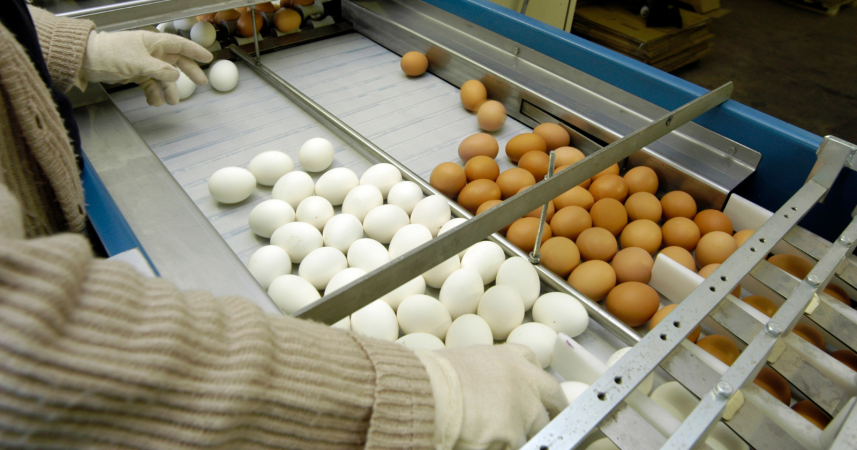
Workers in these facilities face exposure to ammonia from bird waste, respiratory issues from dust and dander, and repetitive motion injuries from processing thousands of eggs per shift.
Many are undocumented immigrants who fear reporting unsafe conditions. Turnover rates are astronomical, which tells you everything you need to know about working conditions.
When we buy cheap eggs, someone is paying the real cost. Often it's the workers who process them, earning low wages in difficult conditions while the industry profits.
The illusion of choice at the grocery store
Walk down the egg aisle and you'll see dozens of brands with different labels, colors, and price points.
It feels like a competitive marketplace with lots of options. The reality? A handful of massive companies control the vast majority of egg production in the United States.
This consolidation means less competition, more power to set prices, and less accountability. When a few players dominate an industry, they can coordinate practices, lobby more effectively against regulation, and weather scandals that would sink smaller operations. The variety you see on shelves is largely an illusion of choice.
This concentration also makes the food system more vulnerable. When avian flu hits a major producer, it can spike prices nationwide and leave shelves empty.
A more distributed system would be more resilient, but that's not how industrial agriculture works.
Final thoughts
I get it. Eggs seem so simple, so harmless. They've been a breakfast staple forever, and questioning them feels almost absurd.
But the more you look at how the modern egg industry actually operates, the harder it becomes to see them as just another grocery item.
The good news? You have options. Plant-based egg alternatives have gotten remarkably good in recent years. JUST Egg scrambles up almost identically to the real thing.
Aquafaba works magic in baking. Tofu scrambles can be genuinely delicious with the right seasoning. These aren't sacrifices. They're just different choices.
You don't have to go fully vegan tomorrow to make a difference. But understanding what's really happening behind those cheerful carton designs?
That's the first step toward making choices that align with your actual values. And that's something worth thinking about.