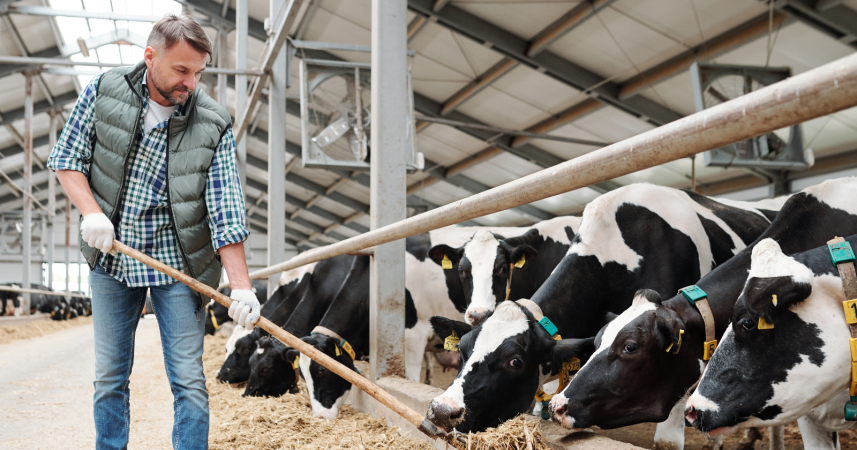
The reality behind your morning latte involves practices most consumers have never heard about, and the truth might change how you see that glass of milk.
We grow up with dairy everywhere. School lunches, cereal commercials, the "Got Milk?" ads that defined a generation.
It's positioned as wholesome, natural, essential. But here's the thing: most people have no idea what actually happens to produce that carton in their fridge.
I'm not here to guilt-trip anyone. That's not my style, and honestly, it doesn't work anyway. What does work is information. When people learn what's really going on behind the scenes, they tend to make different choices on their own.
So let's pull back the curtain on an industry that spends billions making sure you don't ask too many questions. Some of this might surprise you. Some of it might make you uncomfortable. But all of it is worth knowing.
1. Cows don't just "make" milk automatically
This sounds obvious when you say it out loud, but it's something most people never really think about. Cows, like all mammals, only produce milk after giving birth. They're not magical milk fountains. They're mothers making food for their babies.
In the dairy industry, cows are artificially inseminated roughly once a year to keep them pregnant and lactating. According to the USDA, the average dairy cow is impregnated within three months of giving birth, creating a near-constant cycle of pregnancy and milk production.
This isn't a side note about dairy. It's the entire foundation of how the system works.
2. Calves are separated from mothers within hours
Here's where things get uncomfortable. After a cow gives birth, her calf is typically removed within 24 to 72 hours. Sometimes sooner. The reason? That milk is a product, and the calf is competition for it.
Research published in Journal of Dairy Science has documented that both cows and calves show signs of distress during separation, including increased vocalizations and stress hormones. Mother cows have been observed calling for their calves for days afterward.
Male calves often end up in the veal industry, while females enter the same cycle as their mothers. It's a detail the industry doesn't advertise on packaging.
3. The lifespan gap is staggering
A cow's natural lifespan is around 20 years. Some live even longer in sanctuary settings. But dairy cows? They're typically slaughtered between ages 4 and 6, once their milk production declines enough to make them "economically inefficient."
Think about that math for a second. These animals live roughly a quarter of their natural lives before being sent to slaughter. The constant cycle of pregnancy, birth, and high-volume milking takes an enormous toll on their bodies.
By the time they're considered "spent," many suffer from lameness, mastitis, and other health issues directly caused by the demands of industrial dairy production. They're not retired. They become ground beef.
4. Dairy has a massive environmental footprint
You've probably heard about beef's environmental impact. But dairy deserves its own conversation. Producing a single glass of cow's milk generates almost three times the greenhouse gas emissions of any plant-based alternative, according to research from the University of Oxford.
It also requires significantly more land and water. A dairy farm isn't just cows. It's the crops grown to feed those cows, the water they drink, the waste they produce, and the transportation of products.
When you zoom out and look at the full picture, that innocent splash of cream in your coffee carries a surprisingly heavy environmental cost. And with climate concerns becoming impossible to ignore, this matters more than ever.
5. "Humane" labels are often meaningless
Walk through any grocery store and you'll see cartons covered in pastoral imagery. Happy cows on green hills. Words like "humane," "natural," and "farm fresh." It feels reassuring. But these terms are largely unregulated and often mean very little in practice.
Even on farms with better conditions, the fundamental practices remain: repeated impregnation, calf separation, and slaughter when production drops. The label "humane" doesn't change the basic business model. It just makes consumers feel better about participating in it.
I'm not saying every farm is identical. But the marketing often promises a reality that doesn't exist at scale. When billions of gallons of milk need producing, the pastoral fantasy breaks down fast.
6. Dairy consumption is declining, but subsidies keep it afloat
Here's an interesting behavioral economics angle. American dairy consumption has been dropping for decades. People are choosing alternatives, drinking less milk overall, or just eating differently. Yet the industry remains massive. Why?
Government subsidies play a huge role. The dairy industry receives billions in federal support, which keeps prices artificially low and production artificially high. Programs like the Dairy Margin Coverage help farmers even when demand falls.
Meanwhile, surplus cheese gets stockpiled in government storage facilities. The market is essentially saying "we want less of this," but policy keeps pushing more. It's a fascinating case study in how systems resist change even when consumer behavior shifts.
7. The "calcium myth" has been oversold
We've been told our whole lives that dairy equals strong bones. It's practically gospel. But the science is more complicated than the marketing suggests. Countries with the highest dairy consumption don't actually have the lowest rates of osteoporosis. Some have higher rates.
Calcium matters, absolutely. But you can get it from leafy greens, fortified plant milks, tofu, and plenty of other sources. The idea that cow's milk is uniquely essential for bone health is more cultural belief than nutritional fact.
Your body doesn't care where the calcium comes from. It just needs enough of it, along with vitamin D and weight-bearing exercise. The dairy industry spent decades building an association that served their business, not necessarily your skeleton.
Final thoughts
None of this is meant to shame anyone for past choices. I ate cheese for most of my life without thinking twice. We all operate on the information we have, and the dairy industry has been remarkably effective at controlling that information.
But once you know, you can't unknow. And that's actually empowering. Every trip to the grocery store becomes a chance to vote with your dollars. The plant-based alternatives have never been better, more accessible, or more delicious. Oat milk in coffee? Genuinely great. Cashew-based cream cheese? Shockingly good.
You're not sacrificing anymore. You're just choosing differently. And those choices, multiplied by millions of people, are exactly why the industry is nervous enough to fight so hard for subsidies and marketing. Change is already happening. The question is just whether you want to be part of it.