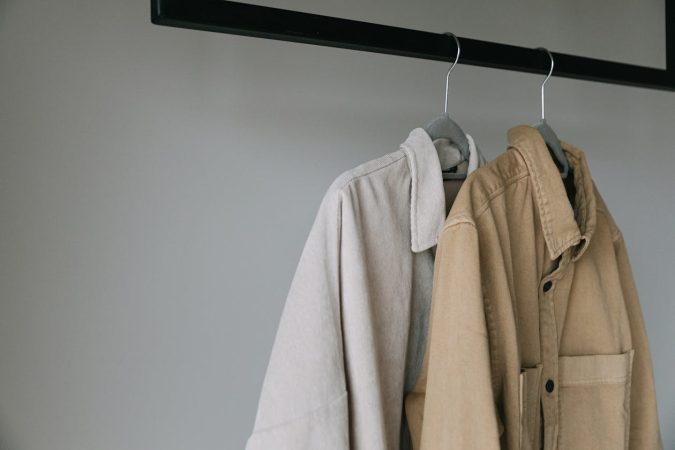
The beige, the gray, the black on black on black — it was never about aesthetics, and the people wearing those colors for years already know that, even if they can't say it out loud.

Add VegOut to your Google News feed. 
Somewhere around my mid-thirties, I stopped wearing color. I didn't announce it. I didn't curate a capsule wardrobe or read a minimalism blog. I just noticed one afternoon, folding laundry on my bed in Venice Beach, that everything coming out of the dryer was some shade of charcoal, navy, or washed-out olive. My partner pointed it out first, actually, holding up two nearly identical dark gray t-shirts and asking which one was the "good" one. I laughed. But the question sat with me longer than it should have.
Most people assume that dressing in muted, colorless clothes for extended periods is a style preference. A personality trait, maybe. The kind of thing you'd file under "minimalist" or "classic" or "just not a color person." We have an entire cultural vocabulary built around treating wardrobe neutrality as sophistication. Black is slimming. Gray is professional. Beige is timeless. The fashion industry reinforces this constantly, and the people around us rarely question it because dull clothing doesn't draw attention. That's precisely the point.
But what I've come to understand, both through my own reckoning and through years of reading behavioral psychology, is that chronic color avoidance in clothing often traces back to something far less elegant than taste. It traces back to a deeply ingrained fear of being seen.
I don't mean shyness. Shy people still wear red sometimes. I mean a specific, practiced, almost architectural effort to avoid drawing any form of attention to oneself, built over years of reinforcement. The trait these people share has nothing to do with fashion sense or aesthetic preference. It has to do with a relationship to visibility itself, one shaped by anxiety, by early experiences of judgment, and by an avoidance pattern so subtle it disguises itself as personal style.
Research suggests that avoidance behaviors function as a relief loop: you feel anxious about something (being noticed, being judged, standing out), you take an action to reduce that anxiety (wearing something that won't attract eyes), and the temporary relief reinforces the behavior. Over time, the loop tightens. What started as a single safe choice becomes a closet full of them. Baylor College of Medicine's clinical resources on anxiety describe this as the avoidance cycle, where short-term comfort gradually narrows a person's world. The relief feels like a solution. It is, in fact, the mechanism that keeps the fear alive.
I recognized this in myself only after I'd been vegan for a few years and had started paying closer attention to the unconscious patterns driving my daily choices. My whole vegan journey had been an education in how much of what we do on autopilot is actually a response to something we've never examined. I'd spent three years as an aggressive evangelist, pushing my dietary beliefs on everyone around me, before I finally understood that my intensity wasn't about saving animals. It was about controlling how people perceived me. The leather jacket I donated within two days of going vegan, the quinoa salad I brought to barbecues, the lectures I delivered at dinner tables: all of it was about being seen a certain way.
The wardrobe thing operated on the opposite end of the same spectrum. Where my vegan evangelism was about demanding visibility on my terms, my colorless clothing was about refusing visibility altogether. Both were fear responses. One just looked louder.

When I started paying attention, I noticed the pattern everywhere. A woman I met at a farmers market in Santa Monica told me she'd worn almost exclusively black for eleven years. She was an artist. She painted in wild, saturated color, canvases that practically vibrated. But she dressed like she was attending a perpetual funeral. When I asked about it (gently, because I've learned the hard way that pushing people toward self-examination doesn't work), she said something that stayed with me: "My paintings can handle being looked at. I can't."
That sentence contains an entire psychology. The separation between what we create and who we are, the belief that our work can withstand scrutiny but our bodies, our presence, our physical selves in space cannot. It's a form of self-erasure performed daily, garment by garment.
Studies suggest that the colors we choose to wear can communicate emotional states and personality dimensions to others. As one analysis of color psychology in fashion notes, our color choices function as a silent language, communicating mood, personality, and intention before we ever open our mouths. The inverse is equally true: choosing to speak in no color at all is its own statement, one that says, roughly, "Please don't notice me here."
What makes this pattern so durable is that it works. Nobody stages an intervention because you wear gray. Nobody pulls you aside to ask if you're okay because your sweater is beige again. The absence of color doesn't register as a cry for help. It registers as nothing, which is exactly what the anxious brain wants. To register as nothing. To pass through a room without leaving a visual imprint.
I later found that some psychologists who study avoidance patterns consider this kind of behavior especially resistant to change because the person experiencing it rarely identifies it as a problem. A recent piece in Psychology Today on avoidance describes how avoidance can permeate every domain of a person's life, from skipping dental appointments to dodging difficult conversations, all driven by the same underlying engine: the desire to escape discomfort. Clothing choices fit neatly into that architecture. They're just quieter about it.
The fear at the root of chronic color avoidance tends to be relational. People I've spoken with about this pattern almost always trace it back to early experiences of being judged for standing out. A parent who criticized their appearance. A schoolyard incident where being noticed meant being targeted. A cultural message, absorbed young, that visible people become vulnerable people. The children who were told they were too sensitive often grew into adults who learned to make themselves small in every available dimension, including the visual one.

I want to be careful here. Some people genuinely prefer neutral palettes. Some people look extraordinary in all black and know it. There's a real difference between choosing muted tones from a place of confidence and choosing them from a place of contraction. The distinction usually shows up in how the person talks about it. Confident neutral-wearers tend to describe their choices in terms of what they like: the clean lines, the versatility, the feel of a good black cashmere. Fear-based neutral-wearers tend to describe their choices in terms of what they're avoiding: "I don't want to be too much," "I don't want people staring," "I just don't want to deal with it."
The language of avoidance is always negative. It's defined by what it's moving away from, never by what it's moving toward.
For me, the shift started small. I bought a rust-colored linen shirt at a thrift store in Silver Lake. I put it on and felt physically uncomfortable, the way you feel when someone takes your photograph and you weren't ready. My partner told me it looked great. I wore it to a coffee shop where I write sometimes, and nobody said a word. Nobody stared. Nobody pointed. The catastrophe my nervous system had been bracing for simply didn't happen.
This is what exposure does. It reveals the gap between the anticipated disaster and the actual outcome. I didn't need to attend a workshop or hire a color consultant. I just needed to notice what I was doing and why, then test whether the feared consequence was real.
There's a connection here to something broader about how we curate our external presentation in an age of constant visual scrutiny. We think of clothing habits as aesthetic choices, surface-level decisions made in the mirror each morning. But every choice about what to put on your body is also a choice about how much space you're willing to take up. How much of yourself you're willing to offer to the gaze of others. How much risk you're willing to accept just by walking into a room.
The surprising trait, the one that connects years of colorless dressing to a deeper psychological pattern, is hypervigilance about other people's perception. These aren't people who don't care about appearance. They care enormously. They've simply decided that the safest way to manage that care is to give others nothing to form an opinion about.
I came across a video recently from The Artful Parent that examines Brooklyn Beckham's public struggles through the lens of parental control and performance—it's a different context, but the same underlying dynamic of someone taught to prioritize how they appear over who they actually are.
It's exhausting, this kind of preemptive self-censorship. I know because I lived inside it. The energy that goes into ensuring you're visually unremarkable is energy that could go toward creative work, toward connection, toward the simple pleasure of putting on a shirt because it made you feel something when you saw it on the hanger. That low-grade fatigue, the kind that comes from waking up to another day that looks exactly like yesterday, sometimes starts in the closet.
I still wear a lot of dark colors. I live in California. Black t-shirts are practically the state uniform. But the ratio has shifted. There's a faded coral in there now. A mustard yellow. A deep teal that my partner bought me for my birthday last year. Each one felt like a small act of defiance against a part of my brain that still whispers, every morning, that the safest thing is to disappear.
The whisper hasn't stopped. I've just gotten better at not obeying it.
If you recognize yourself in any of this, I'd offer one thought: pay attention to the language you use when you describe your wardrobe preferences. If the words are all about avoidance ("I don't," "I can't," "I wouldn't"), the clothing might be doing psychological work that you haven't fully reckoned with. The fear of being seen is one of the most common human fears, and one of the least discussed, precisely because the people experiencing it have gotten so good at making sure nobody notices.
That's the paradox. The skill that protects you is the same skill that keeps you hidden. And hidden, over enough years, starts to feel like gone.
Color won't fix that. A bright scarf won't heal an anxiety pattern built over decades. But noticing the pattern, naming what it actually is instead of calling it a preference, creates a crack. And cracks, in my experience, are where intentional living begins. Not with a dramatic wardrobe overhaul. With one honest look at why the closet looks the way it does.
Mine looked like a grayscale photograph of a person who was terrified of being perceived. Once I could say that plainly, the photograph started, slowly, to develop some color.