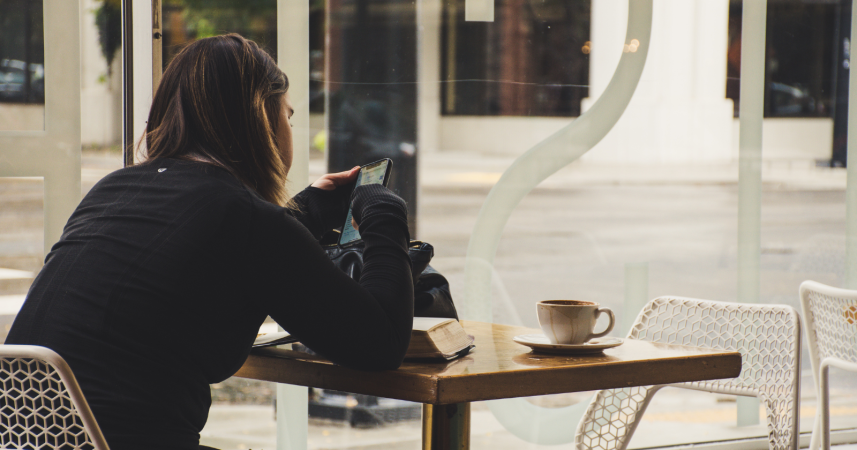
When a single song, a simmering pan, or a short line can’t outlast your glowing rectangle, your mind’s trying to tell you something

Add VegOut to your Google News feed. 
Attention is a muscle.
If yours twitches every time your screen lights up, you’re not a moral failure—you’re modern.
Here are twelve simple “can you do this without touching your phone?” tests.
If two or more feel hard on a normal day, your attention isn’t broken. It’s just undertrained. I’ll give you quick fixes for each.
Let's get to it.
1. Listen to one song from start to finish
No skipping at the bridge. No “just checking” the time. No toggling to a different playlist. If a three-minute track can’t hold you, that’s signal. Music is built to pull you in. If your thumb still drifts toward your screen, your reflex to “switch” is stronger than your reflex to “sink in.”
Tiny fix: put your phone face down and away for the length of the song. If that’s too easy, play the whole album on a walk—with your phone in a pocket, not your hand.
2. Read five pages without grazing your notifications
Articles count. Books count more. Five pages is nothing… until your brain starts bargaining: quick scroll, quick text, quick dopamine top-off. If you can’t clear five pages, longform anything will always be uphill.
Tiny fix: airplane mode + timer for 12 minutes. Stop when the timer ends—even if you’re in flow. Ending on purpose tells your brain reading is safe to repeat.
3. Cook a simple meal without a mid-recipe scroll
Scrambled tofu, pasta, a sheet-pan dinner—twenty to thirty minutes of chopping, stirring, tasting. If you find yourself grabbing your phone while the onions are sweating, that’s not “multi-tasking.” That’s a habit of escape when the task turns ordinary.
Tiny fix: make the kitchen a no-phone zone by default. Music via speaker is fine. Messages wait until plating.
4. Hold a ten-minute conversation without glancing down
This is the one that quietly damages relationships. When you glance, the other person feels it—even if you don’t reply. Micro-distraction reads as “you’re not the main tab.”
Tiny fix: put the phone screen-down and out of reach when someone starts talking. Say, “You’ve got me for ten.” Sounds cheesy. Works anyway.
5. Sit through a meeting or class without a “quick check”
Be honest: is your phone on the table like a third participant? When you sneak a glance every few minutes, you’re not just splitting attention; you’re teaching your brain that boredom equals danger.
Tiny fix: one index card instead of your phone for notes. If you need to look something up, write a “?,” keep listening, search later. Your recall improves when you aren’t constantly context-switching.
A few years ago, I caught my own hypocrisy.
I’d written about presence that morning… then sat in a team sync tapping open Slack every time someone paused. Afterward, I couldn’t remember the decision we’d made.
The next week I brought a pen and a half sheet of paper. No phone. I jotted three questions and one action. The meeting ran shorter. I didn’t have to ask anyone to repeat themselves.
Attention wasn’t about heroics; it was about removing the slot machine from my lap.
6. Watch 20 minutes of a show without second-screening
If Netflix needs Instagram to keep you entertained, that’s not entertainment; that’s divided attention dressed as leisure. You don’t rest when you split your focus; you just feel foggy afterward.
Tiny fix: one screen rule. If you’re watching, you’re watching. Put the phone in another room. (Yes, another room. Distance beats willpower.)
7. Wait in a line without “filling” the gap
Grocery queue. Coffee shop. Post office. If your hand moves to your pocket the instant you stop moving, you’ve taught your brain that “idle” is intolerable. Waiting is a free attention workout; most of us outsource it to the feed.
Tiny fix: use “line time” to train micro-focus. Pick one thing to notice: three smells, five colors, one overheard sentence without judgment. You’re not meditating; you’re practicing staying with what is.
Important: never “just check” your phone while driving. Not at a light, not “for a second.” That’s not an attention problem; that’s a safety problem. Full stop.
8. Work for one 25-minute block without touching your phone
Call it a Pomodoro, a sprint, a focus block—whatever. If you can’t do 25 minutes on one task without a screen peek, deep work will forever feel mythical.
Tiny fix: pair a kitchen timer with a “phone box” (a literal bowl on the other side of the room). Start the timer. Sit down. When your brain screams “but what if,” say, “It can wait 18 minutes.” It almost always can.
On a tight deadline last summer, I was stuck at 80% and spiraling. I kept “checking” Twitter between paragraphs—my excuse was “research.” I finally dragged a shoebox onto the shelf, dropped my phone in, and set a 25-minute timer.
The first sprint felt like withdrawal. The second felt tolerable. The third? I forgot the phone existed. Two sprints later, the piece was done. I didn’t get smarter. I got uninterrupted.
9. Take a 15-minute walk with no earbuds, no phone in hand
If the idea makes you itchy, that’s data. We’ve outsourced thinking to podcasts and quiet to content. A bare walk is how you reacquaint yourself with your own head.
Tiny fix: leave with a note card and pen, not your phone. If a “must remember” thought pops up, write two words and keep walking. Headphones are a treat; silence is training.
10. Go to bed and wake up without the scroll
Bookending your day with glow-screens fries your attention. At night, the feed accelerates your mind when it should be decelerating. In the morning, you outsource your priorities before you’ve picked one.
Tiny fix: charge your phone outside the bedroom. Buy a $15 alarm clock. Read one page of a paper book at night; write one line in the morning (“Today will be a win if I ____”). Low-effort, high return.
11. Do a workout without mid-set checks
You rest 60 seconds… and boom, three minutes of reels. Your heart rate drops, your focus shatters, and you turn a 40-minute session into 70 aimless minutes.
Tiny fix: print or scribble the plan beforehand. Put the phone in a locker or on airplane mode with a single timer running. Music is fine; apps that tempt you aren’t.
12. Sit still for two minutes doing nothing
No breathing app. No guided anything. Just two human minutes of stillness. If your skin crawls and your hand twitches toward your phone, that’s not a personal failing. It’s a nervous system that forgot boredom is safe.
Tiny fix: try the “2-minute stare.” Look out a window. Don’t optimize it. When your mind sprints, label it “planning” or “remembering,” exhale, and come back to the view. Daily, not perfectly, is the goal.
Why this happens (and why you shouldn’t shame yourself)
Your phone is a casino in your pocket. Intermittent rewards (“maybe there’s a new thing!”) are the stickiest kind. You didn’t “choose” to enjoy micro-hits of novelty; your brain was built for novelty. Add notifications engineered to feel urgent and you get a reflex—check, check, check—that feels like oxygen.
As I’ve mentioned before, you don’t beat reflex with lectures. You beat it with friction and replacement.
-
Friction: make the easy thing harder (distance, airplane mode, do-not-disturb).
-
Replacement: give your attention something simple and finite to do (a timer, a card, a single question).
Do that long enough and your baseline improves. Not because you grew superhuman discipline, but because you stopped inviting a slot machine to every task.
A simple 7-day attention tune-up
-
Day 1 — One-song test: phone out of reach, one track, just listen.
-
Day 2 — Five pages: airplane mode + 12-minute timer.
-
Day 3 — Line practice: stand without scrolling. Notice five colors.
-
Day 4 — 25-minute sprint: phone in a box; one task; timer on desk.
-
Day 5 — Walk bare: 15 minutes outside, no earbuds, not in your hand.
-
Day 6 — Screen-free bookends: phone out of bedroom; one page night/morning.
-
Day 7 — Two minutes of nothing: stare out a window. Label thoughts, exhale.
Repeat the week. Add minutes only when it’s easy.
Tools that help (because systems beat willpower)
-
One-screen home screen: remove everything except Phone, Messages, Camera, Maps.
-
Grayscale mode: kills the slot-machine shine.
-
Notification audit: off by default; on only for humans.
-
App buckets: socials in a folder on the last screen. Tiny speed bump, big effect.
-
Analog allies: timer, index cards, paper book, nightstand alarm clock.
What “better” feels like
You won’t become a monk. You will notice:
-
Conversations breathe because you’re not splitting them with a feed.
-
Work blocks actually end with something you can point to.
-
Walks feel longer—in a good way.
-
Bedtime isn’t a battle with blue light and infinite scroll.
-
Boredom stops feeling like danger and starts feeling like… space.
That’s the whole game. Not perfection—presence enough to put your attention where you want it, when you want it.
Pick one of the twelve tests and run it today.
Set a timer. Put the phone farther away than your arm.
When the itch hits, smile and let it pass.
Your attention is still yours. You just have to practice using it on purpose.
What’s Your Plant-Powered Archetype?
Ever wonder what your everyday habits say about your deeper purpose—and how they ripple out to impact the planet?
This 90-second quiz reveals the plant-powered role you’re here to play, and the tiny shift that makes it even more powerful.
12 fun questions. Instant results. Surprisingly accurate.