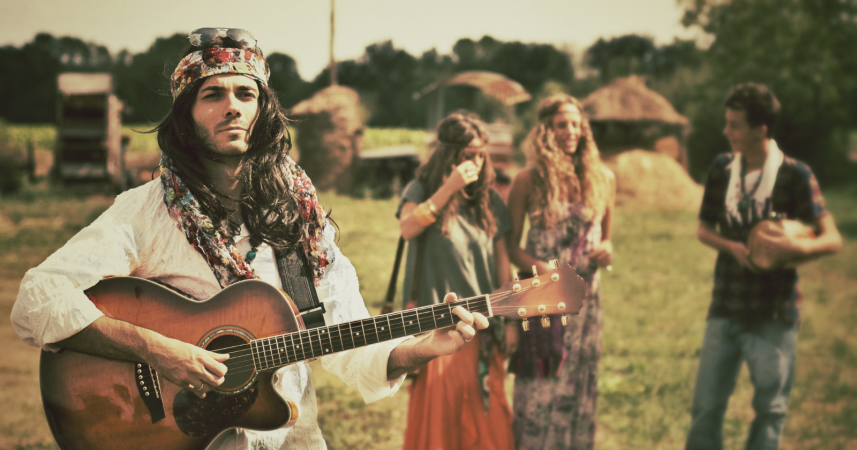
If you remember when long hair was rebellion and communes were real options, you lived through a cultural shift that permanently changed America
Ever wonder if you're part of that generation that came of age when everything was changing?
The hippie movement wasn't just about flowers and music. It was a complete rejection of everything the previous generation stood for. Those who participated were primarily born during or shortly after World War II, in the 1940s and early 1950s, and they fundamentally reshaped American culture in ways we still feel today.
If you grew up during this era, certain experiences shaped you in ways that younger generations simply can't relate to. Here are ten defining moments that marked you as part of this transformative time.
1) You witnessed the shift from crew cuts to long hair
Hair became a statement of rebellion.
When I was sorting through old family photos at my grandmother's house last year, I found a picture of my uncle from 1964 with a military style crew cut. By 1968, the same guy had hair down to his shoulders.
This wasn't just about fashion. Long, often scraggly hair became part of the hippie look, along with bowler hats, love beads, bells, and colorfully designed clothing.
Your parents probably freaked out about it. Mine certainly did. But that was kind of the point.
The length of your hair announced what side you were on. It told the world you rejected the conformity of the 1950s and weren't interested in playing by the old rules.
2) You remember when rock music actually scared adults
Music festivals weren't corporate sponsorship opportunities back then.
The musical Hair, celebrating the hippie lifestyle, opened on Broadway in 1968, and the film Easy Rider, which reflected hippie values and aesthetics, appeared in 1969. These weren't just entertainment. They were cultural earthquakes.
The bands mattered in a way that's hard to explain to someone who didn't live through it. When Jefferson Airplane or the Grateful Dead played, they weren't just performing. They were channeling something bigger.
I've mentioned this before but the connection between music and consciousness was central to the entire experience. The sound wasn't background noise. It was the soundtrack to a revolution.
Adults genuinely believed rock music would destroy civilization. Looking back, maybe they were right to worry. It did destroy their civilization. That was the whole idea.
3) You experienced the draft lottery
Nothing focused the mind quite like knowing your birthday could determine whether you'd end up in Vietnam.
More than two million American men were drafted, and some counterculturists showed their contempt for the war by burning their draft cards.
Even if you weren't old enough to be drafted yourself, you knew someone who was. Your brother, your boyfriend, the guy who sat behind you in algebra class.
The war split the country down the middle. You were either a dove who wanted it to end or a hawk who supported continued involvement. There wasn't much middle ground.
This wasn't abstract politics. These were real decisions about real lives, and the pressure shaped an entire generation's relationship with authority and government.
4) You remember Haight-Ashbury before it became a tourist attraction
There was a moment when San Francisco's Haight-Ashbury district represented possibility itself.
During the 1967 Summer of Love, thousands of young people went to San Francisco seeking to live the countercultural lifestyle. If you were there, you witnessed something that can't be recreated or fully explained to someone who missed it.
The reality, of course, was messier than the mythology. The large influx of people turned the neighborhood into a poverty-stricken area that wasn't well kept, leading to crime and changing the scene from a safe haven for artists to a dangerous and unsanitary place.
But before it all fell apart, there was this brief window when it felt like a new way of living might actually be possible.
Even if you never made it to San Francisco, you knew about it. It represented something everyone was either moving toward or running away from.
5) You understood that clothes were political statements
Getting dressed wasn't a neutral activity.
Bell bottoms, tie-dye, peasant blouses, anything flowing or colorful announced your allegiances before you opened your mouth. You could spot your people across a crowded street.
My partner, who's younger, once asked me why everyone dressed the same if they were so committed to individualism. That's missing the point entirely. The uniformity was the statement. It said you belonged to something bigger than yourself.
Hippies adopted their own look with colorfully designed clothing, bell-bottom pants, and Victorian shawls, typically wearing flowers in their hair and painting their bodies in Day-Glo bright colors.
Your appearance could get you refused service at restaurants or stopped by police. What you wore had consequences, which made it matter more than fashion ever has since.
6) You attended be-ins and teach-ins
These weren't Ted Talks or networking events. They were genuinely new forms of gathering.
The faculty at the University of Michigan suspended classes and conducted a 24-hour teach-in on the war, and the idea quickly spread, with the first national teach-in held at 122 colleges and universities across the nation.
Be-ins were even stranger. Hippies held happenings, be-ins, and acid tests featuring music from groups like the Grateful Dead and Jefferson Airplane. These gatherings had no agenda beyond being together and experiencing collective consciousness.
The concept sounds ridiculous now, doesn't it? Just show up and be present. No structure, no goals, no product to sell.
But that was exactly the point. You were rejecting the idea that every gathering needed a purpose beyond human connection.
7) You explored Eastern philosophy before it went mainstream
Hippies commonly sought spiritual guidance from sources outside the Judeo-Christian tradition, particularly Buddhism, Hinduism, and other Eastern religions, sometimes in various combinations.
I read my first book on Zen Buddhism at seventeen, borrowed from a friend who'd gotten it from someone else. The pages were dog-eared and annotated. It felt like you were part of a secret knowledge network.
Astrology, meditation, karma. All of these concepts were genuinely foreign to mainstream American culture. The period was often referred to as the Age of Aquarius, which now sounds almost charmingly naive.
But discovering these ideas felt revolutionary. You were accessing wisdom traditions that your parents' generation had completely ignored. It suggested there were other ways of understanding reality beyond what you'd been taught in Sunday school.
8) You knew people who actually moved to communes
Some of your friends didn't just talk about alternative lifestyles. They lived them.
When the Summer of Love ended, thousands of hippies left San Francisco, with a large minority heading back to the land and creating the largest number of intentional communities in United States history.
By the early 1970s, about 750,000 people lived in more than ten thousand communes across the country. Think about that number. Three quarters of a million people who actually tried to build something different.
Most communes didn't last. The ones that survived did so through compromise and structure, which kind of defeated the original purpose. But the attempt mattered.
You either went yourself, knew someone who did, or seriously considered it. The option felt real in a way it simply doesn't today.
9) You remember when psychedelics were part of consciousness exploration
The drug conversation was completely different then.
Hippies promoted the recreational use of hallucinogenic drugs, particularly marijuana and LSD, justifying the practice as a way of expanding consciousness. Whether you participated or not, you understood this framing.
These weren't party drugs or escape mechanisms. They were tools for seeing reality differently. The language around substances emphasized enlightenment and awareness, not just getting high.
Obviously, this led to problems. Not everyone who took acid found enlightenment. Some people just found bad trips and lasting consequences.
But the cultural context was distinct from today's recreational drug culture. There was an earnest belief that chemistry could unlock higher consciousness, and that belief shaped how an entire generation approached altered states.
10) You experienced the transition as it all ended
Maybe the most defining experience was watching it fall apart.
After the Vietnam War ended in the mid-1970s, the counterculture movement died down, though the media continued to idolize hippie culture.
Most former hippies either returned to school or joined the labor force, cutting their hair, giving up free love and drugs, marrying, and slowly adopting mainstream lifestyles.
If you lived through this, you watched your friends gradually drift back toward conventional life. They got jobs, moved to suburbs, had kids. The revolution became a phase.
That transition shaped you as much as the peak years did. You learned that idealism has limits, that practical concerns eventually matter, and that the system is harder to escape than young people believe.
But you also retained something. Even those who fully reentered mainstream life carried with them changed values about authority, individual freedom, and social justice.
The bottom line
The hippie generation wasn't just about superficial markers like clothing and music. It represented a fundamental questioning of American values that we're still processing today.
Many aspects of hippie counterculture have been assimilated by the mainstream, including greater acceptance of religious and cultural diversity, natural food and herbal remedies, and various personal appearance options.
If these experiences resonate with you, you were shaped by a unique moment in history. The specifics of your involvement mattered less than the fact that you came of age when alternatives seemed genuinely possible.
That window closed. But it opened first, and being there when it did marked you permanently.
What’s Your Plant-Powered Archetype?
Ever wonder what your everyday habits say about your deeper purpose—and how they ripple out to impact the planet?
This 90-second quiz reveals the plant-powered role you’re here to play, and the tiny shift that makes it even more powerful.
12 fun questions. Instant results. Surprisingly accurate.