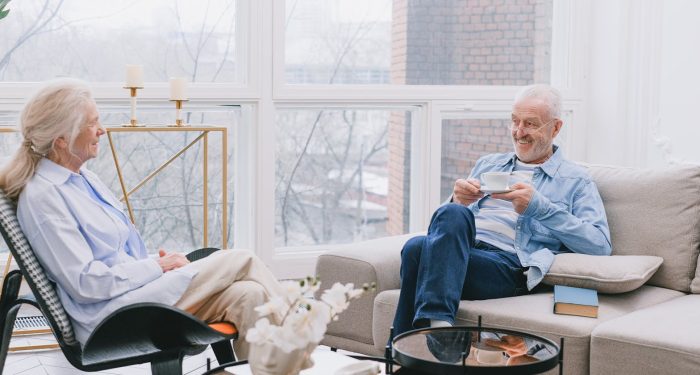
The 70-year-olds who seem the most at peace aren't always the ones with the fullest calendars

Add VegOut to your Google News feed. 
Every Saturday at my local farmers market in Venice Beach, I see the same handful of older regulars. Some of them move through the stalls like they're running late for something. Loading bags, checking phones, ticking off a list. Others drift. They stop at the honey stand for no reason. They hold a peach like it's the first one they've ever seen. They talk to vendors for ten minutes about nothing in particular.
I used to think the first group had it figured out. Now I'm not so sure.
Because the ones who linger, the ones who seem to have nowhere urgent to be, also seem to be the ones having the best time. Not in a flashy way. In a quiet, settled, almost magnetic way. And the more I've read about what actually makes people happy in later life, the more I think that difference isn't random. It's everything.
The gospel of staying busy
We've been told a story about aging for as long as most of us can remember. The story goes like this: stay active, stay sharp, stay relevant. Keep moving. The moment you stop, you start to decline. Retirement is something to be "managed" with schedules and hobbies and purpose statements, or it'll swallow you whole.
And look, there's a kernel of truth there. Complete isolation and zero engagement aren't great for anyone. But somewhere along the way, "stay active" got twisted into "never stop producing." And that's a very different message.
I've mentioned this before but one of the most consistent findings in behavioral psychology is that we underestimate how much of our identity is shaped by what we do all day. When work disappears, a lot of people don't just lose a paycheck. They lose the thing that told them who they were every morning. So they scramble to replace it. Golf on Mondays, volunteering on Tuesdays, book club on Wednesdays. A packed calendar as proof of life.
The 2024 MassMutual Retirement Happiness Study found something revealing about this gap between expectation and reality. Before retirement, people imagined their days full of travel and exercise. In practice, the top activity for current retirees was watching television. Not because they were unhappy, necessarily, but because the fantasy of constant motion rarely matches the body's actual preferences once the pressure to perform is gone.
What the body was whispering all along
Here's the thing nobody tells you about rest: your body has been requesting it your entire life. Not just sleep. Not just a vacation. A fundamentally different relationship with stillness.
Think about every Sunday afternoon you felt guilty for lying on the couch. Every sick day you spent half-working from bed. Every holiday where you answered emails because doing nothing felt physically uncomfortable. That discomfort wasn't laziness knocking at the door. It was conditioning. The belief, baked into us from childhood, that your value is tied directly to your output.
Research from Psychology Today calls this "productivity guilt," and it's more widespread than most of us realize. The pattern runs deep: rest triggers anxiety, so we avoid it, which creates burnout, which makes rest feel even more dangerous. It's a loop. And for a lot of people, it takes decades to even notice it's running.
My grandmother is one of the hardest-working people I know. She raised four kids on a teacher's salary and still volunteers at a food bank every Saturday. For years I admired her pace without questioning it. But recently I asked her if she ever just sits and does nothing. She looked at me like I'd asked her to explain quantum physics. "What would I do?" she said. And I realized she genuinely didn't know. The idea of rest without purpose had never been presented to her as an option.
That's not a generational quirk. That's a cultural inheritance most of us are still carrying.
The permission problem
So why do the happiest people over 70 seem different? Not because they found the perfect hobby or the ideal volunteer gig. But because at some point, they gave themselves permission to stop performing.
That word, permission, matters. Because nobody hands it to you. Your employer certainly won't. Society won't. Even your family, with the best intentions, will often push you to "stay busy" because they equate stillness with decline. The permission has to come from inside, and for a lot of people, it takes until their sixties or seventies to grant it.
Stanford psychologist Laura Carstensen has spent decades studying what she calls the "positivity effect" in aging. Her research shows that as people get older and begin to sense that time is limited, they naturally shift their attention toward positive experiences and away from negative ones. They stop chasing and start savoring. They become more selective about how they spend their time and who they spend it with.
But here's the part that doesn't get talked about enough: that shift isn't automatic for everyone. The people who resist it, who keep white-knuckling their way through packed schedules because slowing down feels like giving up, often miss the window entirely. They stay busy and wonder why they don't feel fulfilled. Meanwhile, the ones who lean into the slowdown, who let the stillness in, report higher well-being and deeper satisfaction with life.
It's not about doing nothing. It's about no longer needing to justify every hour.
Presence over productivity
I think about this a lot in my own life, even though I'm decades away from retirement. Some of my best moments aren't the ones where I'm producing anything. They're the ones where I'm standing on my balcony in Venice Beach, watering the herbs in my little garden, not thinking about deadlines. Or when I'm cooking something slow on a Sunday evening, no recipe, no plan, just seeing what happens with whatever's in the fridge.
Those moments used to feel indulgent. Like I was stealing time from something more important. It took me years to understand that they were the important thing. That the body wasn't asking for a vacation. It was asking for a different mode of being. One where the point of the activity is the activity itself, not what it produces.
The Harvard Study of Adult Development, which has been tracking participants since 1938, found that the people who thrived most in later life weren't the busiest or the most accomplished. They were the ones with the warmest relationships and the deepest sense of connection to the present. Robert Waldinger, the study's current director, has said that good relationships don't just protect our bodies, they protect our brains. And the quality of those connections at 50 was a better predictor of health at 80 than cholesterol levels.
What's interesting is that presence is a prerequisite for connection. You can't be deeply engaged with another person while mentally auditing your to-do list. You can't savor a conversation if you're already thinking about the next one. The happiest older adults figured this out, sometimes by choice, sometimes by necessity. But the result was the same: they traded breadth for depth, and their lives got richer.
The quiet ones who got it right
There's a specific kind of happiness I've noticed in people over 70 who've made this shift. It doesn't look like excitement. It looks like ease. They're not performing contentment for anyone's benefit. They're just present in a way that's almost startling in a culture built on distraction.
I see it on my photography walks around Griffith Park sometimes. An older couple on a bench, not talking, not looking at phones, just sitting together watching the light change. A man reading a book so slowly you'd think he was memorizing every page. A woman sketching something in a notebook, completely absorbed.
These aren't people who gave up on life. These are people who finally aligned with what life was actually offering them.
Research published in the USC Dornsife Center for Self-Report Science backs this up. A landmark study using data from 400,000 participants found that life satisfaction dips to its lowest point in the early 50s, then rises steadily through age 80. Reports of anger, frustration, and stress were highest in younger adults and gradually lessened with age. One explanation is simple: older adults have more control over how they spend their time. They're no longer trapped in jobs they don't enjoy or social obligations they can't escape.
But the deeper explanation is more profound. As people age, they get better at filtering out what doesn't matter. They stop saying yes to things that drain them. They stop measuring their days by output and start measuring them by how they feel. And they discover, often with genuine surprise, that the thing they'd been calling laziness their whole lives was actually the only version of rest their body was ever asking for.
The bottom line
You don't have to wait until 70 to give yourself permission to stop. You don't have to earn rest by first exhausting yourself. And you definitely don't need a packed schedule to prove that your life has meaning.
The happiest people in later life aren't the ones who stayed busy. They're the ones who finally listened to what their bodies had been saying all along. And what the body says, when you get quiet enough to hear it, is pretty simple: slow down, pay attention, and stop apologizing for being still.
That's not laziness. That's wisdom arriving on its own schedule.