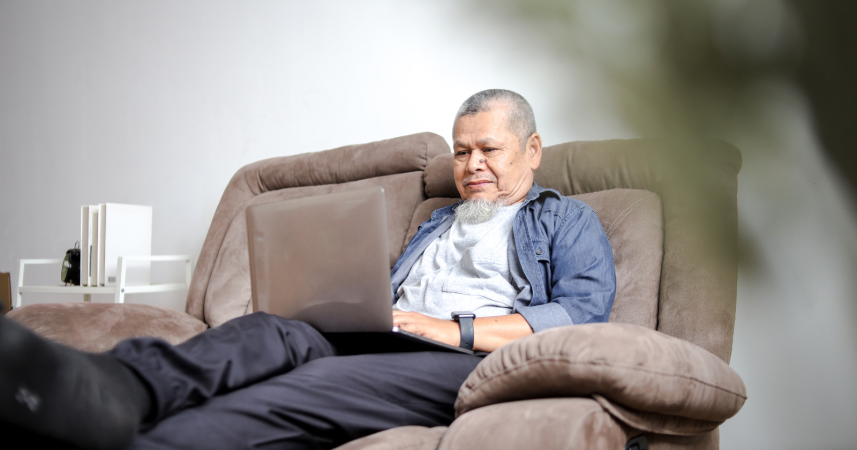
The nightly ritual of elderly parents dozing off to blaring televisions isn't about refusing proper bedtime routines—it's their desperate attempt to fill the deafening silence of days spent entirely alone.

Add VegOut to your Google News feed. 
Last Tuesday evening, I found myself standing in my neighbor's doorway, returning a casserole dish.
Through the living room archway, I could see her father in his worn leather recliner, chin on his chest, while a game show host's enthusiastic voice bounced off the walls at a volume that made me wince.
She caught my glance and whispered, "Every single night. Won't go to bed properly, just falls asleep right there with that TV blaring." The resignation in her voice was familiar—I'd heard it from countless friends navigating their parents' aging.
But what struck me most was the loneliness radiating from that scene: an old man, surrounded by canned laughter and artificial conversation, drifting off to another night of interrupted sleep.
We often interpret these moments through the lens of stubbornness or declining self-care. Dad won't listen. He's being difficult about bedtime. He refuses to turn off that television.
But psychology suggests something far more heartbreaking might be happening. Those voices from the television—the news anchors, the sitcom families, the late-night hosts—might be filling a silence that's become unbearable.
The hidden epidemic of elder loneliness
When was the last time your aging parent had a real conversation that wasn't about doctor's appointments or medications? I mean a genuine exchange—the kind where someone asks about their thoughts on the morning news, their memories of similar times, or simply how their day unfolded?
Research has found that older adults who lived alone reported greater loneliness during periods when viewing television, suggesting that TV may serve as a form of companionship for those without other social interactions.
This finding stopped me cold when I first read it. Television as companionship. Not entertainment, not distraction—companionship.
I think about the seven years I spent caring for my second husband through Parkinson's disease. Even with me there every day, he craved the constant chatter of the television. At first, I took it personally. Was I not enough company?
But I came to understand that the TV offered something I couldn't: endless variety of voices, stories that required no reciprocation, conversation without the exhausting work of forming words when your body won't cooperate.
When nighttime brings more than just darkness
There's another layer to this nightly ritual that many families don't recognize.
Dr. Christine Chelladurai, DO, a geriatric medicine specialist, explains: "Sundowning is a condition that results in agitation, behavioral problems or difficulty sleeping. It affects individuals with dementia or Alzheimers and begins at dusk as the sun goes down."
Even for those without dementia, evenings can trigger a particular kind of anxiety in older adults.
The approaching darkness, the quieting of the neighborhood, the knowledge that another day has passed—these can all intensify feelings of isolation. The television becomes a barrier against these creeping shadows, both literal and metaphorical.
I remember those six months after my husband died when I barely left the house. Evenings were the worst.
That's when couples cook dinner together, when families gather, when the world seems designed for people who aren't alone. The TV became my dinner companion, my evening ritual, my protection against the silence that threatened to swallow me whole.
The vicious cycle of isolation and sleep
Here's where it gets complicated. Studies indicate that social isolation in older adults is associated with poorer sleep quality, with depression partially mediating this relationship.
So that father falling asleep in his recliner isn't just lonely—his loneliness is likely disrupting his sleep, which then affects his mood and energy the next day, making him less likely to seek out social interaction. Round and round it goes.
Dr. Augelli, a sleep specialist, notes: "The primary concern here is that TV light and sound will keep you from getting into the deeper, more restorative stages of sleep."
So while the television might feel like company, it's actually preventing the kind of rest that might give someone the energy to seek real human connection the next day.
Beyond the obvious: understanding the whole picture
What else might be happening? Sometimes the recliner routine masks physical realities we haven't considered. Chronic pain might make lying flat uncomfortable. Breathing issues could worsen when horizontal. The recliner might simply be the only position that offers relief.
Research has found that greater loneliness and social isolation were associated with more disrupted sleep, measured by actigraphy, in older adults. Notice how everything connects—loneliness affects sleep, poor sleep affects mood and health, declining health increases isolation.
Have you asked your father about his daily routine lately? Not just whether he took his medications or ate lunch, but who he talked to? What made him laugh? What he's looking forward to? The answers—or the struggle to find any—might reveal more than any sleep study could.
Breaking the pattern with compassion
So what do we do with this understanding? First, we stop treating the television-and-recliner routine as mere stubbornness. We recognize it for what it might be: a symptom of profound loneliness, a makeshift solution to an unbearable problem.
My Sunday evening phone calls with my daughter have become sacred. Not because we discuss anything earth-shattering—often we don't—but because they're reliable human connection. They're proof that someone in this vast world is thinking of me, expecting to hear my voice.
Could you become part of your parent's evening ritual? Not to wrestle them into bed or turn off the TV, but to sit with them for a while? Share a cup of tea, comment on the show they're watching, tell them about your day?
Even fifteen minutes of real presence might ease the transition to night better than hours of television voices.
Consider too the practical adjustments. If the recliner has become the preferred sleeping spot, could you make it safer and more comfortable? Better pillows, a soft throw blanket, dimmer lighting?
If we can't immediately solve the loneliness, we can at least ensure the makeshift solution doesn't cause additional harm.
Final thoughts
That image of an elderly parent asleep in their recliner, television blaring, breaks my heart differently now.
I see not stubbornness but adaptation, not carelessness but a deep human need being met in the only way available. Those television voices aren't just noise—they're proof that somewhere, life continues, people are talking, the world hasn't forgotten you exist.
The real question isn't how to get Dad to turn off the TV and go to bed properly. It's how to ensure that the voices keeping him company at night aren't the only conversation in his day.
Because everyone—at every age—deserves more than the hollow comfort of canned laughter and scripted dialogue. They deserve the messy, beautiful, irreplaceable sound of someone who loves them saying their name.