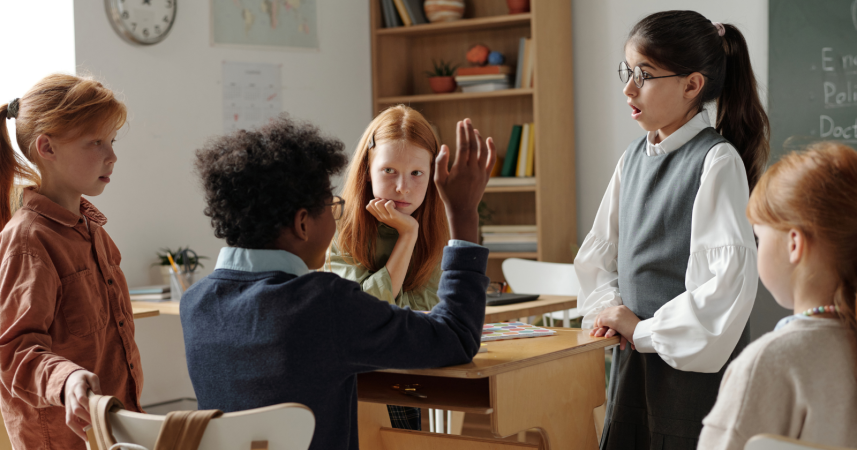
For decades, those straight-A report cards weren't just grades — they were survival receipts, proof that your family's sacrifice was worth it, and if you're reading this with a knot in your stomach, you're probably still collecting them.

Add VegOut to your Google News feed. 
The smell of garlic and oregano still takes me back to those nights hunched over homework in the corner of my family's souvlaki shop kitchen.
The industrial dishwasher would be humming, prep cooks chopping onions for tomorrow's service, and there I'd be, trying to solve for X while translating the produce supplier's invoice from Greek to English for my father. I thought every kid did their homework between the prep table and the walk-in fridge.
What I didn't understand then was that I wasn't just doing homework. I was performing a carefully choreographed dance of survival that millions of immigrant kids know by heart. We weren't just good students because we were naturally ambitious.
We were translating our parents' sacrifices into grade point averages, converting their broken English into our perfect attendance records.
The invisible weight of being the family translator
Su Yeong Kim, Ph.D., Professor of Human Development and Family Sciences at the University of Texas at Austin, puts it perfectly: "In many immigrant households, children carry more than homework in their backpacks. They also carry the role of interpreter."
That role goes far beyond language. You're interpreting bank statements at age ten, explaining medical diagnoses at twelve, negotiating lease agreements at fifteen. You become the bridge between two worlds before you've figured out which world you actually belong to.
Every A on your report card isn't just an academic achievement. It's proof that the family investment is working, that the move across oceans and continents wasn't for nothing.
I remember being eleven years old and having to explain to my mother why my teacher wanted a parent-teacher conference. She immediately assumed I'd done something wrong. The concept that teachers might want to meet parents just to check in was foreign to her.
So I translated not just the words but the entire North American educational culture, all while trying to hide my own confusion about why this meeting mattered so much to everyone.
When high expectations become your operating system
Growing up in Hamilton, Ontario, as the oldest of three in a Greek-Canadian family meant expectations weren't just high, they were atmospheric. My parents worked six days a week and took us to church on the seventh. Rest was what other families did.
But here's what's fascinating about those expectations. Dr. Kim's research reveals that "Research shows that children benefit most when expectations are paired with care. High standards can motivate, but they must be balanced with emotional support."
The problem is, many immigrant parents show care through those very expectations. The pressure to excel becomes the language of love. Every demand for better grades is actually saying "I want you to have options I never had." Every criticism of a B+ is really "I'm terrified you'll struggle like we did."
You internalize this until excellence becomes your default setting. Decades later, you're still operating on that same programming, treating every work project like it's a final exam that determines your family's future.
The myth of the bilingual advantage
Everyone talks about how bilingual kids have cognitive advantages, as if speaking two languages automatically makes you some kind of child genius. The reality is messier.
Dr. Kim challenges this oversimplification: "Bilingualism does not hand every child a golden ticket to cognitive superiority. It is a lived reality influenced by home, school, and community."
That lived reality meant constantly switching between being my parents' voice in English and finding my own voice in either language. It meant knowing exactly how to argue with a supplier in Greek but struggling to express my feelings in any language at all.
The cognitive advantage everyone talks about came with a cognitive cost: the exhaustion of never being able to fully relax into one identity or the other.
Why we're still performing decades later
I spent my thirties and forties defining myself entirely by the restaurant. When the divorce finally came at 36, it was the first crack in an identity I'd been building since childhood. That's when I realized I was still that kid doing homework in the kitchen, still proving something to someone who wasn't even watching anymore.
Research on immigrant children found that they often exhibit resilience factors like strong family support and community engagement, which contribute to their academic success despite challenges like poverty and trauma.
But what happens when those same resilience factors become compulsions? When the strong family support becomes an inability to set boundaries? When community engagement becomes an endless need for external validation?
Many of us are still translating, still bridging worlds, still trying to justify our existence through achievement. We've turned survival mechanisms into personality traits. The hypervigilance that helped us navigate two cultures becomes anxiety. The perfectionism that earned us scholarships becomes imposter syndrome with a corner office.
Breaking the performance while honoring the story
Dr. Kim warns that "Viewing individuals through the lens of 'fragility' may pathologize ordinary cultural adjustments, making them appear abnormal."
This is crucial. The goal isn't to pathologize our experiences or dismiss them as trauma. These patterns served us. They got us through. They were acts of love, even when they didn't feel like it.
Studies show that children of immigrants, particularly those from Hispanic backgrounds, face unique challenges such as immigration trauma and poverty, which significantly influence their educational outcomes. But focusing only on the challenges misses the incredible resourcefulness these experiences created.
These days, I donate leftover consulting hours to help immigrant families setting up small food businesses. I watch their kids doing homework in the back while their parents prep for the lunch rush, and I see that same performance beginning. But I also see something else: the opportunity to acknowledge both the beauty and the burden of what they're carrying.
Final words
That kid doing homework in the souvlaki shop kitchen was performing survival, yes. But he was also learning resilience, adaptability, and the complex art of holding multiple truths at once. The performance might be exhausting, but it's also made us who we are.
The work now isn't to stop performing entirely but to choose our performances more consciously. To recognize when we're operating from that old programming and ask ourselves: Is this excellence serving me, or am I serving it? Am I achieving because I want to, or because I'm still trying to justify my place at the table?
The answer doesn't have to be absolute. Some days, you'll still be that kid with the backpack full of invisible responsibilities. Other days, you'll just be yourself, whatever that means. Both are okay. Both are part of the story.
And maybe that's the real achievement: finally giving ourselves permission to stop translating our worth into accomplishments and just exist, garlic and oregano scented memories and all.
If You Were a Healing Herb, Which Would You Be?
Each herb holds a unique kind of magic — soothing, awakening, grounding, or clarifying.
This 9-question quiz reveals the healing plant that mirrors your energy right now and what it says about your natural rhythm.
✨ Instant results. Deeply insightful.

Gerry Marcos
Gerry spent 35 years in the restaurant business before trading the kitchen for the keyboard. Now 62, he writes about relationships, personal growth, and what happens when you finally stop long enough to figure out who you are without the apron. He lives in Ontario with his wife Linda, a backyard full of hot peppers, and a vinyl collection that’s getting out of hand.
More Articles by Gerry