Between the gentle snip of scissors and the honest gaze in the mirror, I've discovered that my hairdresser knows more about my widowhood, my fears, and my small triumphs than anyone else in my life—because she's the only one who asks the real questions and actually waits for the answers.

Add VegOut to your Google News feed. 
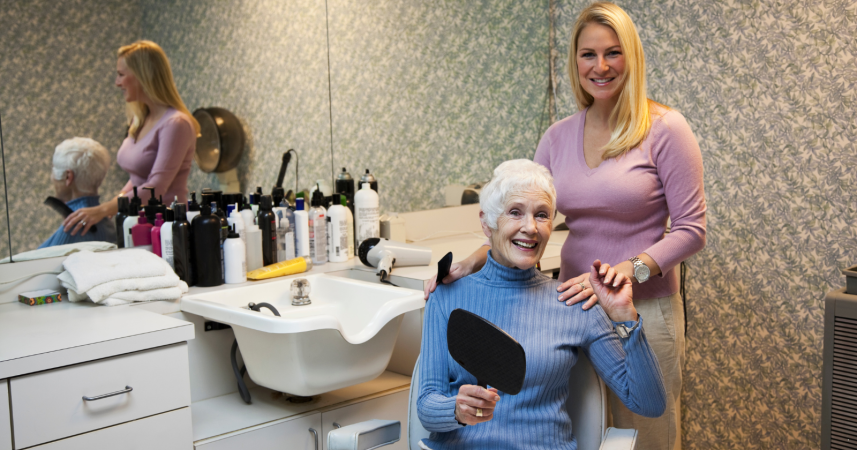
The vinyl chair squeaks slightly as I settle into it, that familiar chemical smell of hair products mixing with the lavender hand lotion she always wears. She drapes the black cape around me with practiced ease, our eyes meeting in the mirror, and then comes the question that somehow breaks me open every single time: "How are you really doing today?" Not the polite version we toss around like loose change. The real question, asked by someone who actually waits for the answer.
I discovered something unexpected at 70. My hairdresser has become my confessor, my therapist, my most trusted confidant. Every six weeks, I tell this woman things I can't seem to say anywhere else. Maybe it's the rhythm of her scissors, or the way she looks at me through the mirror instead of directly, or how her hands keep working while I talk, creating this strange bubble of safety I've never found in more conventional places.
The unexpected intimacy of necessary appointments
There's something about sitting in that chair that strips away pretense. You can't check your phone. You can't busy yourself with tasks. You're literally captive for forty-five minutes, watching your own reflection while someone tends to you with careful attention. After my husband died two years ago, after seven years of watching Parkinson's slowly take him piece by piece, I went through months where I barely left the house. But even then, even when showering felt impossible some days, I kept my hair appointments.
She noticed when I lost weight. She noticed when I stopped coloring my hair because I couldn't bear to sit still that long. She noticed when I started wearing earrings again, six months later, and said quietly, "You're coming back to yourself." How did she know what even I hadn't realized yet?
The truth is, we develop these relationships with the people who touch us regularly, who see us up close in ways our families often don't anymore. My grown children love me, but they see me through the lens of their childhood, through their own needs and histories.
One needs distance to feel like an adult; the other craves closeness but doesn't know how to ask for it. Neither of them really sees me as I am now, this woman figuring out who she is at 70, separate from the roles of wife and mother that defined me for so long.
Why strangers sometimes know us better
Have you ever noticed how much easier it is to tell your story to someone who doesn't know your history? There's no baggage, no expectations, no need to maintain consistency with who you've always been. In that salon chair, I don't have to be strong or wise or together. I can admit that I ate cereal for dinner three nights in a row last week, that I'm terrified of dying alone, that sometimes I talk to my husband's photograph and wait for him to answer.
My hairdresser doesn't judge these confessions. She just keeps cutting, occasionally making that soft "mmm-hmm" sound that means she's listening, really listening. She told me once that she considers these conversations sacred, that what happens in her chair stays there. It's like having a therapist who also makes you look better, which honestly might be the perfect combination.
The widow's support group I joined has become my closest circle of friends, and we share everything from medication side effects to dating horror stories. But even with them, there's a certain performance of recovery we all do, a mutual reassurance that we're moving forward. With my hairdresser, I don't have to be moving anywhere. I can just be exactly where I am.
The gift of being truly seen
"You know what I love about you?" she said last month, pausing with her comb mid-air. "You're not trying to look younger. You're just trying to look like yourself."
That observation hit me harder than any compliment about looking good for my age. Because she was right. Somewhere in the past two years, I'd stopped fighting against aging and started working with it. In a previous post, I wrote about learning to claim my space as an older woman, about refusing to be invisible. But what I'm discovering now is that being visible isn't about being noticed by everyone. It's about being truly seen by a few people who matter.
My hairdresser sees me. Not the English teacher I was for 32 years, not the widow learning to live alone, not the mother trying to navigate adult children with different needs. She sees the woman who sits in her chair every six weeks, who's finally being honest about the terror and beauty of this stage of life.
Creating sacred spaces in ordinary places
What makes a relationship honest? Is it time? History? Blood? Or is it something simpler: the willingness to show up as you really are and have that truth received without judgment?
I think about all the places we're supposed to find connection. Churches, community centers, family dinners. But sometimes the most profound connections happen in the most ordinary spaces. The salon chair. The grocery store checkout line where the same clerk always asks about your week. The coffee shop where the barista knows your order and your name.
These micro-relationships matter more than we acknowledge. They're the scaffolding that holds up our days, especially when the larger structures of our lives shift or crumble. When you're 70 and starting over in ways you never expected, these small, consistent connections become lifelines.
My hairdresser probably doesn't know she's become one of the most important people in my life. How could she? It sounds absurd when I write it down. But every six weeks, she creates a space where I can fall apart if I need to, where I can celebrate small victories, where I can be uncertain and afraid and hopeful all at once. She holds my secrets as gently as she holds my head when she washes my hair, and there's something holy in that ordinary act of care.
Final thoughts
Next week, I'll be back in that vinyl chair, watching her mix the silver and white tones that make my hair look like moonlight instead of surrender. She'll ask me how I'm really doing, and I'll tell her the truth, whatever that happens to be that day. It's become one of the most honest relationships in my life, and perhaps that's exactly what I need right now. Not advice, not fixing, not even understanding. Just someone who asks the real question and waits, scissors poised, for the real answer.