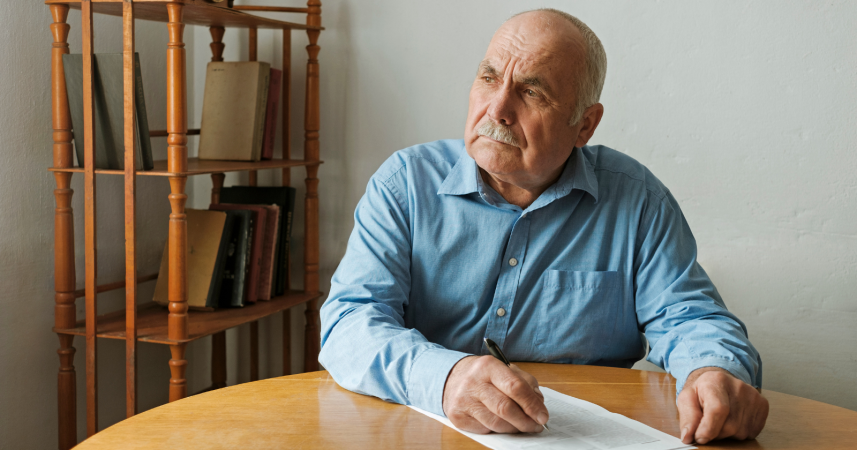
At seventy, I've filled dozens of notebooks with every conversation, recipe, and sunset—not because my memory is failing, but because watching my mother lose hers to Alzheimer's has turned me into someone who documents life so obsessively that I've almost forgotten how to live it.

Add VegOut to your Google News feed. 
The morning light catches the dust motes floating above my writing desk, where three notebooks lie open like patient listeners. The blue one holds grocery lists and doctor's appointments.
The leather-bound journal contains memories I'm racing to capture. The spiral notebook, worn at the edges, is where I write letters to people I haven't lost yet. My handwriting has changed over the years, from the confident loops of my teaching days to something more deliberate now, each word anchored firmly to the page as if I'm afraid it might float away.
I turned seventy last month, and people keep telling me how sharp I am. "You remember everything!" they say, and they're right. For now. But that's exactly why I've become obsessed with writing it all down. Not because I'm forgetful, but because I'm terrified of the day when I might be. And this fear, I've realized, is already changing who I am.
The weight of watching memory disappear
When my mother developed Alzheimer's, I watched her stories evaporate like morning fog. First, she lost the recent things. Then the middle years vanished. Finally, even her childhood in Ohio became fragments.
One afternoon, she looked at me with such clarity and said, "I had a whole life, didn't I? Where did it go?" I held her hand and told her about the garden she kept, the way she sang while cooking, how she taught me to fold fitted sheets properly. But I could see in her eyes that my words were just sounds, not memories.
That experience carved something deep into me. Now, when I forget why I walked into a room or can't recall the name of that actor we both know, a cold finger traces down my spine. Is this how it starts? This perfectly normal, age-appropriate forgetfulness feels like standing at the edge of a cliff I watched my mother fall from.
So I write. Obsessively. Compulsively. I document conversations with my children, describe the way the garden looks in October, record the recipe for that soup everyone loves.
My gratitude journal, which began as a healing practice after my husband passed, has morphed into something else entirely. It's become evidence that I existed, that these days meant something, that I was here and paying attention.
When preparation becomes its own prison
Virginia Woolf once wrote, "The future is dark, which is the best thing the future can be, I think." But what happens when we try to illuminate every corner of that darkness with our careful preparations? What happens when we become so focused on preserving ourselves that we forget to actually live?
Last week, my daughter called to tell me about her promotion. Instead of simply celebrating with her, I found myself reaching for my notebook, jotting down the date, the company name, her new title. She laughed, but not unkindly. "Mom, you don't need to document everything. Just be here with me." But how could I explain that being here feels inextricably linked to being able to prove I was here?
I've started writing birthday letters to my grandchildren that they'll receive when they turn twenty-five. Part of this feels like love, like giving them a piece of me to hold onto. But another part, the part that keeps me up at night, knows I'm writing these because I'm afraid I won't be able to tell them these things myself.
Not because I'll be gone, but because I might be here but not here, present but not present, the way my mother was in those final years.
The paradox of trying to hold on
Do you ever notice how the more tightly you grip something, the more it seems to squeeze out between your fingers? That's what this feels like. In trying to capture every moment, I sometimes miss the moment itself. I'm so busy writing about the dinner party that I forget to taste the food. I'm so focused on describing my granddaughter's laugh that I forget to laugh along with her.
The irony isn't lost on me. In my fear of losing myself to forgetfulness, I'm losing myself to fear. I spend hours organizing photos into albums with detailed captions, creating a museum of my own life while I'm still living it. My friend asked me recently if I was preparing for death, and I had to tell her no, something worse. I'm preparing for the possibility of living without knowing I'm living.
Finding my mother's old recipe box last year should have been purely joyful. Inside were index cards in her careful script, not just ingredients and instructions but little notes. "Add extra vanilla when you're sad," one read. "This is the cake that made your father propose," said another.
These weren't written from fear but from love, a natural desire to pass something forward. There's a difference between leaving breadcrumbs because you want to share the path and leaving them because you're terrified of getting lost.
Finding balance between fear and freedom
A few months ago, I challenged myself to go one entire day without writing anything down. No notes, no journal entries, no lists. Just living. It was harder than quitting coffee. My hands kept reaching for pens that weren't there.
But something interesting happened around dinnertime. Without the buffer of documentation between me and my life, everything felt more immediate, more raw, more real. The sunset wasn't something to describe but something to experience. My neighbor's story wasn't material to record but a moment of connection to savor.
I'm learning, slowly, to distinguish between writing from joy and writing from fear. When I document my garden's progress or capture a family recipe, that feels like creation, like love. When I frantically scribble down every detail of a conversation I'm afraid I'll forget, that feels like something else.
It feels like building a fortress against an enemy that might never come, and even if it does, no amount of notebooks will stop it.
Final thoughts
I still write every day. The notebooks remain open on my desk, ready and waiting. But I'm trying to change my relationship with them. Instead of writing against forgetting, I'm learning to write toward remembering. There's a difference. One comes from fear, the other from gratitude. One tries to stop time, the other celebrates it.
Maybe the real tragedy isn't forgetting our lives but being so afraid of forgetting that we forget to live them. Maybe the answer isn't in the notebooks at all but in trusting that the important things, the essence of who we are, lives in more than just our memories.
It lives in the people we've loved, the kindness we've shown, the moments we were fully present for, even if we can't recall them perfectly later.
The dust motes are still dancing in the morning light. I close the leather journal and pick up my coffee instead. Today, I think, I'll write less and live more. The fear is still there, probably always will be. But I'm learning that courage isn't the absence of fear. It's choosing to dance anyway, even when you're not sure you'll remember the steps.
What’s Your Plant-Powered Archetype?
Ever wonder what your everyday habits say about your deeper purpose—and how they ripple out to impact the planet?
This 90-second quiz reveals the plant-powered role you’re here to play, and the tiny shift that makes it even more powerful.
12 fun questions. Instant results. Surprisingly accurate.