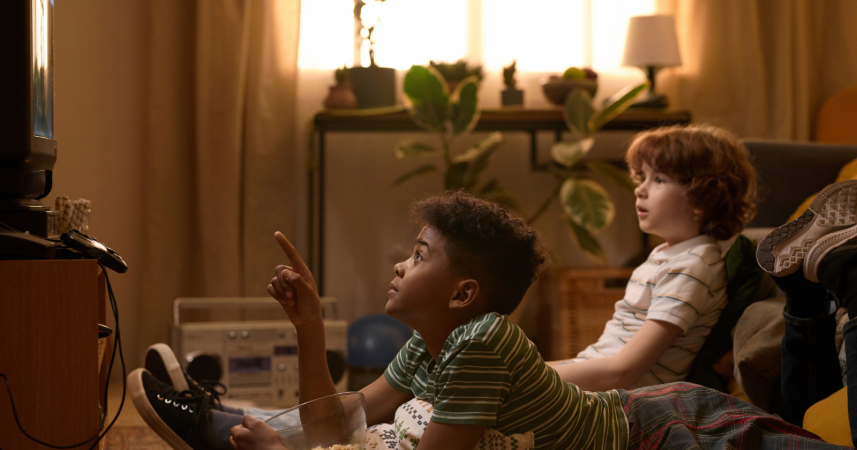
You absorbed lessons without realizing you were being taught, and that foundation still shows up in who you are today.
There was a very specific kind of magic to Saturday mornings growing up.
No school.
No responsibilities.
Just cereal bowls that were probably too big and cartoons that felt like they were made just for us.
Before algorithms decided what we watched and before streaming erased the concept of “waiting,” Saturday mornings were sacred.
You had one shot.
Miss the episode and it was gone.
Looking back now, those cartoons didn’t just entertain us.
They quietly shaped how we think, how we relate to others, and how we see the world.
If these nine cartoons were part of your childhood, chances are you belong to a small, transitional generation.
One that remembers life before constant connectivity, but adapted fast when it arrived.
Let’s talk about them.
1) Teenage Mutant Ninja Turtles
Four mutant turtles.
A rat mentor.
Pizza as a personality trait.
On paper, it’s ridiculous.
Yet somehow, it worked perfectly.
This show taught us teamwork in a way school group projects never did.
Each turtle had a distinct personality, strengths, flaws, and ego.
They clashed constantly, but when it mattered, they showed up for each other.
Looking back, that’s a pretty solid lesson in collaboration.
You don’t need identical values or styles to build something great.
You just need shared purpose and mutual respect.
Also, let’s be honest, this cartoon singlehandedly raised a generation of kids who believe food is more than fuel.
Pizza nights weren’t just meals.
They were rituals.
And if you now appreciate a perfectly blistered crust or balanced toppings, this show might deserve some credit.
2) Pokémon
I still remember rushing home to catch the latest episode, convinced I was somehow falling behind if I missed it.
Pokémon was the first time many of us encountered long-term progression storytelling.
You didn’t just drop in randomly.
You followed journeys.
You watched characters grow, fail, and slowly get better.
Ash didn’t win all the time.
In fact, he lost a lot.
That mattered.
It quietly normalized persistence.
Improvement wasn’t instant.
Mastery took time.
Effort counted.
There’s a reason so many people from this generation are obsessed with self-improvement, leveling up, and tracking progress.
Pokémon wired us to believe growth is incremental, not magical.
3) Rugrats
This one hits differently as an adult.
As kids, we laughed at diaper mishaps and toddler logic.
As grown-ups, Rugrats feels like a masterclass in empathy.
The world was shown entirely through a child’s perspective.
Adult conversations became nonsense.
Ordinary situations felt terrifying or magical depending on context.
That’s a powerful reminder we often forget.
Everyone is interpreting reality through their own lens.
If you’re the kind of person who tries to understand people before judging them, Rugrats probably played a role.
It taught us early that perspective changes everything.
4) X-Men: The Animated Series
This cartoon was way deeper than it had any right to be.
As a kid, you watched for the action and superpowers.
As an adult, you realize it was a metaphor for discrimination, identity, and belonging.
The X-Men weren’t celebrated heroes.
They were feared. Misunderstood. Marginalized.
Watching this week after week subtly trained us to question authority narratives and feel compassion for outsiders.
It nudged us toward inclusivity long before social media turned it into a daily conversation.
If you’re someone who instinctively roots for the underdog or questions “the system,” this show helped plant that seed.
5) Dexter’s Laboratory
 This was pure chaos wrapped in a lab coat.
Dexter’s Laboratory celebrated curiosity, experimentation, and obsession.
Dexter failed constantly.
His inventions backfired.
His plans unraveled.
Yet he kept building.
That’s such a healthy model for creativity and innovation.
Try things. Break them. Learn. Repeat.
For a generation that grew up to tinker with tech, side hustles, startups, and creative projects, this cartoon quietly normalized trial and error.
Also, Dee Dee was a reminder that creativity doesn’t always look serious.
Sometimes chaos is part of the process.
6) Scooby-Doo
Scooby-Doo taught us something incredibly practical.
Most monsters aren’t monsters.
They’re just people in masks.
Every episode reinforced the same idea: fear shrinks when you investigate it.
Curiosity beats panic.
Logic beats superstition.
That mindset sticks.
If you’re the type who prefers understanding problems instead of avoiding them, Scooby-Doo trained that muscle early.
It made skepticism cool and showed that courage often looks like asking questions.
Plus, let’s acknowledge how much food played a role here too.
Scooby Snacks, absurd sandwiches, and the idea that eating together was part of friendship.
That theme pops up more than we realize.
7) Animaniacs
This show trusted kids way more than most adults did.
The humor was layered.
Slapstick for children, satire for parents, and pop culture references that flew over our heads until years later.
Animaniacs taught us that intelligence and silliness aren’t opposites.
You can be playful and sharp at the same time.
For those of us who now enjoy smart humor, clever writing, and cultural commentary, this cartoon set the tone.
It made learning fun and irreverent instead of stiff.
It also encouraged curiosity.
If you didn’t get a joke, you looked it up later.
That instinct to explore references didn’t start on Google.
It started here.
8) Power Rangers
Every episode followed the same formula.
And we loved it.
There’s something comforting about structure.
Team formation. Training. Rising stakes.
Victory earned, not handed out.
Power Rangers reinforced discipline and consistency.
Show up. Work together. Respect the hierarchy.
It wasn’t subtle, but it was effective.
If you’re someone who thrives on routines, group workouts, or structured environments, this show likely resonated more than you realized.
Also, it normalized the idea that strength comes in many forms.
Different colors. Different styles. Same mission.
That’s a lesson adulthood keeps reinforcing.
9) Batman: The Animated Series
Finally, this is where things got serious.
Batman wasn’t flashy.
He wasn’t invincible.
He was strategic, disciplined, and deeply flawed.
This show explored moral ambiguity in a way most kids’ programming avoided.
Villains weren’t just evil.
They were broken. Motivated. Complex.
It forced us to sit with uncomfortable questions.
Can justice exist without compassion?
What does responsibility really mean?
How much of our past defines us?
For a generation that grew into nuance, gray areas, and critical thinking, Batman played a big role.
It respected our intelligence before we knew we had it.
The bottom line
If you grew up with these cartoons, you experienced a very specific cultural moment.
You learned patience because episodes aired once a week.
You valued community because watching was shared.
You absorbed lessons without realizing you were being taught.
That generation sits in an interesting place now.
Old enough to remember life without screens everywhere.
Young enough to adapt quickly when they arrived.
Those Saturday mornings weren’t just entertainment.
They were early training grounds for curiosity, empathy, resilience, and creativity.
And honestly, that’s not a bad foundation to build a life on.
If you ever find yourself nostalgic for simpler times, maybe it’s not about the cartoons themselves.
Maybe it’s about remembering who you were becoming while watching them.
And that version of you still has a lot to offer.
What’s Your Plant-Powered Archetype?
Ever wonder what your everyday habits say about your deeper purpose—and how they ripple out to impact the planet?
This 90-second quiz reveals the plant-powered role you’re here to play, and the tiny shift that makes it even more powerful.
12 fun questions. Instant results. Surprisingly accurate.