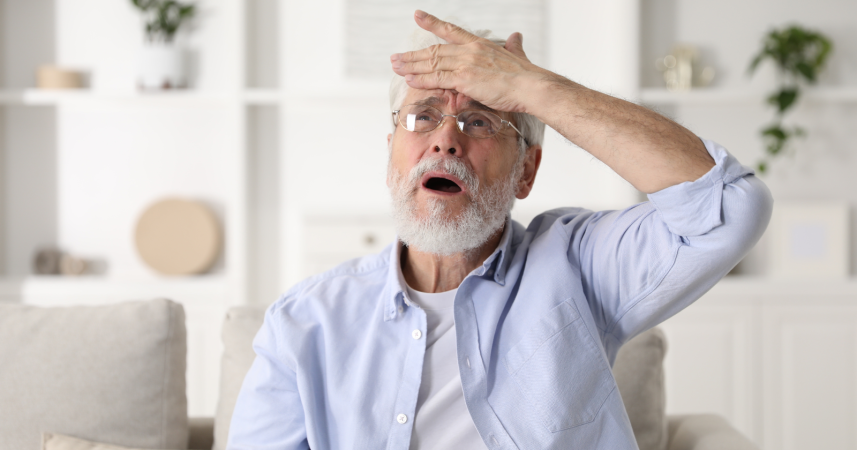
The day I couldn't remember the word "spoon" while holding one was the day I realized that losing your memory doesn't just mean forgetting things—it means watching the person you've always believed yourself to be slowly dissolve.

Add VegOut to your Google News feed. 
Last week, I stood in my kitchen holding the thing you eat soup with, completely unable to summon the word "spoon."
It sat there in my hand, silver and familiar, while my brain fumbled around like someone searching for keys in an overstuffed purse. The word finally came, of course, but not before I'd already started eating my soup with what my mind had decided to call "the round scoopy thing."
This would have been funny if it weren't so terrifying. For someone who spent 32 years teaching high school English, who could once quote entire passages of Shakespeare from memory and never forgot a student's name even years after graduation, these moments feel like watching pieces of myself disappear into fog.
The person I used to be lived in my memory
When I won Teacher of the Year for the second time, the principal called me "a walking encyclopedia of literature."
I wore that description like a badge of honor. My brain was my superpower. I could pull references from obscure poets during class discussions, remember which student had struggled with the same concept three years prior, and juggle lesson plans for five different classes without writing anything down.
But here's what I'm learning: so much of who we think we are lives in our ability to remember who we've been. Our identity isn't just our values or our relationships or our accomplishments. It's the continuous thread of memory that connects all our yesterdays to our today. When that thread starts to fray, you don't just lose facts or words. You lose pieces of the story you've been telling yourself about who you are.
My mother had Alzheimer's, and I watched her forget first the small things, then the big ones, then finally, devastatingly, us. I remember thinking I understood what was happening to her. But I understood it the way you understand a country you've only seen in photographs.
Now, experiencing my own memory slips, I realize I knew nothing about the actual terrain of forgetting, about how it feels from the inside when your most trusted tool starts to betray you.
The cruel mathematics of cognitive decline
Nobody prepares you for the mathematics of this. How you start doing constant calculations: Was that pause in conversation normal or concerning? Did everyone forget that actor's name, or just me? How many times this week have I walked into a room and forgotten why? You become a detective investigating your own mind, looking for patterns, for reassurance, for signs that this is just normal aging and not the beginning of something worse.
What makes it harder is that intelligence has always been currency in my world. In academia, in teaching, even in retirement when I started writing personal essays at 66, being sharp was how I contributed, how I connected, how I proved my worth.
When a friend suggested I share my stories through writing, she said it was because I had "such a gift for remembering details that bring stories to life." Now I sometimes can't remember if I've already told someone a story, so I either repeat myself or stay quiet, neither option feeling quite like me.
Have you noticed how we talk about memory loss in military terms? We "battle" forgetfulness. We "fight" cognitive decline. We "defend" against dementia. As if forgetting were an enemy that could be defeated with enough willpower or sudoku puzzles.
But what if it's not a war? What if it's just change, unwelcome but inevitable, like arthritis settling into my hands, forcing me to hold my pen differently, to type more slowly, to adapt?
Learning to be human without being brilliant
Virginia Woolf once wrote, "The mind is a strange machine which can combine the materials offered to it in the most astonishing ways." But what happens when the machine starts skipping gears? When the materials get filed in the wrong places or disappear entirely?
I'm learning that there's a different kind of intelligence that has nothing to do with memory or quick recall. My teenagers taught me this, actually, though I'm only understanding it now.
The kids who struggled with reading but could fix any broken thing, who couldn't memorize dates but understood people in ways that made them natural healers and helpers. They knew something I'm just learning: being valuable isn't about being the smartest person in the room.
Last month, I couldn't remember the name of a former colleague I'd worked with for twenty years. But I remembered exactly how she took her coffee, that she was afraid of bridges, and that she cried when her son joined the military.
I might lose words, but I still remember feelings. I might forget plots of novels, but I remember how they made me feel. Maybe memory isn't just about information storage. Maybe it's also about the emotional imprint of a life lived with attention.
Who we are beyond our memories
If my identity lives partly in my memory, what happens to that identity as memory fades? This question keeps me up at night.
But morning always brings a different perspective. I watch the sun rise over my garden, and I realize I don't need to remember the Latin names of my plants to love them. I don't need to recall every student's essay to know that I made a difference. I don't need perfect recall to be a good friend, a loving family member, a person of value.
Sometimes I think about my mother in her final years, how she couldn't remember my name but still lit up when I walked in the room. Her memory was gone, but something essential remained: her capacity for joy, her gentleness, the way she hummed when she was content.
Maybe that's what we are at our core, underneath all the memories and knowledge and sharp wit. Maybe we're just the love we've given and received, the moments of kindness, the ability to find beauty in small things.
Final thoughts
I still mourn the sharpness I've lost. Some days, I rage against the fog that creeps into my mind. But I'm also discovering that there's a strange freedom in not being the smartest person in the room anymore. I listen more. I ask for help. I admit when I don't know something. I've stopped trying to prove my worth through my intelligence and started simply trying to be present, to be kind, to be real.
The word for "fork" will probably escape me again. Names will slip away. Stories will get jumbled. But I'm still here, still learning, still becoming. And maybe that's enough. Maybe that's more than enough.
If You Were a Healing Herb, Which Would You Be?
Each herb holds a unique kind of magic — soothing, awakening, grounding, or clarifying.
This 9-question quiz reveals the healing plant that mirrors your energy right now and what it says about your natural rhythm.
✨ Instant results. Deeply insightful.

Marlene Martin
Marlene is a retired high school English teacher and longtime writer who draws on decades of lived experience to explore personal development, relationships, resilience, and finding purpose in life’s second act. When she’s not at her laptop, she’s usually in the garden at dawn, baking Sunday bread, taking watercolor classes, playing piano, or volunteering at a local women’s shelter teaching life skills.
More Articles by Marlene