For six months after my husband died, I found myself standing in aisle seven clutching paintbrushes I'd never use, waiting for the one question that kept me tethered to the world of the living.

Add VegOut to your Google News feed. 
Three months after Tom died, I started buying things I didn't need.
Paint brushes I'd never use. Boxes of screws for projects I'd never start. Sandpaper in every possible grit. The hardware store became my second home, and I told myself I was keeping busy, staying productive, moving forward.
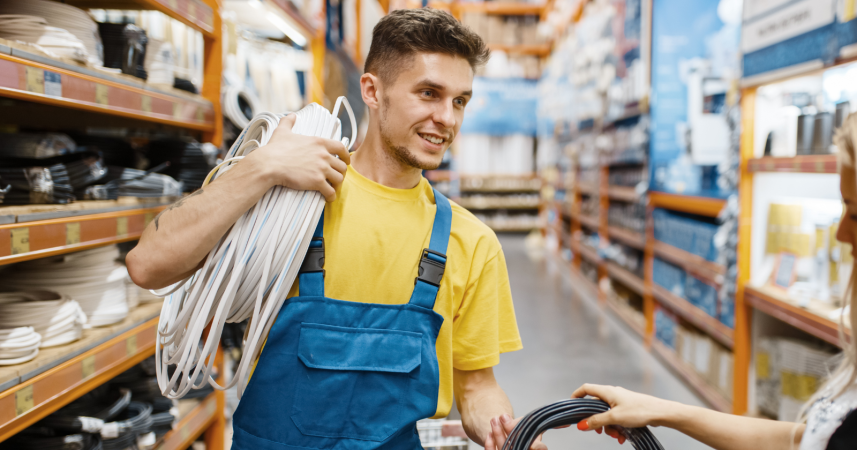
But the truth was simpler and harder to admit: I went there because Randy in aisle seven always stopped what he was doing when he saw me coming, looked me right in the eyes, and asked, "How are you doing today?" Not the automatic, throwaway version we all exchange at checkout counters.
The real question. The one that waits for an answer.
The weight of genuine connection
Have you ever noticed how rare it is for someone to truly ask how you are? We live in a world of surface interactions, quick texts, and emoji reactions. We mistake being busy for being connected.
After losing my husband to Parkinson's, I discovered that loneliness isn't just about being alone. It's about feeling unseen, like you're walking through life as a ghost that everyone passes right through.
Randy didn't know my story. He didn't know about the seven years I'd spent watching the man I loved disappear piece by piece. He didn't know about the empty bed that still felt wrong after months of sleeping alone. He just saw a woman who kept coming back to look at drill bits and doorknobs, and something in him recognized what I needed before I did.
The first time he asked, I almost cried right there between the lumber and the light fixtures. "I'm managing," I said, which was code for barely holding it together. He nodded, not pushing, not prying, just present. "Well, you let me know if you need help finding anything," he said. "Or if you just need to talk about hinges for a while. I'm pretty good at that too."
When strangers become lifelines
During those six months when I could barely leave the house, the world shrank to the size of my living room. Friends called less frequently, uncomfortable with grief that didn't follow a neat timeline. Family members urged me to "get back out there" as if loss was something you could outrun. But grief doesn't work that way. It needs witnesses, not coaches.
Virginia Woolf once wrote, "The eyes of others our prisons; their thoughts our cages." But sometimes, the eyes of others are our liberation. They see us when we've become invisible to ourselves. Randy's simple acknowledgment of my presence, his consistent kindness, became a bridge back to the world of the living.
I started timing my visits for Tuesday and Thursday mornings, and Saturday afternoons. The store was quieter then, and Randy always had time to chat about weather stripping or debate the merits of different wood stains.
We never talked about anything profound. He told me about his grandson's Little League games. I mentioned the tomatoes I was trying to grow. Surface conversations that somehow went deep because they were grounded in genuine care.
The unexpected teachers of connection
What makes someone safe to be vulnerable with? Is it their credentials, their relationship to us, their shared experiences? In my widow's support group, we often talk about the unexpected people who show up in our grief.
The barista who remembers your order and notices when you've been crying. The mail carrier who checks if you're okay when packages pile up. The hardware store employee who treats your third unnecessary visit this week with the same patience as the first.
These people taught me that connection doesn't require deep knowledge of someone's history. It requires presence, consistency, and the willingness to see another human being as worthy of attention and care. Randy never asked why I kept coming back. He never suggested I might have enough paintbrushes by now.
He just kept showing up in aisle seven, ready with his gentle "How are you doing today?"
Finding purpose in small rituals
Those hardware store visits became my anchor points, giving structure to formless days. Monday, Wednesday, Friday were for grief. Tuesday, Thursday, Saturday were for Randy and the ritual of being seen. I'd shower, put on real clothes instead of the bathrobe I'd been living in, and drive the twelve minutes to the store.
Sometimes I think about all the money I spent on supplies for phantom projects. The garage filled with items still in their packaging. But what I was really buying wasn't tools or materials. I was purchasing moments of human connection, three times a week, at $15 or $20 a pop. Cheaper than therapy and, in those raw months, just as vital.
Do you have places like this? Spaces where you're recognized, where your presence matters to someone, even if that someone is technically a stranger? We underestimate these thin connections, these gossamer threads that hold us to the world when the thick ropes have snapped.
The courage to receive kindness
Accepting kindness from strangers requires a particular type of courage. It means admitting we need something we can't provide for ourselves. It means being vulnerable with people who owe us nothing. After 32 years of being the teacher, the helper, the one with answers, I had to learn to be the one who needed.
Randy probably had no idea he was saving my life in small increments.
Three conversations a week, five minutes each. Fifteen minutes total. That's all it took to keep me tethered to the world while I figured out how to rebuild a life that made sense without Tom in it. Fifteen minutes to remember that I still existed, still mattered to someone, even if that someone was just doing his job with unusual grace.
Final thoughts
I still shop at that hardware store, though less frequently now. Life has expanded again, filled with new routines and connections. Randy still works aisle seven, and he still asks how I'm doing, though now I can answer honestly that I'm good. Really good. We've never had coffee or exchanged phone numbers.
We might not recognize each other out of context. But for a season when I desperately needed it, he was my proof that kindness exists, that strangers can be angels, and that sometimes the most profound connections happen in the most ordinary places.
If you're lucky enough to be someone's Randy, you might never know it. But if you're someone who needs a Randy, I hope you find the courage to drive to your version of the hardware store, even when you don't need anything except to be asked how you're doing by someone who actually wants to know.
What’s Your Plant-Powered Archetype?
Ever wonder what your everyday habits say about your deeper purpose—and how they ripple out to impact the planet?
This 90-second quiz reveals the plant-powered role you’re here to play, and the tiny shift that makes it even more powerful.
12 fun questions. Instant results. Surprisingly accurate.