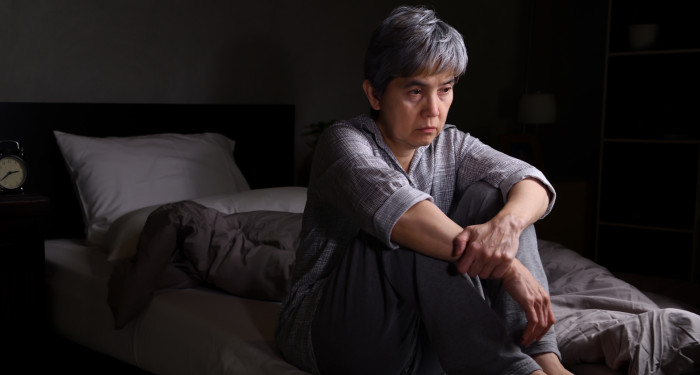
After decades of smoothing over awkward moments and managing everyone else's emotions, something profound happens when you realize you have more years behind you than ahead — you finally stop pretending that poor treatment is acceptable.

Add VegOut to your Google News feed. 
Last week at the grocery store, I watched a woman in her seventies hand back a bruised apple to the produce clerk and ask for a different one.
The young man rolled his eyes, muttered something under his breath, and reluctantly went to fetch another. Twenty years ago, I would have judged that woman as demanding. Now? I see someone who has finally stopped accepting less than what she deserves.
We have this peculiar notion that growing older means becoming sweeter, more accommodating, more willing to go along to get along. But what if the opposite is true? What if those "difficult" older people aren't losing their social graces at all, but rather gaining the courage to stop pretending that poor treatment is acceptable?
I spent decades teaching high school English, and one thing those teenagers taught me was the power of calling things what they are. They had no patience for pretense.
Meanwhile, I was spending my adult life smoothing over awkward moments, accepting backhanded compliments with a smile, and saying "it's fine" when it absolutely wasn't. The irony wasn't lost on me that I was teaching Shakespeare's truth-tellers while living as a people-pleaser myself.
The exhaustion of endless accommodation
Have you ever calculated how much energy you spend managing other people's feelings? I'm talking about the mental gymnastics we perform daily: laughing at jokes that aren't funny, pretending not to notice when someone interrupts us for the third time, or expressing gratitude for "favors" that actually create more work for us.
For most of my life, I was an expert at this emotional labor.
When someone gave me a gift that was clearly regifted or chosen without thought, I would gush with appreciation. When relatives made cutting remarks disguised as concern, I would thank them for their input. The performance was exhausting, but I told myself this was what gracious people did.
Then came therapy in my fifties, prompted by a particularly brutal year of trying to please everyone while feeling increasingly invisible.
My therapist asked me a simple question that changed everything: "What would happen if you just stopped?" Not stopped being kind, not stopped caring about others, but stopped absorbing everyone else's discomfort as my responsibility.
The answer terrified me. People might think I was rude. They might call me difficult. They might not like me anymore. But then she asked the follow-up question that really got me: "And how is being liked by everyone working out for you so far?"
When boundaries become "difficult behavior"
There's a fascinating double standard in how we judge assertiveness across age groups. When a thirty-five-year-old professional refuses to work unpaid overtime, we call it setting healthy boundaries. When a seventy-year-old woman refuses to babysit her grandchildren every weekend, suddenly she's being selfish.
I think about this often when I hear younger family members complain about their "stubborn" elderly parents.
The parent who won't move to a different city to be closer to adult children, the grandmother who won't give up her Thursday book club to provide free childcare, the uncle who stops attending events where he's consistently treated as a punchline. Are these people being difficult, or are they simply done sacrificing their comfort for others' convenience?
Virginia Woolf once wrote about the tyranny of the teacup, how women were expected to pour tea and make pleasant conversation while the men discussed important matters. How many of us are still pouring that metaphorical tea decades after Woolf pointed out its absurdity? And more importantly, why do we act surprised when women of a certain age finally put down the teapot?
The gift of running out of time
Something shifts when you realize you have more years behind you than ahead. It's not morbid; it's clarifying.
Suddenly, spending an entire dinner party listening to someone's conspiracy theories while nodding politely seems like a waste of precious time. Pretending to enjoy visits from people who only contact you when they need something feels absurd.
I remember having to fail a student I genuinely liked during my teaching years. She was bright, funny, and tried hard, but she simply hadn't done the work. The old me would have found a way to pass her, to avoid the discomfort of her disappointment and her parents' anger.
But I realized that my discomfort wasn't more important than her education. That experience taught me that kindness and standards aren't opposites; sometimes the kindest thing is to be honest.
This same principle applies to aging. When older people stop accepting subpar treatment, they're not being cruel. They're recognizing that their time and energy are finite resources that deserve respect. They're modeling what it looks like to value yourself without apology.
Refusing to perform gratitude
Perhaps the most radical shift I've noticed in myself and my peers is the refusal to perform gratitude for things that don't merit it. This doesn't mean becoming ungrateful; it means being honest about what actually deserves thanks.
When someone does you a "favor" that you didn't ask for and then expects effusive gratitude, that's manipulation, not kindness. When family members make minimal effort but expect maximum appreciation, that's entitlement. Yet for years, many of us performed elaborate gratitude rituals for these hollow gestures, afraid that honesty would make us seem harsh.
I think about my son's wedding years ago. I had reservations about his choice of partner, serious ones. The old me might have hinted, might have tried to manage the situation indirectly.
Instead, I bit my tongue completely, recognizing that this wasn't my discomfort to manage or my choice to make. Interestingly, that marriage proved me entirely wrong, and my daughter-in-law has become one of my dearest friends.
But here's the thing: I didn't pretend to be thrilled at the time. I was honest about needing time to get to know her, and that honesty built a foundation for real relationship, not a performed one.
Final thoughts
If you're reading this and recognizing yourself in either role, the "difficult" older person or the frustrated younger one, I want to offer this: authenticity is not a character flaw.
The people who become more themselves as they age, who stop managing everyone else's emotions at their own expense, aren't broken. They're free.
The next time you encounter an older person who seems "difficult," ask yourself what they might be refusing to absorb. What performance are they declining to give? What treatment are they no longer willing to normalize? You might find that their difficulty is actually dignity, finally claimed after decades of giving it away.