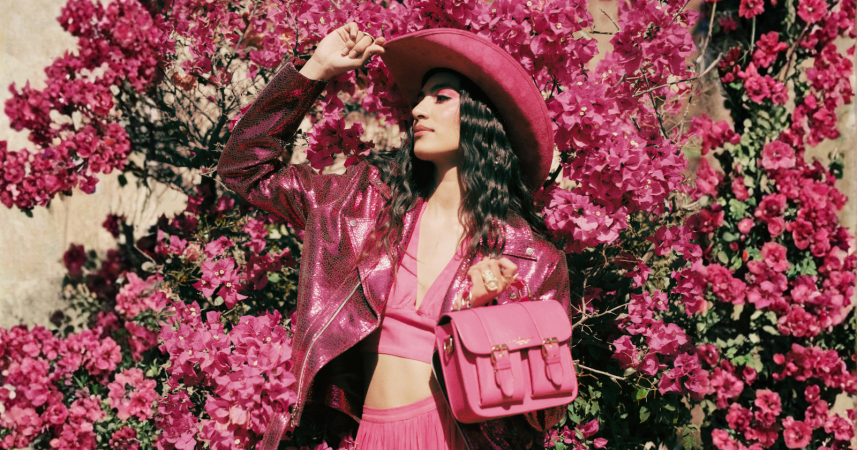
Blend your clothes with intention and let them do the talking, but make sure they do not talk over you.
Crafting a personal style is less about price tags and more about what you want people to read about you at a glance.
Some choices whisper, while others shout.
Today I am looking at seven choices that tend to make the old-guard of quiet wealth wince, yet they remain wildly popular with those of us raised on mall culture, TikTok, and the dopamine hit of something new.
Let’s not waste any time and get into it:
1) Big logos
You know the look: Monogram tee, belt buckle you can see from a city block away, and a handbag plastered with a designer’s initials.
People who grew up around quiet wealth usually avoid this. They prefer stealth labels or no labels at all.
In psychology terms, it is the difference between overt signaling and costly signaling.
One yells, the other implies.
The old money instinct says true quality does not need a name tag to be believed.
Why do big logos stay beloved? Visibility; when you finally get access to things you once only saw in shop windows or on celebrities, you want your wins recognized.
A logo gives fast proof, and it tells your peers what tribe you belong to and what class corridor you are trying to walk down.
There is also novelty dopamine.
New plus noticeable feels exciting and, if you worked hard to afford it, it makes sense to want credit.
Just know that logos can become the star of the outfit rather than you.
If your goal is timeless ease, swap the billboard branding for great fabric, quiet stitching, and a tailor who knows your shoulders better than you do.
2) Hype sneakers
Limited drops, resale pages, and a shoe box treated like a safe deposit box.
The old money crowd often sticks with heritage loafers, simple trainers, or leather boots that outlive a decade.
They like patina, they like repairs, and they like not caring if grass stains happen at a garden party.
The middle loves the game.
Hype sneakers come with story, scarcity, and community.
They are NFTs you can actually wear.
When I was in Tokyo a few years back, I joined a small line outside a boutique and ended up trading playlists and photography tips with a kid who knew more about midsole foam densities than most shoe engineers.
That is part of the magic: You are buying belonging.
From a behavioral angle, the scarcity effect magnifies perceived value.
The harder the chase, the sweeter the win.
If you enjoy the chase, own that; if you want your style to feel calmer, let a single hype piece anchor an otherwise quiet outfit.
Think Oxford shirt, clean trousers, and the wild sneaker doing all the talking.
3) Flashy belts
The oversized buckle is a billboard positioned at the center of your body.
Old money tends to treat belts like plumbing.
The best kind works and disappears; they lean toward slim leather, subtle hardware, and a finish that ages gracefully.
The belt-as-centerpiece is popular because it compresses a luxury signal into a single item.
It is like putting a signature on your waist.
Anchoring theory shows how one striking element can frame how people read everything else.
A big buckle anchors attention and suggests the rest must be just as premium.
I tested this in a very non-scientific way: One weekend I wore the same black jeans and white tee with two different belts.
With the loud buckle, strangers commented on the brand; with the quiet belt, people asked what cologne I was wearing and where I got the tee.
Same outfit, different anchor.
If you want people to notice your overall vibe instead of a logo, keep the belt minimal and sharpen the fit.
4) Head-to-toe matching

Matchy-matchy tracksuits, monochrome sets, and coordinated couples outfits that look great in the grid.
Old money favors mixing textures and tones, letting clothes look collected over time rather than purchased in one sweep.
There is an appetite for imperfection there.
A frayed cuff on a well-loved oxford, or a sweater that looks like it has been on three family trips.
The appeal of perfect matching is control.
It is tidy, it photographs clean, and there is less risk of clashing.
For anyone balancing work, kids, and real-life mess, a matching set is a stress reliever.
The fluency effect in psychology says our brains prefer things that are easy to process.
Matching equals easy; easy often reads as stylish to the modern eye.
The tradeoff is depth as too much coordination can flatten your look.
Add one element with history to bring dimension.
Maybe it is a vintage watch from your grandparent, a canvas tote with years of beach sand in the seams, or a pair of beat-up vegan suede sneakers.
The slight mismatch gives your outfit a story.
5) Maximal accessories
Stacked bracelets, layered chains, double watches, sunglasses plus hat plus scarf plus logo cap all together.
The old money instinct is edit.
As Coco Chanel put it, “Before you leave the house, look in the mirror and take one thing off.”
Whether or not you love Chanel, the reduction rule still works.
Maximal accessories are popular because they let you craft identity in modular form.
You can remix daily, and you can tell a mood without buying a new wardrobe.
It is also a way to add perceived value without crossing the price threshold of a tailored coat.
The psychology here is the assortment illusion: The more variety on display, the richer the picture feels.
However, attention is a limited resource.
Pile on too much and you dilute the power of any single piece.
I’ve mentioned this before but a simple litmus test helps: Pick your hero.
If your glasses are bold, go easy on the chain; if your ring is a statement, make your watch a whisper.
6) Trend hauls
The haul video is a modern rite of passage: Bags on the bed, tags flashing, and a quick parade of pieces that will probably live short lives.
The old money taste skews toward a lean closet with seasonal rotations.
Rewearing is the point, repairing is a hobby, and tailors are on speed dial.
Hauls are adored because they scratch three itches at once: Novelty, status, and content.
When you grew up without endless outfit choices, that first big box from a fast-fashion site hits like a festival.
If your social world lives on camera, new outfits are fuel for the feed.
Behaviorally, it is the variable reward loop.
New arrivals, uncertain fit, possible compliments, the occasional perfect piece that justifies the spree.
The loop keeps spinning as the cost is in cohesion and, honestly, in the planet.
I love clothes, but I also love breathing clean air and eating food that does not require a chemistry degree to pronounce.
As a vegan, the ethics of consumption sit front row for me.
That does not mean you cannot play with trends.
It means build a trend budget the way you build a grocery budget.
One or two experiments each season, chosen on purpose, paired with a rule: If it does not work with at least three things I already own, it is a pass.
7) Athleisure everywhere
Leggings to brunch, hoodies to dinner, and running shoes with suits? The old money crowd will wear sweats, sure, but usually only behind hedges.
In public, they default to structured pants, collared shirts, and shoes with soles that see cobblers.
Why is athleisure adored in the middle? Comfort.
We like to be seen as people on the move, disciplined, always optimizing.
Athleisure broadcasts health and hustle even when we are just grabbing almond milk.
There is also a materials story: Technical fabrics genuinely perform as they can stretch, breathe, and survive spills.
However, performance can cheapen an outfit when the context asks for ceremony.
The trick is to hybridize:
- Trade the gym hoodie for a knit zip that reads sweater, not bench press.
- Swap the running shoes for minimal trainers.
- Choose joggers with a front crease and a hem that respects your ankle bones.
Same comfort, better code-switching; if you want the old school seal of approval without losing ease, tailor your athleisure.
Tailors are not just for suits.
They can taper tech pants, shorten hoodie sleeves, and rescue a saggy collar.
A few patterns emerging
You do not need to belong to a country club to understand why the quieter side of style endures, or abandon the joy of street culture, tech fabrics, and the thrill of a clean pair of kicks.
Blend them with intention and let your clothes do some talking, but make sure they do not talk over you.
That is it from me today! Try one edit this week and see how it changes how you feel when you walk into a room.
Your mirror will tell you the truth, while your calendar and your values will tell you the rest.