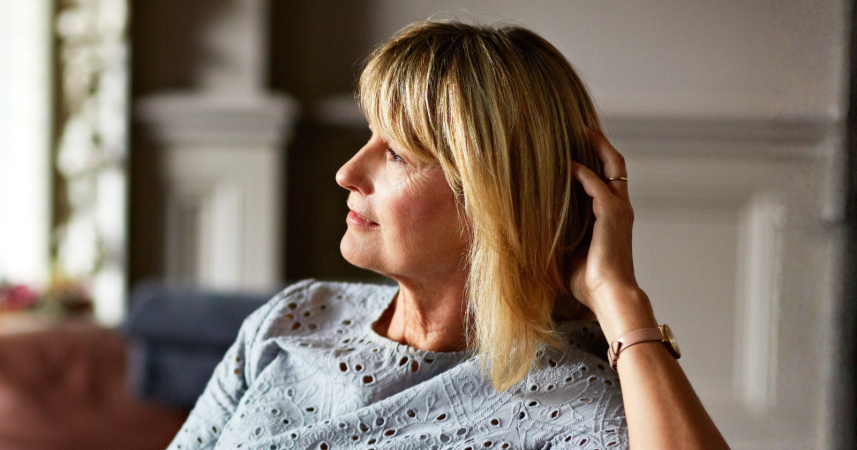
As you age, you might notice yourself declining party invitations with relief rather than guilt, craving meaningful conversations over cocktail chatter, and discovering that a quiet morning with tea brings more joy than a packed social calendar. Science says this shift toward introversion is actually a sign of emotional maturity.

Add VegOut to your Google News feed. 
Last week, I turned down an invitation to a colleague's retirement party, and instead of feeling guilty about it, I felt relieved.
Twenty years ago, I would have been there with bells on, staying until the very end, helping clean up, and probably organizing the group gift.
But something has shifted in me over the years, and I've noticed I'm not alone in this change.
If you've found yourself craving more solitude lately, preferring deep conversations over cocktail party chatter, or feeling perfectly content with a smaller social circle, you might be experiencing what many of us discover as we age: a natural drift toward introversion.
Before you start worrying that you're becoming antisocial or isolated, let me reassure you that this shift is not only normal but can actually be a sign of emotional maturity and self-awareness.
1) You've started saying no to social events without guilt
Remember when FOMO ruled your calendar?
These days, you might find yourself experiencing something closer to JOMO, or the joy of missing out.
Where once you would have agonized over declining an invitation, worried about what people would think or what you might miss, now you simply check in with yourself and ask, "Do I actually want to go to this?"
This is about recognizing that your energy is a finite resource, and you've earned the right to spend it wisely.
When I do attend social events now, I arrive fully present rather than exhausted from overcommitting myself.
The quality of my interactions has improved dramatically because I'm choosing to be there rather than feeling obligated.
2) Small talk feels increasingly draining
Have you noticed how conversations about the weather or what you watched on TV last night leave you feeling empty?
As we age, many of us develop what I call a "substance craving" in our interactions.
We want to discuss ideas, share experiences that matter, explore the questions that keep us up at night.
At my weekly supper club with five women friends, we've unconsciously created a no small talk zone.
We dive straight into the meaty stuff: how we're navigating aging parents, what we're learning about ourselves, the books that are changing our perspectives.
These conversations energize rather than drain me, and I've come to realize that's because they honor the depth we've earned through our years of living.
3) Your ideal weekend involves more solitude than socializing
Virginia Woolf wrote about the necessity of "a room of one's own," and as I've aged, I've come to understand this need viscerally.
My mornings have become sacred.
I wake at 5:30 AM naturally now, and that first hour with my tea and journal feels like coming home to myself.
No voices, no demands, just the gentle unfolding of my own thoughts.
This is solitude, and there's a world of difference between the two.
Loneliness is the absence of connection when we crave it, while solitude is the presence of our own company when we choose it.
The ability to enjoy your own company is actually a sign of psychological health and self-sufficiency.
4) You prefer deeper connections with fewer people
Do you find your social circle shrinking but your friendships deepening?
This is perhaps one of the most beautiful aspects of becoming more introverted with age.
We stop collecting friends like trading cards and start cultivating relationships like a garden, understanding that meaningful connections require tending, attention, and care.
I've discovered that maintaining five or six deep friendships is far more fulfilling than juggling dozens of surface-level acquaintances.
These are the people who know your whole story, who you can call at 2 AM, who will sit with you in silence when words aren't enough.
Quality over quantity is a wisdom that comes with understanding what truly nourishes us.
5) Crowds and busy environments feel overwhelming
You might find yourself seeking out the quiet coffee shop, the early morning grocery run, or the matinee movie showing.
This is about recognizing what environments allow you to feel most like yourself.
Our nervous systems actually become more sensitive to stimulation as we age, making us naturally more attuned to environmental overwhelm.
Choosing calmer environments is knowing yourself well enough to create conditions where you can thrive rather than just survive.
6) You need more recovery time after social interactions
After hosting Thanksgiving dinner or attending a wedding, do you find yourself needing a full day or two to recharge?
This increased need for recovery time is a clear sign of introversion, and it's perfectly healthy.
Think of it like exercise: As we age, we might need more recovery time between workouts, and that means we're listening to our bodies.
I've learned to build this recovery time into my schedule proactively.
After my volunteer shift at the women's shelter, where I teach interview skills and pour myself into helping others, I always schedule a quiet evening at home.
This is self-preservation that allows me to show up fully when I do engage with the world.
7) You've stopped apologizing for who you are
Perhaps the most telling sign of all is this: You've stopped feeling like you need to explain or justify your need for quiet time, your preference for staying in, or your selective social calendar.
This self-acceptance is the gift of aging, the understanding that you don't need to be everything to everyone, and that honoring your own nature is essential.
Being single at social events used to make me feel like I needed to work harder to fit in, to be more outgoing to compensate for arriving alone.
Now? I arrive as myself, engage as feels natural, and leave when I'm ready.
The freedom in this self-acceptance is extraordinary.
Final thoughts
Becoming more introverted as we age is a refinement of it.
It's the confidence to know what feeds your soul and the courage to choose it, even when it goes against social expectations.
This shift toward introversion is often our psyche's way of telling us we've earned the right to be selective, to choose depth over breadth, quality over quantity.
So, if you recognize yourself in these signs, celebrate them.
You're becoming more authentically yourself.
What’s Your Plant-Powered Archetype?
Ever wonder what your everyday habits say about your deeper purpose—and how they ripple out to impact the planet?
This 90-second quiz reveals the plant-powered role you’re here to play, and the tiny shift that makes it even more powerful.
12 fun questions. Instant results. Surprisingly accurate.