Talking to your pets like people isn't just cute, it's quietly training you to be more honest and emotionally available in your human relationships too
I'll admit something that might sound ridiculous. Yesterday morning, while making my oat milk latte, I caught myself explaining to my neighbor's cat why I was running late. Not in that quick, throwaway "hey buddy" kind of way. I mean a full, detailed account of how my alarm didn't go off, how I'd stayed up too late reading about cognitive biases, and how the whole morning had spiraled from there.
The cat blinked at me. Slowly. Twice.
And somehow, that felt like enough.
If you've ever narrated your grocery list to a dog or debriefed your workday to a parrot, you already know what I'm talking about. There's something about talking to an animal that feels different from talking to a person. Safer, maybe. Less performative. And as it turns out, that feeling isn't just in your head. Research suggests that people who regularly talk to their pets like they're human tend to develop communication habits that actually make them better at connecting with other humans too.
Here's why that matters more than you think.
The real reason you talk to your cat like a roommate
Psychologists have a word for what we do when we chat with our pets as though they understand every syllable. It's called anthropomorphism, and it's the tendency to attribute human characteristics, emotions, and mental states to non-human entities. Your dog isn't actually judging your outfit. Your cat doesn't really have opinions about your ex. But your brain treats them as if they do.
Nicholas Epley, a behavioral scientist at the University of Chicago and one of the leading researchers on anthropomorphism, has argued that this tendency isn't a sign of immaturity or delusion. It's actually a byproduct of the same cognitive machinery that makes us good at reading other people. The same mental tools we use to infer what a friend is thinking or what a colleague really meant by that email are the tools we activate when we imagine our dog is sulking because we left for work.
In other words, talking to your pet isn't a weird quirk. It's your social brain doing reps.
A rehearsal space with no stakes
Here's what I find most interesting about this whole thing, and I've mentioned this before but it keeps proving true: the environments where we practice being honest matter just as much as the honesty itself.
Think about the last time you wanted to say something vulnerable to someone you care about. Maybe you needed to admit you were struggling, or that something they did hurt you, or that you didn't have it all figured out. Chances are, you rehearsed it. In the shower. In the car. In your head while pretending to listen to a podcast.
Talking to a pet is a version of that rehearsal, except it happens out loud. And out loud matters.
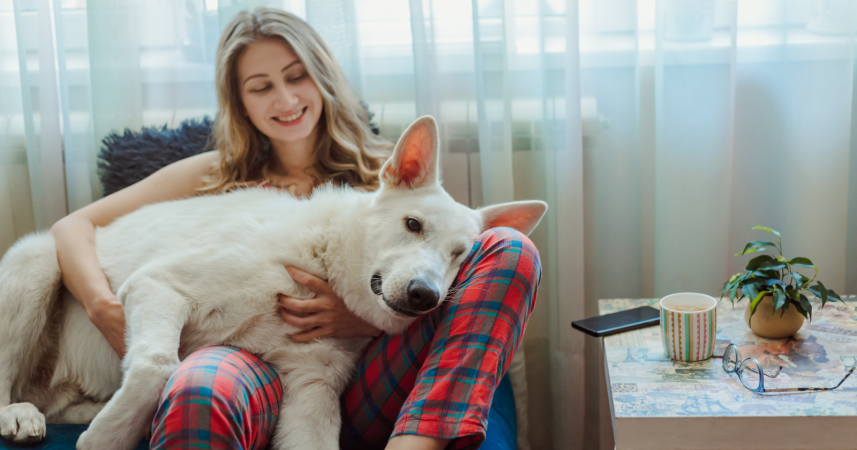
When you tell your dog about your terrible day, you're not just venting into the void. You're practicing the act of putting internal experience into words. You're narrating feelings that might otherwise stay tangled up in your chest. And you're doing it in front of a living creature who won't interrupt, won't argue, and won't make you feel stupid for saying it.
According to Psychology Today, people who anthropomorphize tend to show stronger social bonds and richer empathy. The habit of imagining an inner world for another being, even an animal, exercises the same perspective-taking muscles we rely on in human relationships.
What your pet can't do is exactly the point
Your cat can't validate you. Your dog can't offer advice. Your goldfish isn't going to text you back with a thoughtful response at 2 a.m.
And that's precisely what makes these conversations so useful.
When I lived through my aggressive vegan phase years ago, I learned something painful about communication. I spent three years armed with statistics and moral arguments, convinced that if I just said the right thing in the right way, people would change. My friend Sarah's birthday dinner became a lecture. Family gatherings turned into debates. I was so focused on being right that I forgot how to actually connect with anyone.
What finally broke the pattern wasn't a better argument. It was learning to talk without needing a specific response. Learning to say things honestly, without controlling the outcome.
That's what talking to a pet teaches you. You learn to express yourself for the sake of expression, not for the sake of winning. There's no scoreboard. No defense mechanism on the other end. Just you, saying what's true, and a creature who receives it without judgment.
Research on self-disclosure consistently shows that the act of sharing personal information, even when the listener can't fully understand it, builds our capacity for vulnerability. It trains us to tolerate the discomfort of being seen. And that tolerance is one of the most important ingredients in any meaningful relationship.
The biology backing all of this up
It's not just a psychological phenomenon either. There's a biological layer to this that I find genuinely fascinating.
A comprehensive review published in Frontiers in Psychology examined dozens of studies on human-animal interaction and found that positive contact with pets is linked to the release of oxytocin, the same hormone involved in bonding between parents and children, and between romantic partners. The review also found evidence that these interactions can reduce cortisol levels, lower blood pressure, and even increase trust toward other people.
So when you're sitting on the couch telling your dog about your annoying coworker, your body is doing more than just relaxing. It's chemically priming you for better human connection. The oxytocin system doesn't distinguish between species when it comes to bonding. A warm, safe interaction is a warm, safe interaction, whether it's with your partner or your Labrador.
This is something I think about a lot during my photography walks around Venice Beach. You'll see dozens of people on any given morning having full-blown conversations with their dogs. Asking them questions. Narrating the scenery. Explaining why they chose to walk left instead of right. From the outside, it looks eccentric. From the inside, it's probably the most emotionally honest those people will be all day.
From pet talk to pillow talk
The real payoff of this habit isn't in the conversations you have with your pet. It's in how those conversations change the ones you have with people.
I've been with my partner for five years now. We have very different lifestyles in a lot of ways, including what we eat and how we think about food. Early on, I could have easily fallen into old patterns of trying to convince and convert. Instead, I'd learned (the hard way, through years of burned bridges) that real communication isn't about persuasion. It's about honesty without agenda.
And honestly? I think some of that skill got sharpened in the smallest, most ridiculous moments. Explaining my feelings to a stray cat on my balcony. Talking through a tough decision while a friend's dog stared at me from across the room. Those moments taught me to hear my own voice saying difficult things without flinching.
As Psych Central notes, anthropomorphism may help people better understand others and connect with the world around them. The same mental habit that lets you imagine your pet has feelings also sharpens your ability to consider what the humans in your life might be going through.
If you've ever had a partner tell you that you're a good listener, or a friend say they feel safe talking to you, part of that might trace back to the hundreds of tiny, unwitnessed conversations you've had with animals who couldn't talk back. You were building a muscle you didn't even know you were training.
Why this isn't just a quirky personality trait
It's tempting to file "talks to pets" under the same category as "collects too many houseplants" or "names their car." Harmless. Cute. A little weird.
But the research suggests it's more than that.
People who regularly engage in anthropomorphic behavior tend to score higher in empathy. They're more likely to consider perspectives beyond their own. They show patterns of emotional regulation, using a calm, gentle tone with their pet, that carry over into stressful human interactions. They practice repair quickly, softening after a raised voice, returning to warmth without being asked.
My grandmother, who raised four kids on a teacher's salary and still volunteers at the food bank every Saturday, has always talked to animals like they're old friends. I used to think it was just her personality. Now I think it might be part of why she's one of the most emotionally intelligent people I know. She never needed a psychology textbook to understand that practicing kindness in small, invisible moments makes you better at kindness in the moments that count.
The bottom line
If you talk to your pets like they're people, you're not being silly. You're rehearsing honesty in a space where it costs you nothing, and building emotional skills that pay off everywhere else.
The habit of narrating your inner life, out loud, to a creature who can't judge you, turns out to be surprisingly good training for the kind of vulnerability that actual relationships require. It lowers your defenses. It teaches you to express without performing. And it keeps your empathy muscles in shape for when the stakes are real.
So the next time someone catches you explaining your day to a cat, don't apologize.
You're just practicing being human.