At the end of the day, your kitchen sink might know you better than your therapist does

Add VegOut to your Google News feed. 
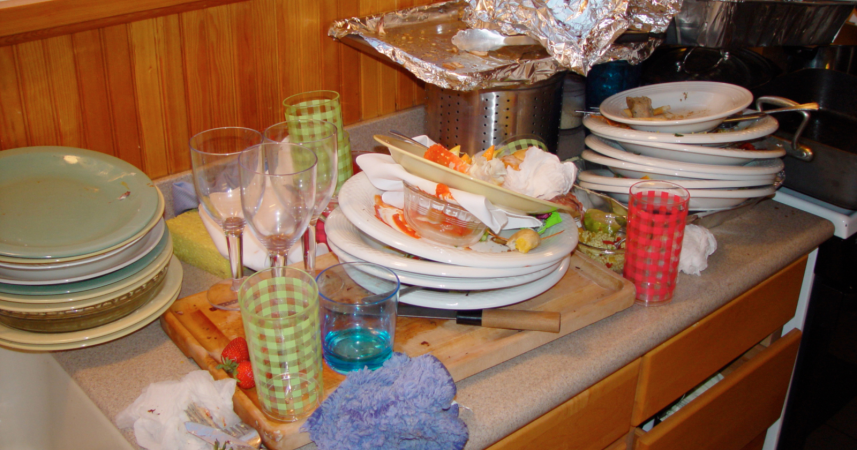
I'll be honest. After a Sunday cooking session with my partner, our kitchen looks like a small, localized disaster. Pots stacked in the sink, a cutting board smeared with turmeric, and at least one pan I swear I'll "deal with later."
For years, I assumed this said something unflattering about me. Lazy. Undisciplined. A little chaotic.
But then I started digging into the behavioral science (as I tend to do when I can't sleep), and what I found was way more interesting than a simple character flaw. Turns out, the way you handle your dirty dishes might actually reveal some surprisingly specific things about the way your brain works.
Not all of them are bad. Some of them are genuinely fascinating.
Let's get into it.
1) They're running low on decision fuel
Here's something most people don't think about: the average adult makes roughly 35,000 decisions a day. What to wear. What to eat. Which email to open first. Whether to reply to that text now or later.
By the time evening rolls around, your brain is running on fumes.
Psychologists call this decision fatigue, and it's been well documented by researchers as a real cognitive phenomenon. The more choices you make throughout the day, the worse your subsequent decisions become. Your brain starts looking for shortcuts. It avoids. It defers. It says "I'll do it tomorrow."
So when someone looks at a pile of dishes and just... walks away? It might not be laziness at all. It might be a brain that's spent its daily decision budget on things it deemed more important.
I've noticed this in myself after a long writing day. I can structure an entire article, respond to a dozen messages, and plan next week's meals. But washing a pan at 9 p.m.? That's where I draw the line.
2) They're wired for creative thinking
This one surprised me, but the research is solid.
A study published in Psychological Science by researcher Kathleen Vohs and her team at the University of Minnesota found that messy environments actually promote creative thinking. Participants in cluttered rooms generated ideas that were rated as significantly more interesting and original by independent judges compared to those working in tidy spaces.
The theory? Orderly environments encourage convention. Disorder encourages breaking free from it.
Now, I'm not saying a sink full of dishes is going to make you the next Picasso. But if you tend to leave things a bit chaotic and also happen to be the person at work who comes up with the unexpected ideas, these two things might be connected.
There's a reason so many writers, musicians, and makers work in spaces that would horrify a minimalist. The mess isn't the enemy of the work. Sometimes, it's a byproduct of a brain that's busy doing something else entirely.
3) They have a higher tolerance for discomfort
Most people assume that leaving dishes in the sink means someone is bothered by the mess but too lazy to fix it. But often, the opposite is true. They genuinely aren't that bothered.
And that tolerance for low-level discomfort? It shows up in other areas too.
I've mentioned this before but researchers who study personality through the Big Five framework have found that people who score lower in conscientiousness (which is linked to tidiness and routine) often score higher in openness. They're more comfortable sitting with ambiguity, with things being "unfinished," with not having every detail nailed down.
In practical terms, this means they might be better at handling uncertainty in their careers, in relationships, even in travel. I've met some of the most spontaneous, adaptable people on the road, and I'd bet good money their kitchens back home weren't spotless.
4) They prioritize presence over productivity
When I cook in the evenings, it's basically meditation for me. Chopping vegetables, layering spices, watching a curry come together. It's the part of my day where I actually slow down.
The last thing I want to do in that moment is shift into cleanup mode. I want to sit down, eat, maybe talk to my partner about something that isn't logistics. The dishes can wait.
And research suggests there's something real going on here. A study published in the Personality and Social Psychology Bulletin found that people who describe their homes as cluttered tend to have elevated cortisol levels, but here's the nuance: the stress wasn't always caused by the clutter itself. It was often linked to the pressure of feeling like they should be doing something about it.
People who leave dishes in the sink without spiraling about it might actually be better at staying present. They're not ignoring the mess. They've just decided it's not worth sacrificing the moment for.
5) They think in systems, not tasks
Some people wash each dish the second it's used. Others wait until the sink is full and do everything in one efficient batch.
Neither approach is wrong, but they reflect very different ways of processing the world.
Batch processors tend to think in systems. They see the bigger picture. They'd rather do one focused 20-minute cleanup than five scattered 4-minute ones throughout the day. It's the same logic behind time-blocking your calendar or meal prepping on Sundays instead of cooking from scratch every night.
I batch cook grains and legumes at the start of each week for exactly this reason. And yes, my sink is a wreck by Sunday afternoon. But by Sunday evening, the kitchen is spotless and the fridge is stocked for the week. It's a system. It just doesn't look pretty in the middle.
6) They're quietly fighting perfectionism
This one is counterintuitive, but stick with me.
For some people, leaving dishes in the sink is actually a small act of rebellion against their own perfectionist tendencies. If they can't do it "right" (the proper soak time, the exact sponge, every surface gleaming), they'd rather not start at all.
Psychologists who study procrastination have noted that perfectionism is one of the most common drivers of avoidance behavior. It's not that the person doesn't care. It's that they care too much, in a way that creates a kind of paralysis.
If this sounds familiar, it's worth paying attention to. Because the same pattern that shows up in your kitchen probably shows up in your work, your creative projects, and your relationships. The "I'll do it when I can do it properly" trap is one of the most quietly destructive habits out there.
7) They process emotions through inaction
Have you ever noticed that your kitchen gets messier during emotionally tough weeks?
It's not a coincidence. Psychologists have long recognized that our physical spaces tend to mirror our internal states. When someone is dealing with stress, grief, overwhelm, or even just a low-grade funk, the first things to slip are usually the small maintenance tasks. Dishes. Laundry. Tidying up.
This doesn't mean the person is falling apart. It means their emotional bandwidth is being used elsewhere.
I've been through periods where I could write 3,000 words in a day but couldn't bring myself to unload the dishwasher. Looking back, those were always the times when something deeper was going on, some emotional processing that I wasn't fully conscious of yet.
So before you judge someone (or yourself) for a messy kitchen, it might be worth asking a different question: what else is going on right now?
8) They value relationships over rules
My partner and I have a pretty good system in our kitchen. Separate chopping boards, a few ground rules about shared meals, and a general understanding that neither of us is going to lose it over a pan in the sink.
But we didn't always have that. Early on, dishes were a friction point. Not because of hygiene or standards, but because of what they represented: who cares more, who does more, who's "pulling their weight."
A body of research in personality psychology suggests that people who are less rigid about household tasks often score higher in agreeableness. They're more willing to let things slide in order to keep the peace. They'd rather have a nice evening together than start a fight about a greasy pan.
That's not weakness. In a lot of cases, it's emotional intelligence.
The dish-leavers of the world aren't always the ones who care less. Sometimes they're the ones who've figured out what's actually worth caring about.
The bottom line
Look, I'm not here to tell you that leaving dishes in the sink is some kind of virtue. It's not.
But it's also not the moral failing we've been taught to think it is. Behind that pile of plates might be a creative mind, a fatigued decision-maker, a person who's choosing connection over chores, or someone who's quietly learning to let go of impossible standards.
The next time you catch yourself staring at a full sink, maybe skip the guilt trip. Instead, get curious about what it might actually be telling you.
You might learn something worth knowing.