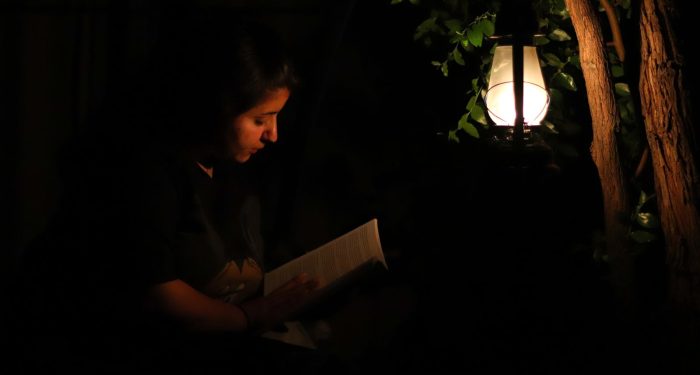
The person who taught themselves at 2 a.m. because they couldn't stop wondering isn't less educated; they're differently wired

Add VegOut to your Google News feed. 
I have a complicated relationship with formal education.
I did fine in school. Passed everything I needed to pass. But the things I actually know, the knowledge I reach for when I'm trying to solve a real problem or understand something that matters, almost none of it came from a classroom.
It came from late nights reading about behavioral psychology because I couldn't stop turning pages. It came from teaching myself how to shoot photos by burning through rolls of film around Venice Beach and getting most of them wrong. It came from my music blogging days, where I had to learn audio editing, web design, and interview technique simultaneously with no syllabus and no deadline, just an obsessive need to make something work.
And I don't think I'm unusual. I think a lot of people quietly carry two educations: the one on their resume and the one that actually runs their life.
Psychology has been studying the difference between these two kinds of learning for decades. And the research suggests that people who educate themselves through curiosity don't just learn different things. They learn differently. Here are eight traits that explain why.
1) They're powered by intrinsic motivation
This is the foundation everything else builds on.
Self-determination theory, developed by psychologists Richard Ryan and Edward Deci, has consistently shown that intrinsic motivation, learning because you genuinely want to understand something, produces deeper engagement, better retention, and more creative application than extrinsic motivation like grades, credentials, or approval.
When curiosity is the engine, learning doesn't feel like obligation. It feels like hunger. You don't stop when the assignment ends. You stop when the question is answered, or when a better question replaces it.
Formal education, by design, leans heavily on extrinsic structures. Deadlines, grades, pass/fail thresholds. These aren't evil, but they do shape the relationship a learner has with the material. When the grade is the goal, comprehension becomes a means to an end rather than the end itself.
Self-taught learners skip that entire dynamic. Nobody is grading their midnight deep dive into how fermentation works or why certain chord progressions trigger emotional responses. The reward is the understanding. And that changes what gets stored and how it gets used.
2) They're comfortable with confusion
Most formal education is designed to minimize confusion. Information arrives in a logical sequence. Concepts build neatly on prior concepts. There's a path, and you follow it.
Curiosity-driven learning has no path. You start with a question that interests you, chase it sideways into three other questions you didn't anticipate, hit a wall of not understanding, sit in that discomfort, and eventually piece something together.
Psychologist Robert Bjork's research on "desirable difficulties" at UCLA supports this. Bjork found that conditions which make learning harder in the short term, things like struggling with unfamiliar material, testing yourself before you're ready, and spacing out practice, actually produce stronger long-term retention and better transfer of knowledge to new contexts.
Self-educated people live in desirable difficulty. They've been doing it so long that confusion doesn't feel like failure anymore. It feels like the first five minutes of every new thing they try.
That's a fundamentally different relationship with not knowing than most classroom-trained learners ever develop.
3) They think in systems, not subjects
Have you ever noticed how formal education slices the world into categories? History in one room. Biology down the hall. Mathematics on Tuesdays and Thursdays.
There are practical reasons for this, of course. But it trains people to think in compartments. To see disciplines as separate containers rather than overlapping lenses on the same reality.
Curiosity-driven learners don't have compartments. A single question about why a particular song resonates emotionally can lead someone through music theory, neuroscience, cultural history, and the psychology of memory, all in one sitting. I've mentioned this before but the best insights I've ever had came from connecting two things that weren't supposed to be related.
When I was blogging about indie bands in LA, I stumbled into an understanding of marketing by watching how certain artists built audiences without labels. Nobody taught me that. It emerged from paying attention across domains simultaneously.
This cross-pollination is something classrooms rarely produce, not because teachers don't value it, but because the structure itself works against it.
4) They build resilience through repeated failure
When you're learning on your own, nobody rescues you.
There's no professor to explain where you went wrong. No study guide to recalibrate with. No classmate to compare notes. When you hit a wall, your options are to quit or to figure it out. And the people who keep going develop a tolerance for failure that's difficult to replicate in structured environments.
Research in Contemporary Educational Psychology has shown that learners who operate under conditions of autonomy rather than external control demonstrate greater persistence and more positive self-perceptions. They fail more often, but the failures don't carry the same social or evaluative weight. There's no red mark. No lowered GPA. Just the private recognition that something didn't work, followed by another attempt.
Over time, this produces people who don't panic when a problem doesn't have an obvious solution. They've been navigating that terrain their entire learning life.
5) They reverse-engineer instead of following instructions
Traditional education teaches principles first, then applies them. You learn the theory of electricity before you wire anything. You study grammar before you write.
Curiosity-driven learners flip this completely. They start with something they want to build, fix, or understand, then work backwards to figure out what knowledge they need.
This is how I learned photography. I didn't read a textbook on exposure and composition first. I took hundreds of bad photos around Griffith Park and Venice Beach, then looked at the ones that worked and asked why. The theory came after the practice, which meant it landed on a foundation of experience rather than floating in abstraction.
Cognitive scientists call this difference "routine expertise" versus "adaptive expertise." Formal education tends to produce people who are excellent at applying known solutions to familiar problems. Curiosity-driven learning produces people who are better at improvising when the problem doesn't fit a template.
6) They tolerate ambiguity
School loves clean answers. Multiple choice. True or false. Right or wrong. Even essay questions usually have a framework the grader is looking for.
Life doesn't work like that. The most interesting and consequential problems are messy, contradictory, and resistant to neat resolution.
Self-educated people have been marinating in ambiguity since they started learning. Nobody told them what to study or when they'd mastered something. There was no syllabus to confirm they were on track. They had to develop their own internal compass for when they understood something well enough to move on.
Research on curiosity and scientific thinking published in Frontiers in Psychology highlights that people who tolerate ambiguity are often more creative problem solvers. When you're not waiting for the "correct answer," you explore more possibilities. You sit with competing ideas longer. You resist the urge to resolve tension prematurely, which is exactly where the most original thinking tends to happen.
I notice this in my own reading habits. I'll go through two books on the same topic that completely contradict each other, and instead of picking a side, I'll sit with both for weeks. That discomfort is productive. It forces a deeper kind of thinking than either book alone would have triggered.
7) They develop brutal self-awareness
In formal education, external feedback is constant. Grades tell you where you stand. Teachers flag your weaknesses. The system evaluates you whether you want it to or not.
When you're learning on your own, that feedback loop doesn't exist. You have to build it yourself. Which means you have to get honest, sometimes uncomfortably honest, about what you actually know versus what you think you know.
Self-taught learners who stick with it long enough develop a calibration skill that's rare in people who've always had external validators. They know their blind spots because they've fallen into them repeatedly without anyone there to catch them. They know the difference between superficial familiarity and genuine understanding because they've been burned by confusing the two.
This kind of metacognition, thinking about your own thinking, is something educational psychology considers essential for deep learning. But it tends to develop faster and more naturally under conditions of autonomy, where the only person responsible for assessing your progress is you.
8) They learn for retention, not performance
Here's the quiet difference that underpins everything else.
A student in a formal system is, at some level, always learning to perform. To demonstrate knowledge on a test. To produce the right output at the right time. This isn't cynical, it's structural. The system requires assessment, and assessment requires performance.
Self-educated learners have no performance to optimize for. They're learning because they want to understand. And research on learning versus performance suggests these are genuinely different cognitive processes. Performance-based learning can create an illusion of mastery, you feel like you know something because you just passed a test on it, but the knowledge often fades quickly because it was encoded for retrieval under specific conditions, not for flexible, long-term use.
When I was a teenager in Sacramento, I crammed for exams like everyone else. I could regurgitate facts for forty-eight hours and then they'd evaporate. But the things I taught myself because I was obsessed, the names of obscure indie bands, the mechanics of a good photograph, the psychology behind why people make the decisions they make, those have stuck for decades.
The difference isn't intelligence. It's the conditions under which the learning happened.
The bottom line
None of this is an argument against classrooms. Formal education provides structure, community, mentorship, and access to resources that self-education often can't replicate. Plenty of fields require the systematic rigor that structured programs provide.
But the research is consistent: the conditions under which curiosity-driven learners operate, autonomy, intrinsic motivation, productive struggle, tolerance for ambiguity, are precisely the conditions that produce the deepest, most durable, and most transferable knowledge.
The beautiful thing is you don't have to choose one path or the other. Whether you have three degrees or dropped out at sixteen, you can cultivate these traits by approaching your next challenge with curiosity instead of curriculum.
Start with something you genuinely want to understand. Let yourself get confused. Question everything. Build your own web of knowledge.
The classroom teaches you what to think. Curiosity teaches you how.
If You Were a Healing Herb, Which Would You Be?
Each herb holds a unique kind of magic — soothing, awakening, grounding, or clarifying.
This 9-question quiz reveals the healing plant that mirrors your energy right now and what it says about your natural rhythm.
✨ Instant results. Deeply insightful.

Jordan Cooper
Jordan Cooper is a pop-culture writer and vegan-snack reviewer with roots in music blogging. Known for approachable, insightful prose, Jordan connects modern trends—from K-pop choreography to kombucha fermentation—with thoughtful food commentary. In his downtime, he enjoys photography, experimenting with fermentation recipes, and discovering new indie music playlists.
More Articles by Jordan