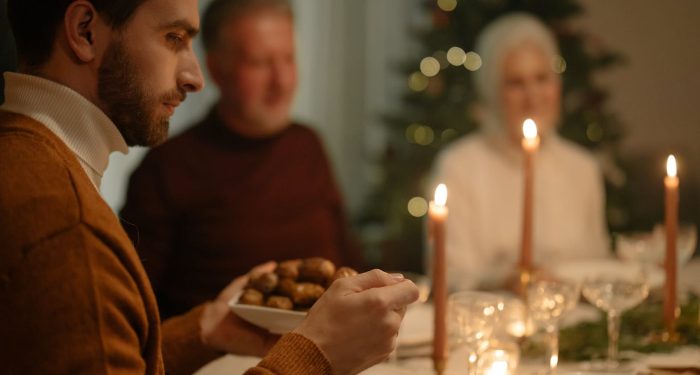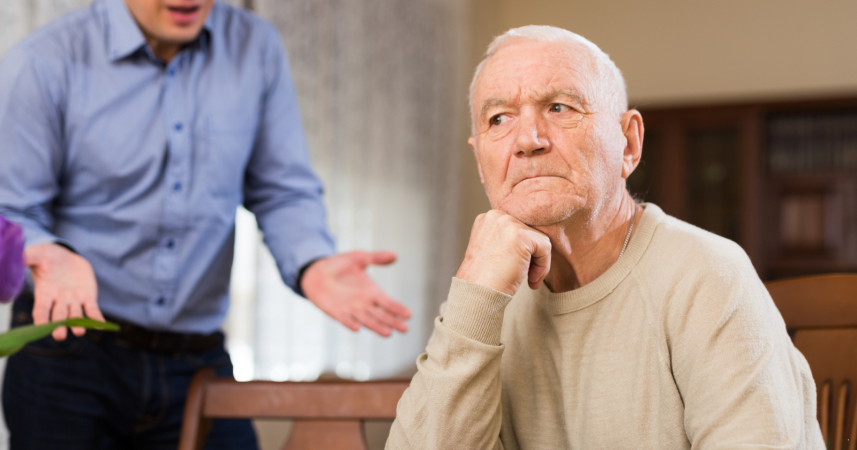
She didn't become difficult at sixty-two; she just stopped pretending that hosting Thanksgiving made her happy

Add VegOut to your Google News feed. 
My friend Sarah had a mother everyone described as "lovely." For forty years, this woman hosted every holiday, remembered every birthday, drove carpool without complaint, showed up to every school event with snacks and a smile, and never once said a difficult word at a family gathering.
Then she turned sixty-two and something shifted.
She stopped hosting Thanksgiving. She told her sister she didn't enjoy their weekly phone calls and would prefer to talk less often. She started saying no to babysitting requests that didn't suit her schedule. She took a ceramics class on Saturday mornings instead of running errands for the family.
The family's reaction was swift and unanimous: something was wrong with her. She'd become selfish. Cold. Difficult. Sarah called me genuinely worried. "She's not herself," she said.
But here's the thing I keep turning over. What if she is herself? What if, for the first time in decades, she's actually being herself, and that's exactly what's making everyone so uncomfortable?
The performance nobody agreed to
There's a version of you that exists for other people's comfort. Most of us start building it in childhood and spend decades refining it. It smiles when it wants to scream. It says "I'm fine" when it isn't. It volunteers for things it resents. It shapes itself around the emotional needs of everyone in the room while quietly suffocating its own.
Psychology Today defines people-pleasing as a pattern of prioritizing others' needs, desires, and approval over one's own wellbeing, often rooted in fear of rejection, insecurities, and the need to be liked. It's not generosity. It's a survival strategy dressed in kind behavior.
And here's what nobody tells you about survival strategies: they have an expiration date.
The cognitive and emotional resources required to maintain a pleasing performance are enormous. You're constantly monitoring social cues, suppressing authentic reactions, managing other people's emotional experiences, and recalculating your behavior based on what will generate the least friction. This isn't just tiring. It's a form of labor that compounds over decades.
When people describe someone as "becoming harder to love" in their fifties or sixties, what they're often witnessing is the moment that labor becomes unsustainable. The person hasn't turned bitter. They've just run out of the willingness to keep performing at their own expense.
What the science actually says about aging and emotional priorities
There's a well-established theory in psychology that reframes nearly everything we assume about difficult older people.
Socioemotional selectivity theory, developed by Stanford psychologist Laura Carstensen, proposes that as people age and their time horizons shrink, their motivational priorities fundamentally shift. Younger people, who perceive time as open-ended, prioritize knowledge acquisition, social expansion, and future-oriented goals. Older people, who are increasingly aware that time is finite, shift toward emotional meaning, authentic connection, and present-moment satisfaction.
This isn't decline. It's reorganization.
Carstensen's research has shown that older adults actively prune their social networks, dropping peripheral relationships and investing more heavily in the connections that feel emotionally genuine. They become more selective about where they spend their energy. They report fewer negative emotions and greater emotional stability than younger adults, not because life gets easier, but because they stop wasting resources on things that don't matter to them.
From the outside, this pruning looks like withdrawal. Like coldness. Like becoming difficult. But from the inside, it often feels like the first honest breath someone has taken in thirty years.
The cost of being easy to love
I think about this in my own life more than I'd like to admit.
I went through a phase in my late twenties and early thirties where I was aggressively agreeable. I'd say yes to everything. Write the article nobody else wanted. Show up at the event I didn't care about. Nod along with opinions I thought were wrong. I told myself this was being a good person. It was actually being a compliant one.
The shift happened slowly. Partly through getting older. Partly through reading enough behavioral psychology to recognize my own patterns. Partly through watching what happens to people who never stop performing: they don't get loved more. They get taken for granted more.
My grandmother taught me this without ever putting words to it. She raised four kids on a teacher's salary, volunteered every Saturday at the food bank, and spent decades being the person everyone could count on. But somewhere along the way, she also became the person who would tell you exactly what she thought about your casserole. Who would decline an invitation without offering an excuse. Who would sit in her own silence and not feel obligated to fill it for someone else's comfort.
She didn't become difficult. She became free.
And some people in the family found that freedom very inconvenient.
Why the people around them resist so hard
When someone who has always been accommodating suddenly stops accommodating, the people who benefited from that accommodation don't experience it as growth. They experience it as loss.
This is the part that rarely gets examined honestly. The family that describes Mom as "not herself anymore" is often really saying: Mom is no longer organizing her personality around our comfort, and we don't know what to do with that.
Research on people-pleasing patterns highlights that when someone who has been chronically over-functioning in relationships starts setting boundaries, the system pushes back. Not because the boundaries are wrong, but because the system was built on the assumption that this person would always absorb more than their share.
I've mentioned this before but the dynamics here are remarkably similar to what I watched happen in my own social circle years ago when I stopped being the guy who always said yes. Some relationships deepened. Others disappeared entirely. And the ones that disappeared weren't the ones that valued me. They were the ones that valued my compliance.
The same thing happens in families when an aging parent stops performing. The children who valued the relationship adapt. The ones who valued the service feel betrayed.
Refusal reframed as deterioration
There's a cultural narrative that frames any withdrawal of emotional labor by an older person as evidence of decline. She's getting cranky. He's becoming set in his ways. They're losing their social skills.
But what if the "social skills" that are declining were never skills at all? What if they were masks? What if the woman who always laughed at her husband's jokes even when they weren't funny, who always pretended she didn't mind hosting, who always swallowed her real opinion to keep the peace, is now simply declining to keep up the act?
That's not deterioration. That's a decision. A conscious or unconscious choice to stop spending whatever time remains on a performance that never served her, only the audience.
I see versions of this everywhere. The retired colleague who finally says what he actually thinks at dinner parties. The aunt who stops pretending she likes her brother's wife. The parent who starts spending holidays the way they want to rather than the way the family expects.
In each case, the person is described as having "changed." But the change isn't in their character. It's in their willingness to hide it.
What this means for the people who love them
If someone in your life is becoming harder to love as they age, the most important question isn't what's wrong with them. It's what version of them were you in love with?
Because if you were in love with the performance, with the always-available, never-complaining, endlessly accommodating version, then yes, you're going to experience their authenticity as a loss. That version is retiring. And it's not coming back.
But if you can look past the discomfort and see what's actually emerging, you might find someone more honest, more present, and more real than the person you thought you knew. The relationship will require renegotiation. It will feel less smooth. It will have more edges.
That's what real people feel like.
The quiet courage of becoming inconvenient
I'm forty-four. I spend a lot of time reading about the psychology of decisions and watching how people navigate the tension between who they are and who they think they should be. I take my camera out around Venice Beach most afternoons, and one thing I've noticed is that the most magnetic people I photograph aren't the ones trying to look a certain way. They're the ones who've stopped trying entirely. There's a looseness to them. An ease that only comes from giving up the performance.
As one Psychology Today writer put it, the liberating truth about aging isn't that you stop caring. It's that you finally learn the difference between kindness and people-pleasing, between consideration and self-abandonment.
That distinction is everything.
The people who become "harder to love" as they age are often the ones who spent decades being easy to love at a cost nobody ever calculated. They smiled through exhaustion. They hosted through resentment. They said yes through gritted teeth because the alternative felt like too much of a risk.
And then one day, the math stopped working. The cost exceeded the reward. And they made a choice that looked, to everyone on the outside, like bitterness.
But it wasn't bitterness.
It was the quiet, courageous, deeply inconvenient act of finally being themselves.
The real question
Here's what I'd leave you with.
If someone in your life is becoming harder to love, ask yourself whether you ever made it easy for them to be honest. Whether the version of them you're mourning was a person or a performance. Whether the warmth you miss was genuine or was just the heat of someone burning themselves out to keep you comfortable.
And then ask a harder question: if they'd been this honest from the start, would you have loved them anyway?
If the answer is yes, then there's still a relationship here. A better one, possibly. One built on who they actually are instead of who you needed them to be.
If the answer is no, then what you're grieving isn't a person. It's a service.
And they were right to stop providing it.
If You Were a Healing Herb, Which Would You Be?
Each herb holds a unique kind of magic — soothing, awakening, grounding, or clarifying.
This 9-question quiz reveals the healing plant that mirrors your energy right now and what it says about your natural rhythm.
✨ Instant results. Deeply insightful.

Jordan Cooper
Jordan Cooper is a pop-culture writer and vegan-snack reviewer with roots in music blogging. Known for approachable, insightful prose, Jordan connects modern trends—from K-pop choreography to kombucha fermentation—with thoughtful food commentary. In his downtime, he enjoys photography, experimenting with fermentation recipes, and discovering new indie music playlists.
More Articles by Jordan