The person your child talks to differently than they talk to you isn't doing your job better, they're doing a completely different one.

Add VegOut to your Google News feed. 
My nephew had a birthday party last month. There were balloons, too much frosting, and the usual chaos of eight-year-olds negotiating whose turn it was on the trampoline.
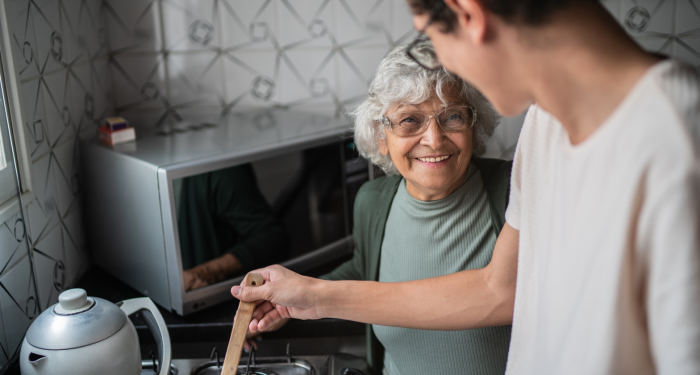
But the thing I keep coming back to wasn't any of that. It was watching my grandmother, who's in her eighties now, sitting in a lawn chair at the edge of the yard, doing absolutely nothing urgent. My nephew wandered over to her at one point, climbed halfway into her lap, and started telling her a long, winding story about a lizard he'd seen near the garage. She didn't check the time. She didn't redirect him. She didn't ask if he'd finished his cake first. She just listened.
And something about that moment landed differently than everything else at the party. It was quieter, slower, and if I'm honest, more meaningful than anything the adults had organized.
I've been thinking about why ever since.
What grandparents offer that parents structurally cannot
There's a version of this conversation that sounds sentimental. Grandparents are wonderful. Kids love grandparents. We should cherish the bond. And all of that's true, but it doesn't quite explain what's actually happening.
The deeper insight is structural, not emotional. Parents, no matter how loving, operate inside a system of constant triage. There are schedules to keep, behaviors to correct, meals to plan, homework to supervise, and a running mental list of all the ways their child needs to be prepared for a world that isn't always kind. Parenting, at its core, is future-oriented. You're always building toward something. Making sure the kid turns out okay.
Grandparents, at least the ones who form those unbreakable bonds, have stepped outside that system. They're not managing a child's development. They're not tracking milestones or worrying about screen time limits. They've already done that job, with all its exhaustion and second-guessing, and they've come out the other side into something else entirely.
What they offer instead is presence without project. Attention without agenda. Love that doesn't come packaged inside a lesson.
And that distinction, it turns out, matters more than most of us realize.
The science of "grandma brain"
In 2021, a team of researchers at Emory University conducted the first study to scan grandmothers' brains while they viewed photos of their grandchildren. The results were striking.
When grandmothers looked at pictures of their grandchildren, the areas of the brain associated with emotional empathy lit up strongly. That's the kind of empathy where you don't just understand what someone is feeling, you actually feel it alongside them. Joy, distress, excitement. The grandmother's brain mirrors the child's emotional state in real time.
But here's the part that caught my attention as someone who reads behavioral science research obsessively: when those same grandmothers looked at photos of their own adult children, a different neural pattern emerged. Instead of emotional empathy, the brain activated areas linked to cognitive empathy. They were trying to understand what their child was thinking or feeling, but from a more analytical distance.
The researchers suggested that young children may have evolved traits that activate not just the maternal brain, but the grandmaternal brain too. And that grandmothers, freed from the daily demands of primary caregiving, may actually be neurologically wired for a deeper kind of emotional attunement with their grandchildren than they had with their own kids.
That reframes the whole conversation. Grandparents aren't offering a watered-down version of parenting. They're offering something neurologically distinct.
The person who has run out of reasons to be anywhere else
Stanford psychologist Laura Carstensen has spent decades developing what she calls socioemotional selectivity theory, and it helps explain a lot of what makes grandparent relationships so different.
The core idea is this: as people perceive their remaining time as more limited, their priorities shift. When time feels expansive, like it does when you're young, you prioritize goals related to learning, achievement, and future payoff. But when time feels finite, you start investing more heavily in what's emotionally meaningful right now. Relationships over accomplishments. Depth over breadth. The present over the future.
Grandparents, by and large, have made this shift. Not because they've given up on life, but because they've arrived at a stage where connection is the point. They're not building careers. They're not climbing. They're not distracted by the same ambient anxiety that makes most parents feel like they're perpetually behind.
This creates something a child rarely encounters anywhere else: the full, unhurried attention of a person who is genuinely not trying to be anywhere else. Who has, in a sense, stopped performing busyness and arrived at something calmer and more concentrated.
I've mentioned this before but the quality of attention in a relationship matters as much as the quantity. My grandmother raised four kids on a teacher's salary. She spent decades juggling work, bills, and all the logistical noise that comes with keeping a family afloat. She didn't have time to sit still back then. Now she does. And the version of her that shows up for my nephew, the one who will listen to a story about a lizard for fifteen minutes without interrupting, is different from the version that raised my mom. Not better or worse. Just freed up.
Why children sense the difference
Kids are remarkably good at reading the emotional texture of a room. They know when an adult is distracted. They can feel when someone is half-listening. And they can absolutely tell the difference between an adult who is managing them and an adult who is simply with them.
A systematic review on emotional closeness between grandparents and grandchildren found that the quality of the relationship matters more than the quantity of time spent together. Emotional closeness, not just physical proximity, was linked to positive psychological outcomes for grandchildren, including better coping skills and increased prosocial behavior.
This tracks with something I've observed in my own family. My grandmother doesn't see my nephew every day. She's not the one packing his lunch or driving him to soccer. But when they're together, there's a quality to the interaction that's hard to replicate. She's not managing behavior. She's not teaching in disguise. She's just there. And in that "just there" quality, something important is being communicated.
The message, whether the child can articulate it or not, is: you are worth my undivided presence. Not because you need to be fixed or shaped or redirected, but because being with you is where I want to be.
That's a rare message to receive from anyone. From a grandparent, it can become foundational.
Why this isn't about replacing the parent
I want to be clear about something, because this is where the conversation can go sideways. None of this means parents are failing. It means they're operating inside a different structure with different demands.
Parents are on the clock. They have to say no. They have to enforce bedtimes and manage tantrums and make the call about whether the third cookie is fine or a disaster. They carry the invisible labor of worrying about a child's long-term wellbeing, which means every interaction has a subtext of future consequence.
Grandparents get to exist outside that calculus. They get to be the person who says yes to the cookie without thinking about the sugar crash. Who lets the child stay up twenty minutes past bedtime just to finish the story. Who treats a Tuesday afternoon like it has no other purpose than sitting on the floor and building something together.
That's not indulgence. It's a fundamentally different relational posture. And research on self-disclosure and relational closeness supports the idea that people, including children, open up more in relationships where they feel accepted without condition. Grandparents, unburdened by the disciplinary role, often become the person a child talks to differently. More freely. With less performance and more honesty.
My partner and I have been together for five years, and we've learned something similar in a different context. The best conversations don't happen when one person is trying to teach the other something. They happen when both people are just present. Not managing. Not correcting. Just being together with nowhere else to be. Grandparents seem to arrive at this by default.
The specific gift of unhurried time
There's something worth naming about the pace of a grandparent-grandchild interaction. It moves differently.
Parents tend to operate in what you might call efficient time. Quick transitions, multitasking, a constant eye on what comes next. This isn't a personality flaw. It's the natural rhythm of someone responsible for keeping a household running.
Grandparents, especially those who've stepped back from work and the daily grind, live in what feels like a different temporal register. Slower. Less compressed. The kind of time where you can walk to the end of the street just to see what's there. Where a conversation about lizards is allowed to meander without a destination.
For a child who spends most of their waking hours inside structured, clock-driven environments, this experience of unhurried time can be profoundly restorative. It teaches them something that no curriculum covers: that they are worth someone's unscheduled attention. That their thoughts and stories and half-formed ideas deserve space, even when they don't lead anywhere productive.
I think about this during my own photography walks around Venice Beach. Some of my best creative work happens when I'm not trying to get anywhere, when I'm just wandering, noticing, taking a slower path. It's the absence of urgency that makes the noticing possible. Grandparents offer children that same absence of urgency, and the child notices. Even if they can't name it.
What the research says about the benefits
The science here isn't just warm and fuzzy. Research from Emory University and others has found that close grandparent-grandchild relationships are associated with fewer emotional and behavioral problems in children and reduced depressive symptoms in older adults. The relationship appears to be genuinely bidirectional: both generations benefit.
For children, having a grandparent who provides emotional stability and unconditional positive regard can serve as a buffer during stressful life events. During family upheaval, divorce, or loss, grandparents often become the steady point in a child's world. Not because they fix the problem, but because they remain consistent. They keep showing up with the same calm presence.
For grandparents, the bond appears to offer something equally vital. A sense of purpose. A continuation of identity. The feeling that their presence still matters deeply to someone. In a culture that often sidelines older adults, the grandchild who runs to the door when they arrive is powerful medicine.
The bottom line
Grandparents who form those deep, unbreakable bonds with their grandchildren aren't competing with the parent. They're not doing a better version of the same job. They're offering something the parenting role structurally cannot provide: attention that has no agenda, love that isn't tied to a schedule, and the unhurried quality of someone who has finally stopped rushing.
That combination, backed by real neuroscience and decades of psychological research, isn't sentimentality. It's one of the most powerful relational gifts a child can receive.
If you have a grandparent like that in your family, or in your memory, you probably already know this.
And if you're lucky enough to be one, just keep showing up. Keep listening to the lizard stories. That slow, unscheduled presence is doing more than you think.
If You Were a Healing Herb, Which Would You Be?
Each herb holds a unique kind of magic — soothing, awakening, grounding, or clarifying.
This 9-question quiz reveals the healing plant that mirrors your energy right now and what it says about your natural rhythm.
✨ Instant results. Deeply insightful.

Jordan Cooper
Jordan Cooper is a pop-culture writer and vegan-snack reviewer with roots in music blogging. Known for approachable, insightful prose, Jordan connects modern trends—from K-pop choreography to kombucha fermentation—with thoughtful food commentary. In his downtime, he enjoys photography, experimenting with fermentation recipes, and discovering new indie music playlists.
More Articles by Jordan