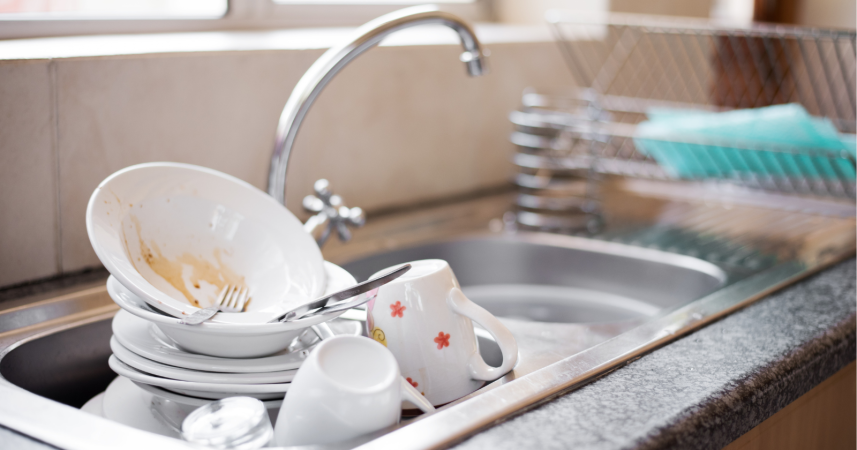
If you leave dirty dishes in the sink, it’s not just a habit—it’s a clue to distinct traits, from batching and energy management to putting people before polish.

Add VegOut to your Google News feed. 
Let’s retire the moral panic about a sink full of plates.
A pile of dishes isn’t proof someone’s lazy or messy or hopeless. It’s often a tiny window into how they value time, focus, energy, and rituals. I’ve lived on both sides—spotless countertop era and “please-don’t-look-in-the-sink” era—and the gap between them wasn’t character. It was choices.
Here are the quiet patterns I keep seeing in folks who tend to let dishes stack up before they deal with them.
1. They optimize for momentum, not optics
Some people do dishes right away to keep appearances. The “pile people” usually prioritize momentum over how things look in the moment. If they’re mid-project, mid-thought, or mid-connection, they’ll protect the flow and batch the cleanup later. It’s not sloppiness. It’s strategy: keep the main thing the main thing, then reset in one sweep.
Tiny fix if this is you: put “5-minute reset” after the day’s last task on your calendar. Timer on, headphones in, surfaces cleared. Momentum and order.
2. They’re time-batching realists
Immediate washing is a single-tasking habit. Pile people are batchers. They’d rather load once than drip-dry five times a day. They know setup/breakdown is the hidden tax on every chore, and they prefer to pay it once. That looks like rinsing and stacking neatly, then running the dishwasher at night or doing a single sink session before bed.
Rule of thumb: when the rack is full, it’s time. Until then, conserve attention.
3. They protect deep work (and deep rest)
Interruptions are expensive. If they’re drafting a proposal, editing photos, or finally exhaling after a long day, dishes won’t jump the line. The sink can wait; the thread they’re following can’t.
Practice: commit to “finish the chapter, then the sink.” The point isn’t avoidance; it’s sequencing.
4. They manage energy, not just time
At 9 p.m., willpower is on fumes. People who let dishes sit often know their energy peaks and dips. They’ll defer low-stakes chores when their brain is mush and save cleanup for the morning when a podcast and coffee make it almost pleasant.
Simple script: “Tired me can soak; rested me can scrub.” Make soaking the minimum viable action.
5. They have a perfectionism streak (that backfires)
“I’ll do it properly later” is a familiar sentence. The bar is high: clear sink, wiped counters, polished stovetop, everything dried and put away. Because the standard is all-or-nothing, the “all” keeps getting postponed. Then the pile grows, and so does the dread.
Counter-move: downgrade the goal. “Good enough now” beats “perfect never.” Rinse and rack counts.
6. They make eco-logic part of the routine
Plenty of pile folks are quietly eco-minded. Running a half-empty dishwasher or a dozen micro-scrubs feels wasteful, so they wait until a full load makes sense. The line between “responsible” and “rationalizing” can blur, but the intent is often stewardship.
Guardrail: one full load per day max, or every other day in small households. Responsible, not swampy.
7. They design around friction
People who stack are often good at systems thinking. They’ll stage a stiff-bristle brush in a jar of diluted soap, add a mesh rack for “already rinsed,” and keep a compost bin within arm’s reach to speed scraping. They remove the little frictions that make cleanup feel like a chore-a-thon.
Low-lift upgrades: a small scraper, a sink caddy, and a “soak first” bowl that lives in the basin.
8. They’re present-first hosts
When friends are over, they don’t disappear for a 20-minute clean. They keep talking, keep pouring, and deal with the aftermath when the last hug is done. It reads like mess. It’s actually a value: people over polish.
Social script: “I’ll soak these; let’s keep chatting. I’ll do the rest when you head out.” No shame, no fuss.
9. They’re comfortable with controlled chaos
Some folks can’t think if there’s a cup in the sink. Pile people often have a higher tolerance for visual noise—up to a point. They know the difference between a staged pile and a stressful one, and they manage accordingly. A tidy stack, rinsed and sorted, doesn’t bother them. A science project does.
Check-in question: “Is this controlled or creeping?” If it’s creeping, reset now.
10. They communicate in systems, not sighs
In shared homes, dish piles create friction when the system is unspoken. The people who handle it well tend to put things on rails: “Odd days/Even days,” “Cook doesn’t clean,” or “Whoever’s home by 8 closes the kitchen.” No keeping score, no weaponized sighs—just an agreed-upon groove.
One-minute meeting: name the pain point, propose a simple rule, try it for a week, then tweak.
11. They’re values-driven prioritizers
Look closely and you’ll see a hierarchy: sleep before shine, deadlines before domestics, relationships before rituals. It’s not that they never clean; it’s that they won’t sacrifice the irreplaceable (rest, health, art, connection) to keep surfaces Instagram-ready.
I’ve mentioned this before but “clean as identity” can make life small. “Clean as support” is the sweet spot: tidy enough to function; free enough to live.
12. They’re good at resets (when they actually reset)
The best pile people have a reset ritual. Sunday night sprints. “Kitchen closed” at 9. Monday morning power wash with a playlist. They let it build within reason, then return the room to zero. That rhythm keeps resentment low and standards humane.
Helpful cadence: one small reset daily (5–10 minutes) and one bigger reset weekly (30–40 minutes). The pile becomes a cycle, not a lifestyle.
The pitch, the pesto, and the sink that swallowed an evening
A few summers back, I was writing a pitch deck while tinkering with a basil pesto—classic “two things at once” hubris. I promised myself I’d wash as I went. Then the deck found a gear. The sun slid down. The pasta got plated. My brain said, “You’re on a roll; the dishes can wait.”
They waited. And multiplied. A green-streaked colander, oily spatula, blender, cutting board, six forks (why?), wine glasses, and the endless parade of bowls you only notice when you’re the one rinsing them. At midnight I faced a stainless-steel mountain and that heavy, avoidant feeling.
The fix wasn’t heroic. I learned my real problem wasn’t the pile; it was decision fatigue.
Late-night me didn’t want to decide the order of operations, so I created a recipe card for future nights: 1) Scrape/compost. 2) Soak bigs. 3) Load plates/bowls. 4) Cutlery cup. 5) Wipe stovetop. 6) Run.
Zero thinking. Ten minutes. The next pesto night, the sink still got messy—but the reset felt automatic instead of emotional. I kept the flow and my kitchen.
What these behaviors really say
If there’s a throughline, it’s this: people who let dishes pile up tend to be intentional in places you can’t see. They bet on batching, guard their focus, honor their energy, and put humans before housekeeping. When that pattern tips into overwhelm, it’s usually due to two culprits—perfectionism and unclear systems—not a character flaw.
If you recognized yourself, try one of these this week:
-
Name your minimum. Mine is “rinse, stack, soak.” Anything above that is a bonus.
-
Create a 5-step reset card. Tape it inside a cabinet. Reduce thinking; increase doing.
-
Schedule the reset. Ten minutes after your day’s last task. Alarms are your friend.
-
Agree on a rule if you share space. “Cook doesn’t clean,” or “Odd/Even,” plus an easy opt-out.
-
Turn cleanup into a ritual. Same playlist, same tea, same time. Make it something your nervous system recognizes.
And if someone in your life stacks dishes while you’re a scrub-as-you-go person, remember: a pile isn’t defiance. It’s a different calculus. You don’t have to love it. But if you can understand it, you’ll argue less and live more.
Related Stories from VegOut
- Psychology says people who were told 'you're so mature for your age' as children didn't receive a compliment — they received confirmation that the adults around them had outsourced emotional labor to a person who still needed a bedtime
- I'm 70 and my daughter asked me at Christmas if I was doing okay — and I said of course, the way I always do, and drove home understanding that the ‘of course’ had become so automatic that I could no longer tell whether it was reassurance or whether I had simply stopped checking
- The happiest people after 70 aren't the ones who stayed busy — they're the ones who finally gave themselves permission to stop, and discovered that what they had been calling laziness their whole working life was actually the only version of rest the body was ever asking for