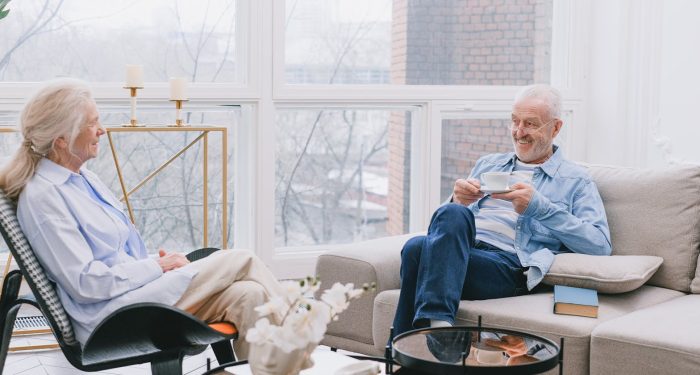
The most expensive anti-aging routine in the world can't compete with a person who finally stopped punishing themselves for who they used to be

Add VegOut to your Google News feed. 
I've been taking photographs around Los Angeles for the better part of a decade now, and there's something I've noticed that I can't quite explain with lighting or angles.
Some people just look better as they get older. Not in a "good genes" way. Not in a "they clearly have an excellent dermatologist" way. Something else entirely. A looseness in their face. An ease behind their eyes. The kind of thing a camera picks up even when you're not trying to capture it.
And the more I've paid attention, the more I've realized that the people who carry this quality almost always share a specific set of internal traits. They've done something with their regret that most people haven't. Not eliminated it. Processed it.
Here's what I keep seeing.
1) They've stopped performing a version of themselves that expired years ago
You can see it in someone's face when they're still holding on to who they used to be. There's a tightness to it. A strain. Like they're wearing a costume that stopped fitting a long time ago but they're afraid of what's underneath.
People who age well have let that go. They're not trying to be the person they were at 25 or 35. They've grieved that version of themselves, maybe even thanked it, and moved on.
This is harder than it sounds. We live in a culture that treats aging like a problem to solve rather than a process to inhabit. But the people who actually look at peace in their fifties and sixties? They've stopped fighting the current. And that surrender shows up physically in ways that no retinol can replicate.
2) They laugh at their former selves without cringing
There's a difference between someone who laughs about their past and someone who winces at it. The wince is unresolved. The laugh is integrated.
I spent three years as the most insufferable kind of vegan evangelist. I'm talking statistics at dinner parties, unsolicited documentaries sent to family group chats, the works. I once ruined my friend Sarah's birthday dinner by turning it into a moral lecture nobody asked for. It took a long time before I could talk about that period without feeling a hot flush of embarrassment.
Now I can laugh about it. Not because it wasn't bad. It was. But because I've actually sat with the regret, understood why I acted that way, and let it teach me something instead of letting it haunt me.
That integration shows up in how people carry themselves. When you've made peace with your worst moments, your face stops guarding against them.
3) They've apologized without keeping score
Ever notice how some older people seem to carry a lightness that has nothing to do with their circumstances? Often, if you dig into their story, you'll find a history of apologies. Real ones. The kind that don't come with conditions or expectations of forgiveness.
Undelivered apologies sit in the body. They tighten the jaw, furrow the brow, hunch the shoulders. They become posture. And over decades, that posture becomes a face.
I still apologize to Sarah for that birthday dinner years later. She laughs it off now and tells me to stop. But the act of owning it, fully and without excuse, changed something in me. It released a weight I didn't even know I was carrying.
People who process regret through honest accountability tend to move through the world differently. There's a physical unburdening that comes with no longer defending your worst decisions.
4) They chose curiosity over bitterness
This one's subtle but it might be the most important.
When something goes wrong in your life, a relationship ends, a career stalls, a decision backfires, you essentially face a fork in the road. You can get bitter about it or you can get curious about it. Both are valid emotional responses. But over time, they produce very different people.
Bitterness hardens. It narrows the eyes and sets the mouth. You can literally see it accumulate on someone's face over the years, like geological layers of resentment.
Curiosity does the opposite. It opens. It softens. The people I've photographed who have this quality tend to ask questions about their own lives rather than make declarations. "Why did I make that choice?" instead of "I can't believe that happened to me."
I read a lot of behavioral science, and one of the recurring findings is that people who adopt a curious stance toward their own mistakes tend to experience less chronic stress and more psychological flexibility. That flexibility translates physically. It's the difference between a face that's bracing for impact and one that's open to what's next.
5) They've let go of at least one grudge that felt permanent
Grudges age people. I don't mean that metaphorically. I mean you can see it.
Holding onto anger and resentment is an ongoing act of physiological stress. The body doesn't distinguish between a threat in front of you and one you're replaying in your mind for the thousandth time. It responds to both with tension, inflammation, and cortisol.
The people who seem to get more attractive with age have usually released at least one grudge they once swore they'd carry forever. Not because the other person deserved forgiveness. But because they got tired of renting out that much space in their nervous system to someone who wasn't paying.
My grandmother is one of the most beautiful women I know, and she's been through things that would have hardened most people. Raised four kids on a teacher's salary. Dealt with setbacks I won't get into here. But she doesn't carry bitterness. She volunteers at a food bank every Saturday and talks about her life with a warmth that has nothing to do with denial and everything to do with choice. She chose not to let the hard parts define her face.
6) They stopped chasing approval from people who don't matter
There's a specific kind of exhaustion that comes from spending your life performing for an audience that was never going to clap. And it shows.
People who age beautifully have usually gone through a quiet reckoning where they identified whose opinion actually matters to them, and stopped contorting themselves to please everyone else. This isn't arrogance. It's editing.
When I first started writing, I wanted everyone to think I was smart. Every sentence was trying to prove something. It made my writing stiff and my face tense, because I was constantly scanning for validation from people I didn't even respect.
Letting go of that need didn't happen overnight. But as it gradually loosened its grip, something physical shifted too. My shoulders dropped. My expression softened. I stopped clenching my jaw while staring at a screen.
The pursuit of universal approval is one of the most aging forces there is. Not because of the stress, though that's part of it. But because it keeps you locked in a version of yourself that was designed for other people's consumption rather than your own comfort.
7) They sit with discomfort instead of numbing it
Most people, when regret or pain shows up, reach for something to make it stop. A drink. A scroll. A purchase. A distraction. Anything to avoid sitting in the feeling long enough to actually hear what it's saying.
The people who carry that rare, quiet beauty into their later years tend to have a different relationship with discomfort. They've learned to stay in the room with it. Not wallow. Not dramatize. Just sit.
I've mentioned this before but cooking has become something like meditation for me. When I'm in the kitchen on a Sunday evening, chopping vegetables and stirring something slow, my mind does this thing where it sorts through whatever I've been avoiding. Regrets surface. Old conversations replay. And instead of reaching for my phone, I just let them move through.
It's not therapy. But it's a practice. And over years, practices like this seem to produce a certain quality of presence that other people can feel and, I believe, see.
8) They stopped trying to look younger and started trying to look like themselves
This might be the most visible trait of all, and it's the most paradoxical.
The people who age most beautifully are almost never the ones trying hardest to fight the aging process. They're the ones who've accepted the lines, the grey, the shifting proportions of their face, and decided to inhabit all of it rather than wage war against it.
This isn't about "giving up." It's about redirecting the energy that used to go toward fighting time and putting it toward actually living in the present. The person who's at ease with their age radiates something that no procedure can manufacture. It's settledness. It's the physical expression of someone who has stopped arguing with reality.
And here's the connection to regret: accepting how you look right now requires accepting every decision, mistake, and detour that brought you here. Every sleepless night. Every wrong turn. Every season of your life that didn't go according to plan. Your face is the accumulation of all of it.
The people who glow? They've made peace with the whole story. Not just the highlight reel.
The bottom line
Beauty that deepens with age isn't genetic luck. It's not a supplement stack or a ten-step routine.
It's the physical residue of someone who has done the quiet, unglamorous work of processing their life honestly. Of apologizing when they needed to, forgiving when it was time, laughing at their own ridiculousness, and choosing to stay curious about their mistakes instead of calcifying around them.
You can't buy that at a store. But you can start building it today.
And your face, eventually, will show the difference.
What’s Your Plant-Powered Archetype?
Ever wonder what your everyday habits say about your deeper purpose—and how they ripple out to impact the planet?
This 90-second quiz reveals the plant-powered role you’re here to play, and the tiny shift that makes it even more powerful.
12 fun questions. Instant results. Surprisingly accurate.