When my daughter asked if I was happy, I said yes without thinking — and then spent a night realizing I'd been performing contentment so convincingly for twenty-five years that I'd fooled the only person who could have done something about it: myself

Add VegOut to your Google News feed. 
She asked it while we were doing dishes. That's the thing about Grace — she never asks the big questions when you're sitting down and ready for them. She asks them while your hands are in soapy water and you don't have time to build a wall.
"Mom, are you happy?"
I said yes the way you say bless you when someone sneezes. Automatically, without thought, because it's what the moment requires. She smiled, I smiled, we finished the dishes, and she went home.
That night I sat in my kitchen with the stove light on — the only light I use during those honest hours — and I asked myself the same question. Not the polite version. The real one. The one with no audience.
And the answer that came back was so quiet I almost missed it: I don't think I've been happy since my mid-forties. I think I've been performing contentment so convincingly, for so long, that I fooled the only person left in the audience. Myself.
The moment it stopped and I didn't notice
I can't point to a date. That's what makes this so disorienting. If happiness had ended with a door slamming or a diagnosis or a specific loss, I could locate it. I could say, "There — that's where it went." But it didn't leave like that. It left the way color fades from a photograph sitting in sunlight. So gradually that you only notice when someone shows you what the original looked like.
My mid-forties. I've been turning that over since the night Grace asked. What was happening then? I was deep into teaching — year twenty or so, the stretch where the idealism has worn off but the pension isn't close enough to justify leaving. My second husband's Parkinson's hadn't been diagnosed yet, but something was starting to shift in him, a tremor in his hand he dismissed as nothing, a fatigue we both pretended was normal. My mother's Alzheimer's was beginning its slow siege. My children were teenagers, which is its own kind of daily crisis management.
I was holding everything. And somewhere in the holding, I stopped feeling and started functioning. The way a pilot switches to instruments when the visibility drops — you stop looking out the window and you just read the gauges. Altitude: stable. Speed: adequate. Keep going.
I kept going for twenty-five years.
What contentment looks like from the outside
The thing is, I wasn't miserable. I want to be precise about that, because this isn't a story about depression, though I've had my seasons of that too. This is about something more insidious — the slow replacement of happiness with its understudy. Contentment. Satisfaction. Fine.
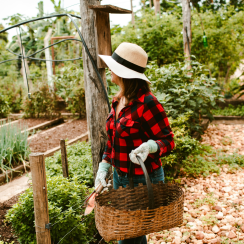
From the outside, fine looked convincing. I showed up. I taught well. I raised my children with love and presence, or as much presence as survival mode would allow. I tended my garden, maintained friendships, went to church, baked bread, kept my house in order. I smiled genuinely at things that genuinely warranted smiling — my granddaughter's first steps, a student's breakthrough with a book they'd resisted, the particular way autumn looks in my neighborhood when the light hits the maples.
But there's a difference between a life that produces moments of joy and a life lived inside happiness. The moments came and went like weather. The baseline — the thing underneath, the hum of being alive — was something flatter. Something managed. Something that required no turbulence and produced no flight.
I became an expert at managed living. At keeping the gauges steady. At answering "How are you?" with "Good, good" and meaning it just enough to pass inspection.
The roles that replaced the feeling
I think what happened in my mid-forties is that I became my roles. Not played them — became them. Teacher. Mother. Wife. Caretaker. Daughter. Each one had a script, and each script had a version of happiness built in. A good teacher finds fulfillment in her students. A good mother finds joy in her children. A good wife finds satisfaction in partnership. I performed those scripts so faithfully that I stopped noticing there was no one behind the curtain.
When you're needed constantly — by students, by children, by a husband whose body is slowly betraying him, by a mother who's disappearing one memory at a time — there's no room for the question "Am I happy?" There's only room for "Am I getting through this?" And getting through it, surviving it, became the thing I confused with living.
My therapist — I started seeing her much later, after my husband passed — once asked me when I last did something purely because it brought me pleasure. Not because it was useful, not because someone else benefited, not because it maintained a relationship or fulfilled an obligation. Just because it felt good.
I couldn't answer. Not because I couldn't remember. Because I wasn't sure I knew the difference.
How you fool yourself
Here's what no one tells you about performing contentment: it works. Not just on other people. On you.
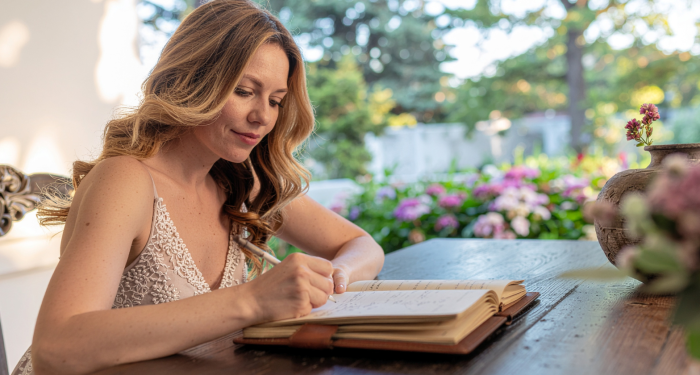
The gratitude journal I've kept every evening since my husband died — three things I'm thankful for, written faithfully before bed. The Sunday phone calls with Grace where I share the nice parts of my week. The way I describe my life to friends at supper club: full, peaceful, rich with small pleasures. All of it true. None of it a lie, exactly. But all of it curated in a way that reinforces a narrative I need to believe.
If I write down three good things every night, I must be happy. If I can list pleasures — the garden, the bread, the grandchildren, the books — I must be content. The evidence is right there in my own handwriting. Who am I to argue with it?
But happiness isn't a list. It isn't evidence you compile to build a case for your own well-being. It's something you feel in your body before your mind can name it — a looseness, a warmth, an unguarded moment where you're not managing anything, just existing. And when I search for that feeling honestly, reach past the curated version and look for the raw one, I come up empty in a way that frightens me.
Not because the emptiness is new. Because I just realized it's been there for twenty-five years and I wallpapered over it so well that I forgot the wall was bare.
The woman behind the performance
So who is she — this woman I've been hiding from myself?
She's tired. Not physically, though that too. Tired of being the strong one, the reliable one, the one who holds it together. Tired in a way that rest can't reach because it isn't about sleep. It's about decades of being the person everyone needed at the expense of being the person she actually was.
She's angry, though that word still makes me flinch. Angry about the years she spent working two jobs while her first husband contributed nothing. Angry about the unfairness of watching her second husband — the good one, the kind one — stolen by a disease that took him one piece at a time. Angry about the career she loved that never paid her what she was worth. Angry about things she smiled through at the time because anger wasn't available to women who wanted to be liked.
And underneath the tiredness and the anger, she's sad. Not about any one thing. About the accumulation. About the realization that she spent the best decades of her adult life in survival mode and called it a good life because survival was all she'd been taught to aim for.
My mother would say "we don't dwell." My generation would say "count your blessings." And both of those are true as far as they go. But they don't go far enough for a woman sitting alone at 70, realizing that the life she's grateful for is not the same as the life she wanted, and that she may have waited too long to notice the difference.
What I'm doing about it, or trying to
I told my therapist what I realized. She didn't look surprised, which tells me she'd been waiting for me to arrive at this particular door for a while.
She asked me what happiness felt like before my mid-forties, and I described a few things — dancing in my kitchen with my children when they were small, the first time a student told me I'd changed their life, a night in the early years of my second marriage when we sat on the porch and he made me laugh until my stomach hurt. They were all moments. Not a state. Even at my happiest, happiness came in flashes.
Maybe that's the honest truth for most people. Maybe sustained happiness is a story we tell ourselves, and the real thing is briefer and rarer than the brochure suggests. But even if that's the case, I want more flashes. I want the unguarded moments back. I want to catch myself smiling when no one is watching and know it's real.
So I'm experimenting, carefully and clumsily. I'm trying to notice when I'm performing versus when I'm feeling. I'm paying attention to what my body does when something actually brings me pleasure — the specific warmth, the way my shoulders drop — versus the things I do out of habit that produce nothing but the appearance of a life well-lived.
I'm letting myself be angry in my journal, which is harder than it sounds when you've spent seventy years being pleasant. I'm asking myself, before I agree to things, whether I want to or whether I'm managing someone else's expectations. The answers are uncomfortable. Some days they're devastating.
Final thoughts
Grace called on Sunday, our usual time. We talked about her garden, my watercolor class, a book we both liked. At the end she said, "Love you, Mom. I'm glad you're doing well."
I almost said "I am." The performance was right there, polished and ready.
Instead I said, "I'm working on some things."
She paused. "What kind of things?"
"The kind that take a while," I said. "But I'm working on them."
It was the most honest thing I've said to her in years. And it wasn't happiness — not yet, maybe not for a while. But it was real, and real is where I have to start if I ever want to stop performing and start actually living whatever time I have left.
I'm 70. I've spent twenty-five years fooling everyone, including myself. The performance was flawless. But the curtain is coming up now, and behind it is a woman who deserves more than fine.
I'm going to find out what more looks like. Even if it's late. Even if it's hard. Even if the answer turns out to be smaller and simpler than I expect.
At least it will be mine.