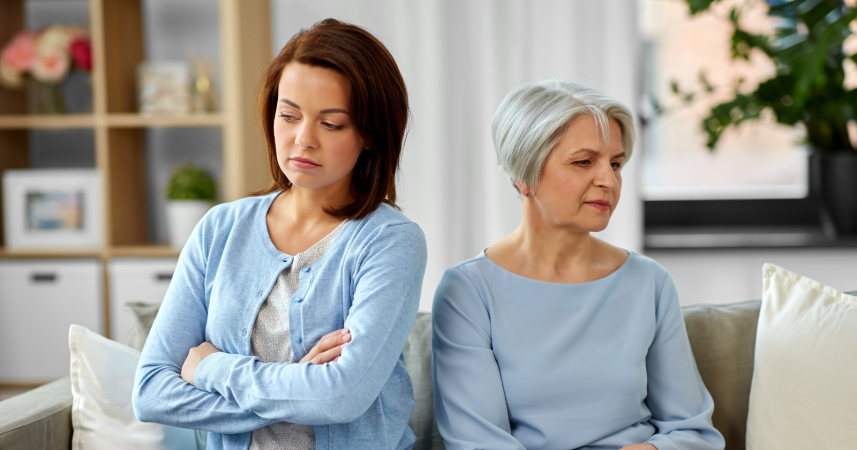
After decades of being "Mom," I discovered my adult children know the woman who packed their lunches and signed their permission slips, but have no idea who I was before them or who I've become since—and the realization that we're strangers living inside a shared history broke my heart wide open.
It happened during Sunday dinner last year when my daughter asked if I'd always been "such a morning person." The question stopped me mid-reach for the potatoes. She genuinely didn't know that I used to stay up until 2 AM grading papers, surviving on coffee and determination, or that my 5:30 AM wake time now is a luxury I chose, not a lifelong habit. In that moment, I understood something that has haunted me since: my children know their mother, but they don't know me.
We tell ourselves that the people who love us best know us best, but I've come to believe the opposite is often true about mothers and their children. The closer the relationship, the more fixed the image, and the less room there is for the person to keep changing underneath it. My children have loved me faithfully for nearly five decades, and that love has, in its own way, frozen me in place.
They know the woman who packed their lunches with notes tucked inside, but not that I often wrote those notes while crying at the kitchen table, overwhelmed by the weight of raising them alone. They know I showed up for every game and recital, but not that I missed my son's college graduation because I couldn't afford the plane ticket, a wound that still stings decades later. They've constructed a version of me from the artifacts of their childhood, and I've let them, because that's what mothers do. We become who our children need us to be, and somewhere in that becoming, we forget to mention who we were before, or who we're still becoming.
My son Daniel, now forty-five with children of his own, recently mentioned how stable our childhood home always felt. I wanted to laugh. Or cry. Probably both. He doesn't know about the two years we survived on food stamps, when I'd swallow my pride like bitter medicine just to keep them fed. He doesn't know about the substitute teaching job I took while finishing my degree, desperate to provide stability while learning that sometimes just showing up matters more than being perfect. That stability he remembers? I manufactured it from exhaustion and willpower, held together with library books and peanut butter sandwiches.
The other night, I was practicing piano, something I took up at sixty-seven just to prove that new skills have no age limit. My fingers fumbled through a simple melody when I realized this is exactly the kind of detail my children don't know about me. They know their mother taught high school English for thirty-two years, but not about the principal who tried to push me out early in my career, or the student whose suicide changed how I saw every struggling kid afterward. They don't know I won Teacher of the Year twice but counted my real victories in quiet moments, like helping a reluctant reader fall in love with books.
Grace doesn't know that watching her struggle with postpartum depression taught me more about helplessness and hope than any of my own battles. She doesn't know that I still carry guilt for leaning on Daniel as "the man of the house" when he was just a boy himself. These are the shadows cast by motherhood, the parts we hide to protect them, and later, to protect ourselves from having to explain.
Virginia Woolf once wrote that "the past is beautiful because one never realizes an emotion at the time." But I'm realizing emotions now, at seventy, that I couldn't afford to feel then. The loneliness of those fifteen years between marriages when I was both desperately alone and completely fulfilled. The way I learned to sleep alone again after twenty-five years of marriage, discovering that grief doesn't shrink, you just grow larger around it. The relief and terror of waiting three years before introducing them to the man who would become their stepfather because I'd learned that protecting hearts matters more than filling voids.
My children were already adults when I maintained my forty-five year friendship with my college roommate despite living states apart. They weren't there when I lost most of my parent friends after the divorce, when couples stopped inviting the single woman to things. They don't know I once accidentally outbid a stranger on a weekend getaway at a school auction, and that stranger became their stepfather, a story that still makes me laugh at life's strange choreography.
Now I wake at 5:30 without an alarm, spend the first hour in silence with tea and my journal, maintaining rituals they've never witnessed. Monday soup-making with whatever needs using up. Thursday morning coffee with my neighbor of fifteen years. Sunday evening phone calls with Grace that anchor our weeks. I've learned Italian at sixty-six, discovered fifty bird species by sound during the pandemic. I volunteer at the women's shelter teaching interview skills, and have learned that female friendships require tending like gardens.
They know I remarried and lost my second husband to Parkinson's, but not that couples counseling in year five taught me that asking for help is its own form of love, or that I'd forgotten our first anniversary because I was still learning to trust happiness. They know their grandmother, my mother, had Alzheimer's, but not how caring for her taught me about anticipatory grief. They know I'm one of four sisters but not about the five-year falling out that taught me forgiveness, or that finding my mother's recipe box showed me how love passes through generations in flour-dusted measurements and penciled notes.
My grandchildren know yet another version of me. The one who lets them make messes baking cookies, who takes each on solo adventure days, who writes birthday letters they'll receive when they turn twenty-five. They see the grandmother who has time, wisdom, and fewer exhaustions. But even they don't know about the woman who practices yoga every morning to stay mobile enough to keep showing up, or who learned that being invisible as an older woman is only true if you let it be.
Sometimes I think about how I've learned to embrace technology by taking senior center classes and asking my grandchildren for help. How I've overcome the shame of divorce in an era when it was stigmatized, survived six months of barely leaving the house after my second husband's death. How I've learned to accept praise for my writing instead of deflecting it, to spend on myself without guilt after years of putting everyone first, understanding that asking for help is a form of love, not weakness.
This is the peculiar grief of aging, not just that your body betrays you with arthritis and failing knees, but that the people you love most know only fragments of your story. They know the mother, not the woman who survived budget cuts that eliminated her beloved creative writing elective, who fought for what mattered and learned that kindness and maintaining standards aren't opposites. They don't know about the mentor who helped me overcome a decade of imposter syndrome, or that teenagers taught me more about wisdom than any adult education could.
Perhaps this is every parent's realization at some point, that we are archaeological sites our children never thought to excavate, layers of selves buried under the topsoil of their needs and our love for them. They know the artifacts: the permission slips signed, the meals cooked, the advice given. But the civilizations that came before and after their time remain largely undiscovered, unknown, unasked about.
Final thoughts
Last week, sitting in my sunroom where I read for an hour each afternoon, I watched a cardinal at the feeder and thought about introductions. I thought about the stories I could pass across the table on Sunday, folded in beside the potatoes. I also thought about how many Sundays have already come and gone without my saying a word, and how easily the next one could pass the same way. The cardinal stayed for a while, then lifted off without ceremony. I sat there a long time after, the question of whether I would ever actually speak still hovering in the room, unanswered, the woman inside the mother still waiting to see if she would introduce herself, or whether she would simply keep watching the feeder, keep becoming someone her children may never quite meet.
If You Were a Healing Herb, Which Would You Be?
Each herb holds a unique kind of magic — soothing, awakening, grounding, or clarifying.
This 9-question quiz reveals the healing plant that mirrors your energy right now and what it says about your natural rhythm.
✨ Instant results. Deeply insightful.
Marlene Martin
Marlene Martin is a retired high school English teacher who spent 38 years in the classroom before discovering plant-based eating in her late sixties. When her daughter first introduced her to the idea of removing animal products from her diet, Marlene was skeptical. But curiosity won out over habit, and what started as a reluctant experiment became a genuine transformation in how she thinks about food, health, and aging.
At VegOut, Marlene writes about nutrition, wellness, and the experience of embracing new ways of eating later in life. She brings a teacher’s instinct for clarity and patience to topics that can feel overwhelming, especially for readers who are just beginning to explore plant-based living. Her writing is informed by personal experience, careful research, and a belief that it is never too late to change.
Marlene lives in Portland, Oregon, where she spends her mornings reading research papers, her afternoons tending a modest vegetable garden, and her evenings knitting while listening to audiobooks. She has three adult children and two grandchildren who keep her honest about staying current.
More Articles by Marlene