What a few years in the world's happiest country taught me about why Americans are doing contentment all wrong

Add VegOut to your Google News feed. 
I've been chasing happiness for most of my adult life. Books, podcasts, meditation apps, therapy, the whole circuit. Turns out I should have just moved to Copenhagen.
I spent three years living in Denmark's capital, working remotely and trying to understand what made this place tick. The answer wasn't what I expected. It wasn't some secret Nordic philosophy or genetic predisposition to contentment. It was simpler than that.
The Danes have built a culture around specific habits that, when practiced consistently, create conditions for happiness to flourish. These aren't revolutionary concepts. They're observable patterns in how people structure their days, relate to each other, and think about work and life.
Denmark ranks second in the World Happiness Report year after year. Not because Danes are immune to stress, depression, or hardship. They're not. But they've created a social framework that makes everyday contentment more accessible than in most other places.
Here's what I learned.
1) They leave work at work
The first thing that struck me about Danish work culture was how seriously people took their boundaries.
Five o'clock arrives, and people leave. Not "leave but check email all evening" leave. Actually leave. Laptops close, phones go on silent, work ceases to exist until tomorrow morning.
The standard work week in Denmark is 37 hours. Not 40, not 50, not "whatever it takes to get ahead." Thirty-seven hours, with a minimum of five weeks paid vacation annually. And people use those vacation days. All of them.
I had a Danish colleague who would decline meeting requests after 4:30 because she needed to pick up her kids from daycare. No apology, no explanation beyond that. Just a simple "I'm not available then."
In the U.S., that would read as lack of commitment or ambition. In Denmark, it's normal. Expected, even.
This isn't laziness or lack of drive. Danes are incredibly productive during work hours. They just don't subscribe to the idea that longer hours equal better results. And it seems to work. Denmark consistently ranks high in productivity despite working fewer hours than most other developed countries.
The psychological impact of this is profound. When you know work won't bleed into your personal life, you can actually relax. You can be present with your family, your hobbies, yourself. That separation creates space for the kind of contentment that gets measured in happiness surveys.
2) Cycling is the default, not the exception
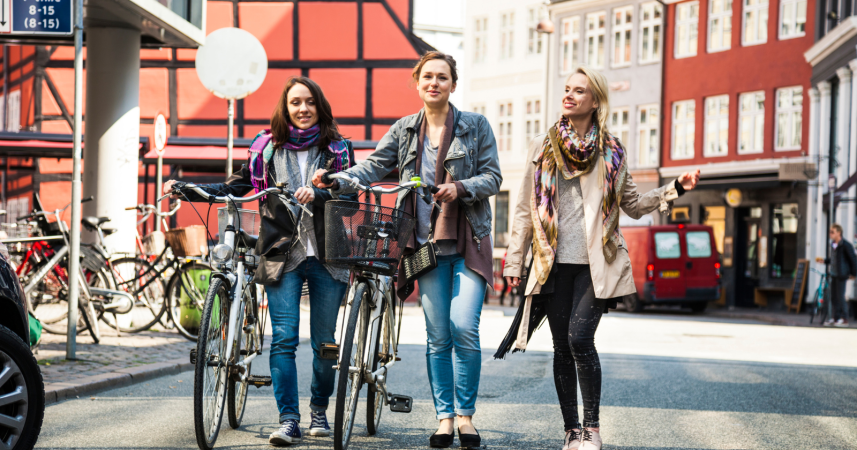
More than 50% of Copenhageners bike to work or school daily. Rain, shine, snow, it doesn't matter. The bike is how you get around.
This might sound like a transportation choice, but it's actually a happiness hack.
First, there's the obvious physical health component. Regular physical activity reduces stress, improves mental health, all the standard exercise benefits. But integrated seamlessly into the daily routine rather than requiring a separate gym commitment.
But the happiness piece goes deeper than that.
Cycling puts you in the world in a way that cars don't. You're not isolated in a metal box, stressed about traffic and parking. You're moving through your city, seeing neighbors, noticing seasonal changes, arriving at work or home slightly invigorated rather than tense from sitting in gridlock.
I started cycling everywhere when I moved to Copenhagen. Not because I'm particularly athletic or environmentally conscious, though those are nice side effects. I did it because it was the easiest option. The infrastructure makes it faster than driving. Safer too, with dedicated bike lanes and traffic lights specifically for cyclists.
Within a month, I noticed I felt better. More alert in the morning, less drained in the evening. That's the genius of Danish urban planning: they've made the healthy choice the convenient choice.
3) Trust operates at a societal level
This one took me longest to understand because it's so fundamentally different from American culture.
Danes trust each other. Not naively, but as a default operating mode.
Parents leave strollers with sleeping babies outside cafes while they go inside for coffee. People don't lock their bikes with heavy chains. Store clerks hand you products to test before you've paid. Politicians bike to parliament without security details.
This trust extends to institutions too. Danes pay some of the world's highest taxes, around 45-56% of their income, and they do it willingly because they trust the government to use that money well. Healthcare is free. Education through university is free. Childcare is heavily subsidized. The elderly receive pensions and in-home care.
The social safety net is comprehensive, and knowing it exists removes a massive source of anxiety. You won't go bankrupt from medical bills. Your kids can attend university regardless of your financial situation. If you lose your job, you have up to two years of support while you find new work.
This creates what psychologists call "freedom from fear." Not perfect security, obviously. But enough cushion that everyday financial stress doesn't dominate your mental space.
When I asked a Danish friend about this, she said something that stuck with me: "I don't worry about the future the way my American friends do. Not because my life is perfect, but because I know if something goes wrong, I won't be destroyed by it."
That sense of security is foundational to happiness.
4) Hygge isn't just candles and blankets
Everyone knows about hygge by now. The cozy aesthetic, the candles, the soft blankets. What gets lost in the Instagram version is that hygge is fundamentally about intentional intimacy.
It's not about stuff. It's about creating spaces and moments where people feel safe enough to be fully present with each other.
A hygge evening might involve board games with family, dinner with close friends, or reading alone by a window. The common thread is the absence of performance. No one's trying to impress anyone. No one's checking their phone every five minutes. The atmosphere encourages you to drop your social armor and just exist.
This is harder to achieve than it sounds. American social culture often involves some level of performance. We're "on" even during downtime. We're thinking about how we appear, what we should say next, whether we're being interesting enough.
Hygge explicitly rejects that. It values comfort over impression, contentment over excitement, togetherness over stimulation.
I experienced this most clearly during Danish winters, which are dark and cold and would be miserable without hygge. Instead of fighting the darkness, Danes lean into it. They light candles, make comfort food from scratch, invite people over for long dinners that stretch into the evening.
The mental health research on hygge shows it's integral to Danish wellbeing. It's a cultural practice that builds and maintains social bonds, provides regular opportunities for genuine connection, and offers a counterbalance to the demands of work and public life.
5) Equality is baked into everything
Denmark has extremely high levels of social equality compared to most countries. This isn't just about wealth distribution, though that matters. It's about how people relate to each other across social hierarchies.
CEOs bike to work alongside entry-level employees. Politicians shop at the same grocery stores as everyone else. There's less visible class distinction in daily life.
This shows up in small ways. Danes don't use formal titles much. First names are standard even in professional contexts. Expensive designer clothing is less common. People don't flash wealth the way Americans do.
The cultural value placed on equality reduces social comparison and status anxiety. When everyone has access to good healthcare, education, and social services, there's less pressure to prove your worth through consumption or achievement.
More equal societies tend to have higher levels of wellbeing. Not because everyone has the same amount of money, but because the gap between top and bottom is narrower, which reduces social stress and increases social cohesion.
Denmark's emphasis on equality also extends to gender. Paternity leave is standard and encouraged. Men are expected to be active parents. Childcare is structured to make it possible for both parents to work if they choose.
This matters for happiness because it distributes the burden of life maintenance more evenly. When social structures support both parents, relationships are less strained, burnout is reduced, and people have more flexibility to create lives that work for them.
6) Social connection is treated as essential infrastructure
Danes prioritize social relationships in a way that many other cultures don't.
Leisure time is protected and abundant. The average Dane spends more time on personal activities outside work than people in most other developed countries. Much of that time goes toward social connection.
Sports clubs, hobby groups, volunteer organizations, these are central to Danish life. People join things. They show up regularly. They build networks of relationships beyond just family and coworkers.
This matters because loneliness is one of the biggest barriers to happiness. The quality of our relationships affects wellbeing more than almost any other factor, including wealth or health.
Americans tend to be more geographically mobile and less rooted in communities. We move for jobs, leave friends behind, rebuild social networks from scratch multiple times throughout our lives. This takes a toll.
Denmark's smaller size and less mobile population means people often maintain friendships from childhood through adulthood. They live near family. They have established social circles that provide consistent support over decades.
When I lived in Copenhagen, I noticed how often people made plans with friends. Not occasional big events, but regular, low-key gatherings. Wednesday dinner with neighbors. Sunday bike ride with a friend. Friday afternoon coffee with former coworkers.
Social connection was woven into the weekly routine, not relegated to special occasions.
7) Modest expectations create space for contentment
This one might be the most important and the hardest for Americans to internalize.
Danes have lower expectations for what life owes them, which paradoxically makes them happier.
They're not chasing the American dream of constant upward mobility, unlimited success, and having it all. They're aiming for something more modest: a good life, comfortable but not extravagant, with enough security and time to enjoy the people and activities they care about.
This isn't settling or lack of ambition. It's a different definition of success.
Life satisfaction depends heavily on the gap between expectations and reality. If you expect constant excitement, perfect relationships, and continuous achievement, reality will always disappoint. If you expect a decent job, good relationships, and regular moments of contentment, reality can meet or exceed those expectations.
The Danish approach to happiness is fundamentally about lowering the bar just enough that everyday life can clear it consistently.
I struggled with this at first. My American conditioning told me that lowering expectations meant giving up, accepting mediocrity, not reaching my potential. But watching how Danes lived, I started to see it differently.
They weren't settling. They were being realistic about what actually makes humans happy, which isn't grand achievements or constant novelty. It's stable relationships, meaningful work, good health, and regular small pleasures.
8) Community responsibility outweighs individual freedom
Denmark places more emphasis on collective wellbeing than individual freedom.
This shows up everywhere. High taxes to fund social programs. Strong labor protections. Environmental regulations. Urban planning that prioritizes cyclists and pedestrians over cars.
Americans often frame this as a freedom vs security tradeoff. Danes see it as investing in the kind of society they want to live in.
The result is a culture where people feel responsible for each other's wellbeing, not just their own. Where contributing to the common good through taxes and social participation is seen as part of being a good citizen, not an imposition on personal liberty.
This creates what some call "social cohesion," the sense that you're part of something larger than yourself, that your wellbeing is tied to others' wellbeing, and that the society you live in is working for everyone, not just the fortunate few.
That sense of belonging and shared purpose contributes enormously to happiness.
9) They've accepted that winter is dark
Danish winters are brutal. The sun rises around 8:30am and sets around 3:30pm. It's cold, wet, and gray for months.
This could be depressing. Instead, Danes have built an entire cultural apparatus around making winter bearable and even enjoyable.
They don't fight the darkness or pretend it doesn't affect them. They acknowledge it and adapt. They light candles everywhere. They create cozy indoor spaces. They spend more time at home with family and friends. They embrace comfort food and warm drinks.
This acceptance of reality rather than resistance to it is a happiness strategy in itself.
So much of human suffering comes from wanting things to be different than they are. We're unhappy because it's raining when we wanted sun, because our job isn't perfect, because our relationships require work, because life is hard sometimes.
Danes seem to have internalized the idea that some things can't be changed, so you might as well adapt and find what's good within the constraints.
Winter is dark? Fine. Make the darkness cozy. Work is necessary? Fine. Structure it so it doesn't dominate your life. Some social inequality is inevitable? Fine. Minimize it as much as possible through policy and culture.
This pragmatic acceptance combined with active problem-solving creates a kind of resilience that supports long-term wellbeing.
Conclusion
After three years in Denmark, I moved back to the U.S. for work. The transition was harder than I expected.
I found myself frustrated by long commutes in traffic, by the expectation of responding to emails at night, by the constant pressure to do more, achieve more, want more. I missed the bike lanes and the reasonable work hours and the general sense that life didn't have to be quite so hard.
But here's what I took with me: the understanding that happiness isn't mysterious or unattainable. It's the result of specific choices about how to structure society, how to spend time, what to value, and what to let go of.
Denmark's high happiness rankings aren't about genetics or personality or some ineffable Nordic quality. They're about creating conditions where everyday contentment is possible for most people most of the time.
You can't import Danish culture wholesale into your own life. Cultural context matters. But you can borrow pieces. You can protect your work-life boundaries. You can prioritize relationships. You can lower your expectations just enough to let reality surprise you. You can create spaces for genuine connection without performance.
The Danes haven't solved happiness. They've just figured out that it emerges naturally when you remove many of the obstacles that prevent it.