Sometimes the youngest-looking person in the room is the one who finally stopped surviving their own life

Add VegOut to your Google News feed. 
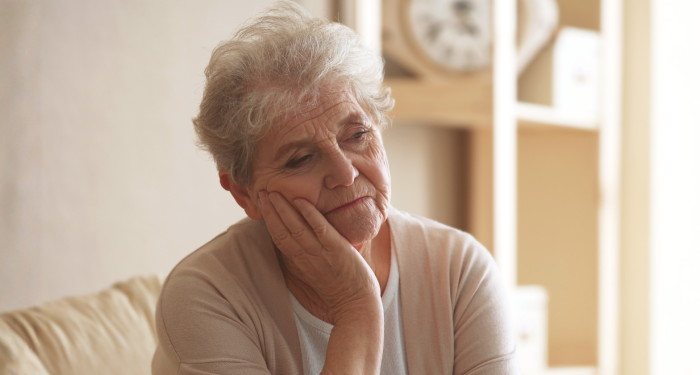
I found it in a shoebox at the back of a closet, tucked between expired coupons and old birthday cards. My mother's wedding photo. White dress. Posed smile. She was twenty-four years old and she looked closer to forty.
Not because of her skin or her hair or anything that basic. It was her eyes. There was nothing behind them. Or rather, there was something behind them, but it was already bracing. Already guarded. Already preparing for a life she could feel closing around her before the reception was over.
I set the photo on the kitchen counter and pulled up a recent picture of her on my phone. She's sixty-eight in that one. Laughing at something off-camera. Her face is lined, sure. Her hair is silver. But she looks younger. Not younger in the way magazines mean it. Younger in the way a person looks when something heavy has finally been set down after decades of carrying.
The difference between those two images isn't collagen. It's freedom.
What fear does to a face
We talk about stress and aging in vague, hand-wavy terms. "Stress ages you." Okay, sure. But we rarely get specific about what kind of stress, or what it actually looks like when it takes up permanent residence in someone's body.
Living in fear is not the same as having a stressful job or a packed schedule. It's not the same as worrying about bills or deadlines. Living in fear is a full-time physiological event. The nervous system never fully comes down. The jaw stays clenched. The shoulders stay up near the ears. The brow stays furrowed in that particular way that isn't concentration but vigilance.
My mother lived in that state for over twenty years. Not because she was anxious by nature. Because she was married to a man who made unpredictability the central feature of their household.
I'm not going to go deep into the specifics. That's her story to tell if she chooses. But what I will say is this: the woman in that wedding photo was not aging normally. She was being eroded. There's a difference between a face that's been lived in and a face that's been survived in.
The performance of being fine
One of the most aging things a person can do is pretend, every single day, that everything is okay when it isn't.
My mother was extraordinary at this. She showed up to school events. Hosted holiday dinners. Smiled in family photos. Made small talk with neighbors. And none of them had any idea what was happening behind the front door. Or if they did, they didn't say anything. Which, in some ways, is worse.
That performance is exhausting in a way that goes beyond tiredness. It requires holding two realities at once: the one you're living and the one you're presenting. And the gap between those two realities sits in the body. It sits in the lines around the mouth. In the tension behind the smile. In the way someone's laugh never quite reaches their eyes.
I think about this a lot now when I look through my camera lens. How much of what we read as "looking old" is actually the visible accumulation of unexpressed truth. How much of what we call "aging well" is really just someone who finally stopped performing.
What leaving looked like
She left when I was in my early twenties. I'd already moved to LA by then, so I experienced it mostly through phone calls and visits home. There was no dramatic scene. No sudden revelation. She just woke up one morning, apparently, and realized she'd spent more years being afraid than she'd spent being alive. And she decided she was done.
The first year after was hard. She was scared, uncertain, rebuilding a life from materials she hadn't touched in decades. She moved into a small apartment in Sacramento and did a lot of nothing for a while. Which, looking back, might have been the most important thing she could have done. After twenty-plus years of hypervigilance, her nervous system needed to learn what safety actually felt like.
I visited her that first Christmas after the separation. And I remember sitting across from her at a restaurant, looking at her face, and thinking something had shifted. Not dramatically. Just a slight softening around the eyes. A jaw that wasn't quite as set. The beginning of something I couldn't name yet.
The years that followed
Here's what nobody tells you about people who leave bad situations late in life: they don't just recover. They bloom. Not immediately. Not linearly. But unmistakably.
My mother started doing things she hadn't done in decades. She took a ceramics class. She traveled. She made friends, real ones, the kind she could actually be honest with. She started cooking again, not as an obligation but as something she enjoyed. Sunday evenings became her thing. She'd try a new recipe, call me to describe how it turned out, and actually sound happy.
I've mentioned this before but there's a concept in behavioral psychology called "post-traumatic growth," the idea that people who survive deeply difficult experiences can emerge not just recovered but fundamentally expanded. It doesn't happen to everyone. It's not guaranteed. But when it does, it's one of the most visible transformations a person can undergo. And it shows up in the face more than anywhere else.
My mother at sixty-eight has more light in her expression than she did at twenty-four. That's not a poetic exaggeration. It's a factual observation from someone who takes photographs for a living.
What the body remembers
There's a physical dimension to this that I think gets overlooked.
When someone lives in a state of chronic fear, the body adapts. Muscles tighten and stay tight. Posture shifts to protect vital organs. Facial expressions narrow to a limited range of "acceptable" emotions. Over years, these adaptations become structural. They become the face.
When the source of fear is removed, the body starts to unwind. Slowly. Reluctantly at first, because the nervous system doesn't trust that the threat is actually gone. But gradually, if safety is sustained, something remarkable happens. The face opens back up. Muscles that were clenched for years begin to release. Expressions that were suppressed start to resurface.
My grandmother, who raised four kids on a teacher's salary and has every reason to look worn out, carries herself with a warmth that defies her circumstances. I used to think that was just her personality. Now I think it's simpler than that. She was never afraid of the person she came home to.
That matters more than any skincare routine ever invented.
The myth of "aging gracefully"
We use that phrase a lot. Aging gracefully. As if it's about poise, or choosing the right moisturizer, or having the discipline to drink enough water.
But the people I've watched truly become more beautiful with time aren't disciplined about self-care in any remarkable way. What they have in common is something harder to put on a label: they're no longer carrying something that was slowly killing them from the inside.
Sometimes that thing is a relationship. Sometimes it's a career. Sometimes it's a version of themselves they were forced to inhabit for someone else's comfort. Whatever it is, the release of it produces a physical transformation that goes far beyond the superficial.
My mother doesn't do anything particularly special for her appearance. She walks in the mornings. She eats what she likes. She sleeps well, which she'll tell you is the single biggest change since her old life. For over twenty years, she never fully slept. Not really. Her body was always half-awake, always listening for what might happen next.
Now she sleeps. And you can see it in her face.
What I see when I look at her now
She came to visit me in LA last year. We walked along Venice Beach in the late afternoon, which is my favorite time for photography, the light goes soft and everything looks a little kinder than it actually is.
I took a photo of her standing near the water. She wasn't posing. She was just looking out at the ocean, thinking about something I didn't ask about. And when I looked at that image later, I saw a woman who was finally, completely, herself.
Not the version of herself that was curated for survival. Not the version that smiled for the camera while calculating the mood of the room. The real one. The one who'd been in there the whole time, underneath the vigilance and the performance and the quiet, relentless fear.
She looked beautiful. She looked free. And she looked, somehow, younger than she did on the day she married the man who took forty years of her life and aged her twenty.
The bottom line
I don't share this story to reduce my mother's experience to a lesson. Her life is not a metaphor. What she went through was real, and specific, and hers.
But I do think there's something worth noticing in the distance between those two photographs. Something that has nothing to do with serums or supplements and everything to do with what happens to the human body when it finally, mercifully, stops being afraid.
If you recognize any of this, in your own face or someone else's, know that it's never too late. My mother was in her late forties when she left. She would tell you the best years of her life started after fifty.
Your face tells your story. But the story isn't over until you decide it is.