While the rest of us rush through self-checkout, psychology reveals that those who wait for human cashiers aren't being inefficient—they're instinctively protecting the brief, vital interactions that secretly anchor their emotional well-being in an increasingly isolated world.
According to a 2023 survey by the National Retail Federation, nearly 67% of consumers have used self-checkout. Yet a growing body of research suggests that what we gain in speed, we may be losing in something harder to measure: the micro-interactions that quietly sustain our sense of belonging. Psychologists call them "weak ties," and for millions of people, the grocery checkout line is one of the last places they reliably occur.
I thought about this recently while watching a woman bypass three empty self-checkout stations to stand in the longest cashier line in the store. She wasn't being inefficient. She was protecting something precious that the rest of us might not notice we're losing until it's gone.
The hidden architecture of our days
Have you ever noticed how certain small rituals hold your week together? Not the big events or scheduled appointments, but the tiny, repeated interactions that create a rhythm to your days?
For me, it's the Thursday morning exchange with the postal worker who knows I'm waiting for packages of books. For my neighbor, it's the brief chat with the coffee shop barista who remembers her order. These moments are so small we rarely name them, yet when they disappear, when the postal worker retires, when the coffee shop installs an automated ordering kiosk, we feel unexpectedly untethered.
Toni Antonucci, Professor of Psychology at the University of Michigan, puts it perfectly: "Weak ties — low-stakes, friendly relationships that come out of daily life — help maintain our well-being." These aren't our deep friendships or family bonds. They're the lighter connections that somehow manage to carry surprising weight in our emotional lives.
The self-checkout machine, in all its beeping efficiency, was designed to eliminate exactly these moments. It solves for speed, not for the grandmother who needs someone to notice she's buying ingredients for her famous pie, or the widower whose only conversation today might be with the cashier.
When efficiency becomes isolation
I remember the months after my second husband died, when leaving the house felt like climbing a mountain. The grocery store became my practice ground for returning to the world. Those cashiers provided the perfect level of human interaction: present but not invasive, friendly but not demanding.
John Horvat II, author at The American TFP, observes that "Self-checkout is also the consequence of corporate cost-cutting. Retailers have welcomed the move because they don't have to deal with employees." But what's being cut isn't just costs. It's the connective tissue that helps many of us feel part of something larger than our individual lives.
During those difficult months, the twenty seconds of conversation at checkout weren't small talk. They were practice runs for remembering how to be human again. The cashier who asked about my garden gave me permission to think about something growing, something future-focused, when I was stuck in grief. The young clerk who needed help finding a produce code reminded me I still had something to offer, even in my fog of loss.
The real cost of convenience
Evan Schuman, a contributor at Computerworld, notes that "Retailers really want shoppers to use self-checkout. For them, self-checkout is a great opportunity to reduce staffing costs." Yet what looks like progress on a spreadsheet might be regression in terms of community health.
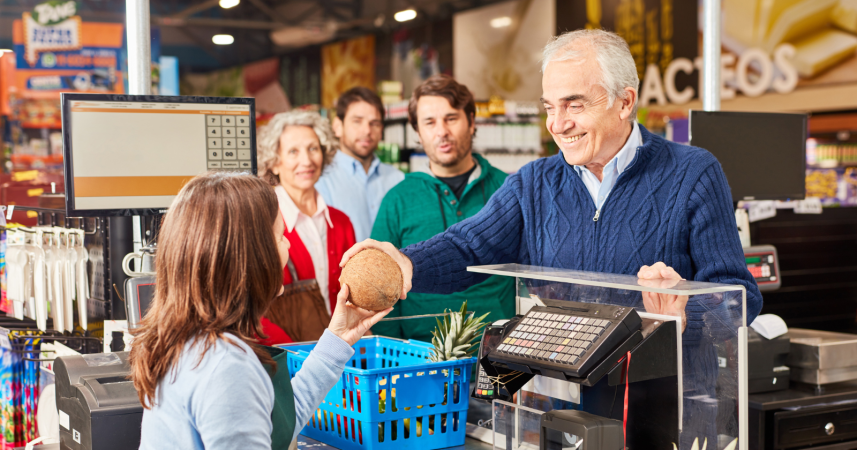
Think about your own week. How many genuine face-to-face interactions do you have with people outside your immediate circle? Not texts, not emails, not even video calls, but actual in-person moments where someone looks you in the eye and acknowledges your existence? For many of us, especially those who work from home or live alone, these brief checkout exchanges might represent a significant percentage of our human contact. We're not being dramatic or old-fashioned when we choose the human cashier. We're instinctively protecting something vital.
More than nostalgia
Some might argue that preferring human cashiers is just nostalgia, a resistance to progress. But research suggests something deeper at work. A study published in the Journal of Retailing and Consumer Services found that basic human needs such as autonomy, competence, and relatedness significantly influence customers' motivation to use self-service technologies like supermarket self-checkouts, suggesting that these needs may drive individuals to prefer human interaction over automated systems.
What strikes me about this research is the word "relatedness." It's such a simple concept, yet so fundamental to who we are as humans. We need to relate to others, to be seen, to matter. Even if just for the thirty seconds it takes to buy milk and bread.
I watch my neighbor struggle with the self-checkout while juggling her toddler and groceries, the machine insisting there's an "unexpected item in the bagging area." I remember being that mother, remember how a kind word from a cashier could transform a difficult morning. The machine offers no grace. No understanding that sometimes the unexpected item is a tired child or a weary heart.
The courage to be inefficient
Interestingly, an article from The Atlantic discusses how some shoppers prefer self-checkout lines, even when they are longer, to avoid human interaction, suggesting that the desire for solitude and control may lead individuals to choose automated systems over human engagement.
This makes perfect sense too. We all have days when we need to be invisible, when interaction feels too heavy. The beauty of choice is that it honors both needs — the need for connection and the need for solitude.
But here's what worries me: when we eliminate human cashiers entirely, we remove that choice. We force everyone into the same isolated efficiency, whether it nourishes them or not.
In my writing about resilience and finding purpose later in life, I often return to this truth: the things that save us are rarely the big, dramatic interventions. They're the accumulated small kindnesses, the tiny points of connection that remind us we're part of the human family.
Final thoughts
The next time you breeze through self-checkout, consider what you're optimizing for. Speed, certainly. Convenience, sure. But what are you optimizing away?
Those brief moments at checkout aren't just transactions. They are, for more people than we'd like to admit, among the only points of genuine human contact in an entire day. And here's the uncomfortable part: most of us will never know when we've had our last one. We'll just wake up one morning in a world of screens and scanners and wonder why everything feels so efficient and so empty at the same time.
So the question isn't really about checkout lines. It's this: how many of the connections you depend on have you already automated away without noticing?