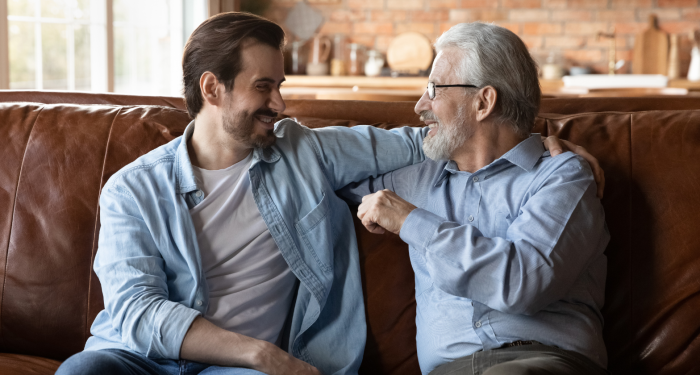
The ordinary moments boomers lived through without a second thought turned out to be the memories they'd cherish most - from dinners without phones to neighborhoods where everyone actually knew each other
Ever notice how the smallest moments from childhood end up being the ones that hit hardest later on?
I've been thinking about this lately, partly because my nephew just turned seven and I watched him lose himself in building a fort out of couch cushions at his birthday party. His parents were stressing about the mess, but I couldn't stop thinking about how he won't remember the expensive toys. He'll remember that fort.
There's something about the boomer generation and their relationship with memory that fascinates me. They grew up in a time before everything was documented, before phones captured every moment. Their memories exist without digital backup, which means the ones that stuck around did so because they actually mattered.
So today, I want to explore those moments that seemed like nothing at the time but turned out to be everything. The memories that sneak up on you decades later and make you realize what you had.
1) Dinners where everyone actually sat together
Remember when dinner meant everyone parked themselves at the same table at the same time?
No phones. No screens. Just forks scraping plates and actual conversation.
My grandmother still talks about this. She raised four kids on a teacher's salary, and dinner was the one time everyone had to show up. No exceptions.
She didn't think much of it then. It was just what you did. But now she tears up talking about those meals, remembering the arguments about nothing and the laughter that made milk come out of someone's nose.
The thing is, those dinners weren't special. That's exactly why they were special.
They were routine. Boring, even. But they built something that weekly family brunches and holiday gatherings can't quite replicate. They built daily connection.
2) Having actual boredom
This sounds strange to say, but boredom used to be a feature, not a bug.
You'd finish your homework, stare at the wall, and have to figure out what to do with yourself. No algorithm suggesting the next video. No infinite scroll. Just you and time.
Boomers didn't realize they were learning how to be alone with their thoughts. They were accidentally developing the ability to generate their own entertainment, to sit with discomfort, to create something from nothing.
I've mentioned this before, but I grew up in the early internet era, right on that cusp. I remember both kinds of childhood: the one where you had to invent games with sticks, and the one where you could disappear into a screen.
The difference is stark.
That forced boredom made people reach for instruments, books, art supplies, weird experiments in the garage. It made them call friends and actually make plans instead of just commenting on posts.
Now that skill feels almost radical.
3) Knowing your neighbors
There was a time when you knew everyone on your block.
Not in a creepy surveillance way. You just knew them because you existed in the same physical space regularly. You borrowed sugar. You chatted over fences. Kids played together in yards without scheduled playdates.
My parents grew up like this in suburban Sacramento. They talk about how Mrs. Henderson would watch them walk home from school. How Mr. Lee taught half the neighborhood kids to ride bikes. How everyone knew which houses gave out full-size candy bars on Halloween.
Nobody thought this was precious. It was just how neighborhoods worked.
But that casual community created a safety net that didn't require apps or Ring cameras. It was organic. People noticed when something was off. They helped because you were neighbors, not because they expected anything back.
That kind of social fabric is harder to weave when everyone's inside staring at screens.
4) Writing actual letters
Before texts, before email, before any of it, people wrote letters.
Real ones. On paper. With stamps.
You'd sit down, think about what you wanted to say, write it out in your actual handwriting, seal it up, and send it off into the void. Then you'd wait days or weeks for a response.
The whole process forced you to be intentional. You couldn't fire off whatever popped into your head. You had to think, compose, commit.
Boomers didn't know they were creating artifacts. Those letters became physical proof of relationships, of specific moments in time, of who they were at different ages.
Digital messages disappear into archives. Letters get found in attics and shoeboxes decades later.
There's something about seeing your grandmother's handwriting from 1965, talking about everyday things that felt mundane then but feel like treasure now.
5) Music that required effort
Want to hear a song? You had to buy the record, flip through your collection, put it on the turntable, and actually listen.
No skipping. No shuffle. You committed to the album.
I collect vinyl now, remnants from my music blogging days, and there's something fundamentally different about the experience. You develop relationships with albums instead of just cherry-picking singles.
Boomers didn't realize they were learning patience and appreciation through physical limitations. The friction of accessing music made it more valuable.
You saved up for that record. You played it until you knew every transition, every lyric, every little quirk in the recording. Music wasn't background noise. It was an event.
That's probably why music from their youth hits so hard now. It's tied to specific albums, specific listening sessions, specific moments of really paying attention.
6) Playing outside until the streetlights came on
The rule was simple: be home when the streetlights turn on.
That was it. No GPS tracking. No checking in every hour. Just freedom with a built-in timer.
Kids would disappear into the neighborhood for hours. They'd explore, build things, get into minor trouble, solve problems, create entire imaginary worlds.
Parents didn't worry the way they do now. Not because the world was safer (it wasn't, statistically), but because the culture was different.
That unsupervised time taught boomers how to navigate social dynamics without adult intervention. How to negotiate rules for games. How to handle conflicts. How to take acceptable risks and learn from the consequences.
Nobody was documenting it for social media. Nobody was optimizing it for developmental benefits. It just happened.
And it built a kind of self-sufficiency that's harder to develop when every moment is structured and supervised.
7) Conversations without googling the answer
What did people do when they disagreed about a fact before smartphones?
They argued. They speculated. They let it remain unsolved.
Sometimes they'd look it up later in an encyclopedia or call someone who might know. But often they'd just move on, living with uncertainty.
This wasn't frustrating to them because they didn't know the alternative. But it created a different kind of conversation, one that valued the process of thinking through problems together over just settling debates with a quick search.
There's something lost when every discussion can be immediately fact-checked. It changes the nature of conversation from exploration to fact verification.
Boomers got to experience the pleasure of wondering, of debating without definitive answers, of forming theories and letting them evolve over time.
That comfort with not knowing everything immediately is surprisingly rare now.
8) Photos that actually required decisions
You had 24 or 36 shots on a roll of film. That was it.
So you thought before you clicked. You framed carefully. You made sure it mattered.
Then you dropped off the film and waited a week to see if any of them turned out.
As someone who's spent years honing photography skills around Venice Beach and LA, I'm fascinated by this constraint. Digital photography freed us to experiment, but it also made images disposable.
Boomers didn't take photos of their lunch. They took photos of birthdays, graduations, vacations. Moments that felt significant.
And because there were fewer photos, each one carried more weight. The family photo album was curated by necessity, not by Instagram aesthetics.
Looking through old photo albums now, you're not wading through thousands of similar shots. You're seeing a careful selection of moments that someone decided were worth preserving.
That scarcity made the memories more precious.
9) Jobs that didn't follow you home
When you left work, you left work.
No email. No Slack. No expectation that you'd be reachable after 5 PM.
Your work life and home life had clear boundaries because the technology to blur them didn't exist.
Boomers didn't know they were experiencing something that would become a luxury. They just clocked out and went home.
This created space for hobbies, for family time, for actual rest. You could be fully present wherever you were because no other context could interrupt.
The "always on" culture is so normalized now that we forget it's a choice, not an inevitability. Boomers got the last era where being unreachable wasn't considered unprofessional.
That boundary protected their mental health in ways they probably didn't appreciate until it was gone.
10) Community spaces that weren't trying to sell you something
Parks, libraries, community centers, even just hanging out in someone's yard.
Spaces existed where people could gather without the expectation of spending money.
These places weren't optimized for profit. They were just there for people to exist in together.
My grandmother volunteers at a food bank every Saturday, and she talks about how different public spaces feel now. Everything's privatized, monetized, surveilled.
Back then, you could just be somewhere without being a customer. Teenagers could hang out at the park or the local diner nursing one Coke for hours, and nobody cared.
That casual access to community spaces created opportunities for connection that weren't transactional.
People didn't realize how valuable this was because it seemed permanent. Why would you appreciate something that's just always been there?
But as third spaces disappear and public spaces become increasingly commercialized, that loss becomes clearer.
Final thoughts
The funny thing about precious memories is that they rarely feel precious while you're living them.
They feel ordinary. Routine. Sometimes even boring.
It's only later, when the world has shifted enough that those moments can't be replicated, that you realize what you had.
Boomers got to experience a particular slice of human existence, one that existed in the gap between extreme scarcity and digital abundance. They had enough material comfort to enjoy life but enough friction to force real presence.
The question for the rest of us is: what are we living through right now that we'll look back on with the same bittersweet recognition?
What seems mundane today that we'll desperately wish we'd appreciated more?
Because I guarantee, we're all taking something precious for granted.
What’s Your Plant-Powered Archetype?
Ever wonder what your everyday habits say about your deeper purpose—and how they ripple out to impact the planet?
This 90-second quiz reveals the plant-powered role you’re here to play, and the tiny shift that makes it even more powerful.
12 fun questions. Instant results. Surprisingly accurate.