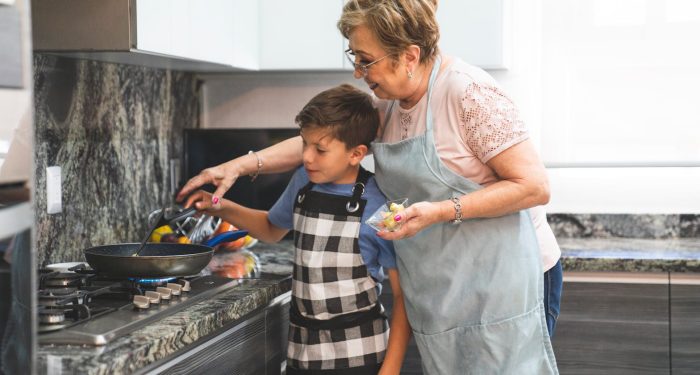
She carried everyone's birthdays in her head, smoothed over decades of family conflicts, and knew exactly who needed what—until the day she realized that in all those years of checking on everyone else, no one had learned to check on her.

Add VegOut to your Google News feed. 
Last week, I watched a woman at the grocery store juggling three phone calls while shopping.
Between selecting produce and checking her list, she was coordinating a doctor's appointment for her elderly mother, arranging a family dinner for the weekend, and helping her adult daughter navigate a work crisis.
Her cart was full of everyone else's favorite foods.
I recognized something in her practiced efficiency, the way she seamlessly wove everyone's needs together without missing a beat, and I recognized something else too: The slight tremor in her hand as she hung up the third call, the way she paused for just a moment in the cereal aisle, closing her eyes and taking a deep breath before continuing.
She reminded me of so many women I've known, and truthfully, of myself during certain seasons of life.
The ones who remember birthdays, who know which grandchild is allergic to strawberries, who can recite everyone's work schedule from memory.
The ones who've spent decades being the invisible thread that keeps the family tapestry from unraveling.
The invisible architecture of family life
Have you ever noticed how some people seem to naturally become the family's central nervous system?
They're the ones who know that Uncle Frank and Aunt Susan can't sit next to each other at Thanksgiving, who remember that cousin Jamie just started a new job, who send the "checking in" texts when someone's going through a rough patch.
During my teaching years, I saw this pattern play out in parent-teacher conferences countless times.
It was almost always the same parent who showed up, who knew the names of their child's friends, who could tell me about their struggles in math and their love of creative writing.
This parent, usually but not always the mother, carried an invisible database of family information that would rival any computer system.
What strikes me now is how this role often goes unnoticed until it changes.
When the family coordinator steps back, whether due to illness, exhaustion, or simply the desire to focus on themselves for once, suddenly everyone realizes they don't know when dad's medication needs refilling or what time the youngest grandchild's recital starts.
When strength becomes isolation
There's a peculiar loneliness that comes with being seen as the strong one.
People assume you don't need checking on because you're always the one doing the checking.
You've handled everything for so long that it becomes your identity, both to others and sometimes to yourself.
I think about a colleague from my teaching days who organized every faculty celebration, remembered every retirement, coordinated meals when someone was sick.
When her husband died suddenly, we all rallied around her for the funeral.
But three months later? Six months later? We'd gotten used to her being fine because she'd always been the one who was fine.
She later told me those months were the loneliest of her life, not because people didn't care, but because they'd never learned to see her as someone who might need care.
Do you find yourself being that person in your family? The one who smooths over conflicts, who plans the gatherings, who keeps track of everyone's emotional temperature?
When was the last time someone asked about yours?
The weight of emotional labor
More than a century later, we've given this phenomenon modern names like emotional labor and mental load, but the experience remains remarkably consistent.
This labor includes not just the doing but the thinking, planning, and anticipating.
It's knowing that your sister gets anxious before big presentations, so you text her encouragement. It's remembering that your brother's anniversary is coming up during a difficult year, so you send a card. It's noticing that your adult child sounds tired on the phone and gently probing to see what's really going on.
After decades of this, you become so good at reading others that you might forget you're equally deserving of being read, of being seen, of being asked, "How are you, really?"
The transition nobody talks about
There comes a point when the family dynamics shift.
Children grow up and move away. Parents age and sometimes pass on. Divorces happen.
The very family structure you've spent decades maintaining transforms into something different, and suddenly your role becomes less clear.
This transition can be profoundly disorienting: Who are you when you're no longer needed in the same way? When the constant stream of family needs slows to a trickle?
Some find it liberating, others terrifying, and many experience both simultaneously.
I wrote in a previous post about finding purpose after retirement, but this is different.
This is about finding yourself when a role you never officially signed up for but fully inhabited begins to dissolve.
Often, just when you might need support navigating this transition, everyone assumes you're handling it beautifully because you always have.
Breaking the pattern with grace
So how do we change this? How do we shift from being the unseen supporter to someone who both gives and receives care?
First, we need to recognize that asking for help is actually a gift to others, allowing them to experience the satisfaction of caring that you've known for years.
When you've been the family caregiver for decades, letting others step into that role can feel unnatural, even uncomfortable, but relationships thrive on reciprocity.
Start small: When someone asks "How are you?" resist the automatic "Fine!" that springs to your lips.
Try "Actually, it's been a challenging week" and see what happens. You might be surprised by how many people have been waiting for permission to care for you.
Consider too that your family may not know how to check on you because you've never taught them.
They're not mind readers, and your competence may have inadvertently trained them to see you as not needing support.
Be direct, and say "I could use someone to talk to about this" or "It would mean a lot if you could help me with something."
Final thoughts
If you recognize yourself in these words, know that your years of holding everything together haven't gone unnoticed by the universe, even if they've been invisible to those closest to you.
Your strength has been a gift, but it doesn't have to be your only identity.
And if you're reading this and thinking of someone in your life who fits this description, perhaps today is the day to reach out.
Not with a need or a request, but with a simple question: "I've been thinking about you. How are you doing these days?"
Then listen, really listen, to the answer.
Sometimes the greatest gift we can give the family keeper is the recognition that they too need keeping.
If You Were a Healing Herb, Which Would You Be?
Each herb holds a unique kind of magic — soothing, awakening, grounding, or clarifying.
This 9-question quiz reveals the healing plant that mirrors your energy right now and what it says about your natural rhythm.
✨ Instant results. Deeply insightful.

Marlene Martin
Marlene is a retired high school English teacher and longtime writer who draws on decades of lived experience to explore personal development, relationships, resilience, and finding purpose in life’s second act. When she’s not at her laptop, she’s usually in the garden at dawn, baking Sunday bread, taking watercolor classes, playing piano, or volunteering at a local women’s shelter teaching life skills.
More Articles by Marlene