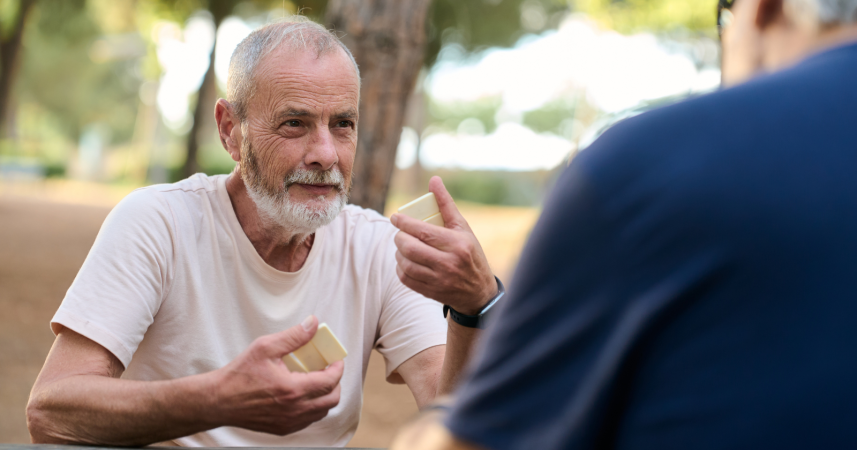
At 82, my father's unexpected answer revealed why he'd been watching that bird feeder so intently—and why I immediately canceled three meetings and booked a flight to Italy.

Add VegOut to your Google News feed. 
Last Tuesday, sitting across from my father in his sunroom, I finally asked the question that had been weighing on me for months.
"Dad, what do you regret most?" He set down his coffee cup, looked out at the bird feeder he'd been watching, and said something I'll never forget: "I spent so much time preparing to live that I forgot to actually do it."
The silence that followed felt like a door opening. Here was my father, a man who'd spent thirty-seven years as a mailman, who knew everyone in town by name and taught me everything about community, telling me he'd missed something essential. At sixty-two myself, his words hit me like cold water. How much of my own life was I still postponing?
The weight of waiting for the perfect moment
My father went on to explain what he meant. He'd always thought there would be a better time for everything. A better time to take that trip to Ireland his grandmother had always talked about.
A better time to learn woodworking from his uncle. A better time to tell people what they meant to him. "I kept thinking I needed to save more money first, or wait until retirement, or until the kids were completely settled," he said.
"But perfect never came. And now my knees won't let me walk those Irish hills, Uncle Frank is gone, and some of the people I loved never knew it."
His confession reminded me of something I'd recently read in Rudá Iandê's book "Laughing in the Face of Chaos." As I've mentioned before when discussing this thought-provoking work, one insight particularly resonated: "We are all wanderers in a strange and inscrutable world, fumbling our way through the darkness with only the faintest glimmer of light to guide us."
The book inspired me to realize that waiting for perfect clarity before acting is just another form of hiding from life itself.
What struck me most was recognizing this same pattern in my own life. How many Italian lessons had I postponed because I wanted to wait until I had "more time" to really focus? I'd finally started learning the language at sixty-six for a trip I'd dreamed about since college. Why had I waited four decades?
The myth of having time later
Have you ever noticed how we treat time like it's a renewable resource? We act as if we can make deposits into some future account where we'll eventually withdraw perfect moments. My father's revelation made me think about all the ways I'd been guilty of this same delusion.
During my years caring for my aging parents while raising my own children, I learned about impossible choices. There were days when I'd promise myself that once this particularly difficult phase passed, I'd focus on my own dreams.
But each phase simply morphed into the next. The kids grew up, my parents passed, and suddenly I was in my sixties wondering where all those "somedays" had gone.
Witnessing my husband's final days taught me the most profound lesson about the fragility and preciousness of time. He had lists, so many lists of things he wanted to do "when he felt better." The guitar in the corner he was going to learn. The letters to old friends he was going to write. The workshop he was going to organize.
None of it happened, not because he didn't care, but because he thought he had more time than he did.
Living with urgency without panic
So how do we live with this awareness without letting it paralyze us with anxiety? This is where my father's wisdom gets even more interesting. "It's not about rushing," he clarified. "It's about choosing. When you know time is finite, you stop wasting it on things that don't matter to your soul."
He told me about the morning walks he takes now, really seeing the sunrise instead of planning his day. About the conversations he has with the grocery store clerk, actually listening instead of rushing through.
About calling his sister every Sunday, not to report news but just to hear her laugh. These aren't grand gestures or bucket list adventures. They're small acts of presence that honor the time we have.
This shift in perspective changed everything for me. Instead of seeing my sixties as a time to finally "catch up" on all I'd postponed, I began seeing each day as complete in itself. That Italian lesson isn't preparation for someday; it's joy right now, stumbling over pronunciations and laughing at my mistakes.
The letter to an old friend isn't an obligation to check off; it's a gift of connection I can give today.
The courage to disappoint expectations
Perhaps the most liberating part of my father's confession was when he admitted he'd spent too much energy trying to meet everyone else's expectations. "I was so busy being the responsible one, the reliable one, that I forgot to be myself," he said.
This resonated deeply with insights from Rudá Iandê's work, particularly his reminder that "Their happiness is their responsibility, not yours." Reading this helped me understand that my father's regret wasn't just about postponed dreams but about the weight of carrying everyone else's needs before his own.
After our conversation, I made a list of all the ways I was still living for other people's approval. The committees I stayed on out of guilt. The social obligations I maintained out of habit. The image of the "perfect grandmother" I was trying to project.
One by one, I started letting them go, not with anger or drama, but with quiet determination to use my remaining years more intentionally.
Final thoughts
My father's answer that Tuesday morning was a gift I didn't expect. At eighty-two, he gave me permission to stop waiting for life to begin. There's something profound about hearing someone you love acknowledge their regrets, not with bitterness but with a gentle warning: don't make my mistakes.
Now, when I feel myself slipping into old patterns of postponement, I remember his words. I think about those untaken walks in Ireland, the unlearned woodworking skills, the unspoken love. And I choose differently.
Not perfectly, not dramatically, but consciously. Because if there's one thing I've learned from my father's honesty, it's that the best time to live your life is always now.
What’s Your Plant-Powered Archetype?
Ever wonder what your everyday habits say about your deeper purpose—and how they ripple out to impact the planet?
This 90-second quiz reveals the plant-powered role you’re here to play, and the tiny shift that makes it even more powerful.
12 fun questions. Instant results. Surprisingly accurate.