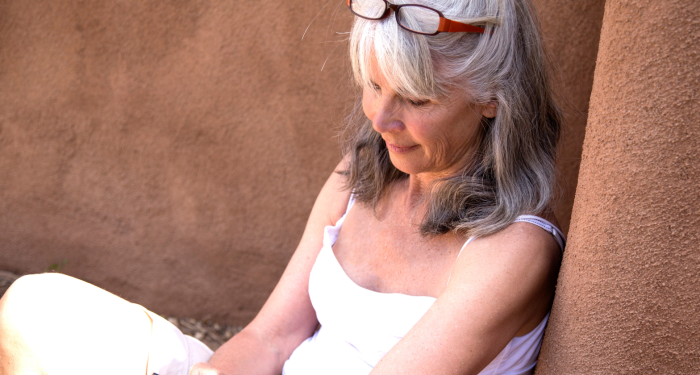
When a story ends, it can feel like jet lag for the heart—because, for a while, you really lived there.
I closed my laptop at 1:17 a.m. and just…sat there.
The apartment was quiet, the tea had gone cold, and the ending of that show kept echoing in the room like someone had left a door open.
I wasn’t sobbing. I wasn’t even disappointed. I was grieving—this odd, tender ache for people who don’t exist and a world I don’t get to visit tomorrow.
If you’ve felt that too—the grocery-aisle flashbacks, the “one more episode” muscle twitching even though there is no more—you’re not broken. You’re built for depth.
Psychology actually has language for why some of us feel this more intensely than others.
And it turns out, the ache points to strengths you might not realize you have. Here are eight of them.
1. You get deeply transported
Some of us don’t just watch or read—we disappear. We’re the ones who miss our subway stop because we were “in it.”
As noted by psychologists Melanie Green and Timothy Brock, narrative transportation is “absorption into a story [that] entails imagery, affect, and attentional focus.”
That’s why the real world blurs when the story world sharpens—and why reentry can feel like jet lag. When the ride ends, the loss feels real because, for a while, it was.
2. You bond hard with characters
You don’t just like characters—you know them.
You could order their coffee for them. You’d recognize their laugh across a room.
Media researchers call these one-sided bonds “parasocial relationships.” And endings can feel like breakups. As communication scholar Jonathan Cohen put it, “the end of parasocial relationships is a painful experience.”
If you mourn a show, it’s not melodrama—it’s your attachment system doing its thing.
3. You carry big empathy reserves
Do you find yourself tearing up in the quiet scenes? Do side characters live in your head rent-free?
High-empathy people absorb emotional tones like a sponge. When the story ends, there’s a kind of emotional momentum that has nowhere to go.
That drop you feel? It’s your nervous system recalibrating without the weekly emotional workout you’ve been doing with those characters.
Personally, I notice this most after long, slow-burn series. It’s like leaving a city you lived in—your heart keeps reaching for the old street corners.
4. You’re a meaning-maker
You don’t consume stories just for thrills—you mine them for frameworks. You notice patterns, test ideas, and fold lessons into your own life.
I’ve mentioned this before but the stories we choose double as mirrors. If a show helped you make sense of a career pivot, a breakup, or even adopting a plant-based lifestyle, the ending can feel like the sudden loss of a mentor.
That tug is a sign that stories are one of your core tools for growth.
5. You need closure (and not all endings give it)
Some finales land like a perfect cadence. Others leave a few notes hanging—and if you’re high on “need for closure,” that can itch.
You might find yourself writing head-canon, reading fan theories, or even rewatching the finale to search for crumbs you missed.
That’s not obsession; it’s an intelligent brain trying to complete a pattern it invested in.
When a narrative refuses neat edges, the ache you feel is the cost of caring about complexity.
6. You’ve got a vivid inner world
If your imagination is Technicolor, stories don’t just entertain you—they colonize your daydreams.
Music cues trigger scenes. A certain coat in a shop window pulls up a character arc.
Your mental imagery is rich enough that when the story goes dark, the sudden quiet is jarring.
Quick experiment: think of the main set from your favorite show. Can you walk through it in your mind and “touch” the furniture? If yes, your imaginative life is doing some heavy lifting—and it makes goodbyes feel heavier too.
7. You ritualize what you love
Maybe you brewed the same tea for every episode. Maybe you read a chapter each night before bed with the same lamp on, the same playlist humming.
Rituals glue meaning to moments. When a story ends, the ritual dissolves with it.
I learned this after finishing a massive fantasy series on a long trip. Every evening in Lisbon, I’d read a chapter on a quiet stairwell near Miradouro da Graça.
When I turned the last page, the view was still there—but the ritual wasn’t. I felt the loss in my body. If this is you, you’re not “too attached.”
You’re a ritualist—and rituals are one of the healthiest ways to anchor a life.
8. You’re community-wired
You don’t just watch; you talk about it. You swap theories, send memes, post recaps, and listen to spoiler-free pods on your morning jog.
When the show is over, it’s not only the story you lose; it’s the weekly campfire with your people.
This is why the “post-finale blues” often fade after you find another crew or pivot your chats to a new shared obsession.
Underneath the grief is a social superpower: you build belonging around ideas. That’s rare—and valuable.
So… what now?
If you saw yourself in a few of these, the “weird grief” makes sense. You were transported, you attached, you found meaning, you ritualized, and you shared the ride. Of course it hurts a little to step off.
A few gentle ways I’ve learned to land:
-
Name it. There’s even a term floating around research circles: post-series depression—described as “a context-specific mood state” with “feelings of emptiness, loss, and melancholy” when a beloved series ends. Naming a feeling shrinks it.
-
Keep a small thread. Save three episode clips or paragraphs that encapsulate what you loved. Revisit them once, intentionally. Then close the tab.
-
Transplant the habit. If you’re plant-based like me, you know the trick: don’t just remove, replace. Swap the nightly binge for a short doc, a new book, or a podcast miniseries—something finite, so your brain sees a bridge, not a cliff.
-
Make a micro-ritual. Keep the tea, keep the lamp, change the story. The brain loves continuity; give it the outline and let a new narrative fill in.
-
Go social on purpose. Nudge the group chat: “New show/book club?” Or take what the story stirred up (courage, compassion, curiosity) and do one small real-world thing with it this week. Volunteer, try a vegan spot you’ve been meaning to check out, journal one page about what changed in you.
The bottom line: the ache you feel is a receipt for having loved something with your whole mind. That’s not a bug. That’s a feature.
And if you’re already eyeing your next great story—same. Let’s be transported again, on purpose, and bring the best of those worlds back with us.
What’s Your Plant-Powered Archetype?
Ever wonder what your everyday habits say about your deeper purpose—and how they ripple out to impact the planet?
This 90-second quiz reveals the plant-powered role you’re here to play, and the tiny shift that makes it even more powerful.
12 fun questions. Instant results. Surprisingly accurate.