The people who need to be asked the most are often the ones who’ve become experts at making sure you never think to ask.

Add VegOut to your Google News feed. 
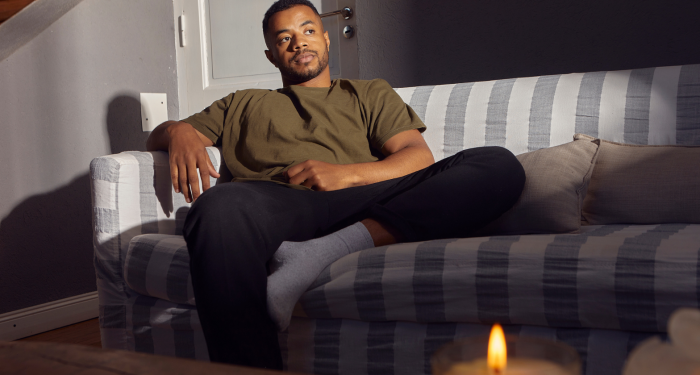
I knew a man who smiled at every family dinner. He passed the bread and asked about your week and laughed at the right moments. He was present in the way that people describe when they're listing a person's qualities at a funeral — he showed up, he was steady, he never complained. And for years, I watched him and thought: there goes a man who is fine.
He wasn't fine. I know that now.
There was something in the way he held his shoulders — just slightly too high, like he was permanently braced against something. In the way he'd go quiet for a half second before answering certain questions. In the way he said "I'm good" so smoothly it had stopped being a sentence and become a reflex. I noticed. I didn't ask. And that's the thing I've been sitting with ever since.
This isn't an article about him, really. It's about the rest of us. The people who saw and stayed silent. The ones who told ourselves we didn't want to pry, or that he'd tell us when he was ready, or — and I'll be honest here — that it was just easier not to open that door. Because what would we do once we opened it?
I've had a lot of years to think about what silence costs.
What I learned from standing at the edge of someone's pain
After my second husband was diagnosed with Parkinson's disease, I spent seven years watching someone I loved carry something enormous and say very little about it. He was a quiet man by nature — he showed love through small acts rather than words, and I had to learn to read him differently than I'd read anyone before. But even knowing him as well as I did, there were nights I'd look at him across the table and realize I had no idea what was happening inside.
What I learned is that the people carrying the heaviest things are often the most practiced at looking like they're not.
They've had years of rehearsal. They know how to redirect a conversation. They know how to make a joke that shifts the focus. They know that if they hold the smile just long enough, most people will accept it and move on. Not because the people around them don't care — but because we've all been taught, in a thousand quiet ways, that asking "are you really okay?" is somehow an intrusion.
It isn't. It's one of the most loving things you can do for another person.
Why we don't ask
I spent most of my career teaching high school English, and one of the most important things thirty-two years in a classroom taught me is that teenagers aren't the only ones who go unasked. Adults are just better at hiding.
I've thought a lot about why we don't ask. Partly, I think, it's fear — fear that if we open the conversation, we won't know what to say next, or that we'll make it worse, or that we'll be pulled into something we don't have the capacity to hold. Partly it's the cultural story we've absorbed that strong people don't struggle, and that to suggest otherwise is to insult them.
But there's something else underneath those reasons that I think is harder to admit: sometimes we don't ask because we already know the answer, and we're not ready for it. We sense the weight. We see the posture. We notice the way the smile doesn't quite reach the eyes. And we choose not to confirm what we already suspect because confirmation means responsibility.
I'm not saying that to be harsh. I did it too. I'm saying it because naming it is the only way to start doing differently.
The question that costs almost nothing
A few years ago I went through a period after my husband passed where I barely left the house for six months. I wasn't advertising that. I was answering texts. I was sounding reasonable on the phone. I was "doing okay, just taking it slowly." And the people who got through to me — who actually reached me — weren't the ones who sent the most messages or dropped off the most food. They were the ones who sat down, looked at me, and said something like: "I don't think you're really okay. And you don't have to be."
That's it. That's the whole thing.
You don't need a script. You don't need to know what comes after the question. You just need to be willing to see someone — really see them — and let them know that you see them. That the performance isn't required. That the smile, as well-practiced as it is, doesn't have to be the whole story.
One thing I've come to believe deeply: grief doesn't shrink. You just grow larger around it. And part of growing larger is learning that you can hold space for another person's pain without fixing it, solving it, or making it go away. Sometimes you just have to sit in the room with it.
What "I'm fine" is really saying
When someone tells you they're fine in that particular tone — clipped, automatic, slightly too quick — they usually mean one of three things. They mean they've decided you can't handle the real answer. Or they mean they've decided they can't handle your reaction to the real answer. Or they mean they've been "fine" for so long that they honestly don't know how to start being anything else.
None of those things are a rejection. All of them are an invitation, if you're willing to take it slowly.
I'm not suggesting you corner people or force conversations they aren't ready for. There's an art to this. Sometimes you plant a seed — "I've been thinking about you, and if there's ever anything you want to talk about, I mean it" — and you let it sit. You come back. You don't pretend you didn't say it. You make yourself a person it's safe to return to.
That's what I wish I had done more deliberately. Not dramatic interventions. Just a quiet, consistent: I see you. I'm not going anywhere. You don't have to be fine with me.
Saying the thing you've been sitting on
If you're reading this and thinking of a specific person — someone at your own table, someone whose posture has been telling you something for years — I want to say this gently: it's not too late to ask.
People carry things for decades waiting for someone to notice and say so. The fact that time has passed doesn't close the door. It might actually make it easier — because you can say, honestly, "I've been thinking about you and I realize I never asked how you were really doing." That kind of honesty tends to open things up rather than close them.
And if you're thinking of someone who is no longer here — if the person you're picturing is someone you can no longer ask — then I hope you can let yourself off the hook with some gentleness. We can only see what we're ready to see. And the fact that you're sitting with this question now means you're paying closer attention going forward.
That matters. It really does.
A note to close
I've been writing personal essays for a few years now, and the ones I come back to most are the ones about the things I got wrong. Not because I believe in punishing yourself for the past — I've learned better than that — but because the places where we fell short of who we wanted to be are often where the most useful lessons live.
I didn't ask. I saw the weight and I told myself it wasn't my place. I was wrong about that, and I've tried to do differently since.
If there's someone in your life carrying something they haven't told you, consider this your permission — your nudge — to gently say: I see you. And I'm asking.
You don't have to have the perfect words. You just have to be willing to ask.
If You Were a Healing Herb, Which Would You Be?
Each herb holds a unique kind of magic — soothing, awakening, grounding, or clarifying.
This 9-question quiz reveals the healing plant that mirrors your energy right now and what it says about your natural rhythm.
✨ Instant results. Deeply insightful.

Marlene Martin
Marlene is a retired high school English teacher and longtime writer who draws on decades of lived experience to explore personal development, relationships, resilience, and finding purpose in life’s second act. When she’s not at her laptop, she’s usually in the garden at dawn, baking Sunday bread, taking watercolor classes, playing piano, or volunteering at a local women’s shelter teaching life skills.
More Articles by Marlene