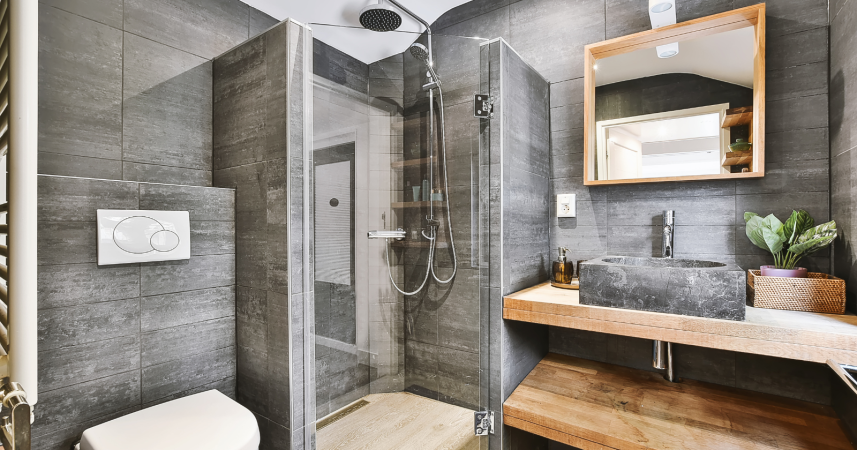
A guest bathroom isn’t about luxury—it’s about dignity, care, and a good towel.
We don’t talk about guest bathrooms much.
But they quietly broadcast how we live—our habits, our values, our blind spots. “The details are not the details. They make the design,” said Charles Eames, and I honestly think he could have been standing in a powder room when he said it.
If you want to know what your home is really saying, start with the smallest room.
Below are nine guest-bathroom items that reveal more than you think—and how to tweak them so they tell the right story.
1. Hand soap
What it says: your priorities, plain and simple.
A cracked pump with mystery gel says “this was an afterthought.” A gentle, cruelty-free soap with a clean scent says “people (and animals) matter here.” If you buy vegan products, your guests notice—even if they don’t mention it. Labels like “paraben-free” and “refillable” also hint at how you weigh health and sustainability.
I travel a bit and always bring back scent memories (a citrusy soap from Lisbon, a cedar note from Vancouver) because a small smell can set the whole tone. One pump, and your home suddenly feels curated rather than cobbled together.
Little upgrade: refill a sturdy glass bottle instead of tossing plastic pumps. It reads calm, intentional, and low-waste.
2. Towels
Towels are hospitality in fabric form.
Thin, scratchy hand towels telegraph frugality or oversight. Plush, clean, and fully dry towels say you care about comfort and hygiene.
Color matters too: bright white signals “we clean often,” while darker tones can read moody or modern but sometimes hide stains—so guests may wonder how often they’re refreshed.
I keep two towels folded and one hanging. It prevents the dreaded “Is this… used?” moment, which is a micro-stress no one needs. And yes, I rotate them after each visit. Nothing fancy—just respectful.
3. Toilet paper (and the backup plan)
Let’s be real: few moments are more revealing than running out of TP in someone else’s house.
If the only roll is hidden behind a childproof cabinet, your bathroom says, “Good luck, traveler.” A visible stack of extras says, “Relax. We thought of you.” The quality of the roll (single-ply vs. plush) also tells your guests whether your home optimizes for budget or comfort.
I’ve mentioned this before, but “clutter is nothing more than postponed decisions,” as organizer Barbara Hemphill put it. That line nudges me to decide once: a small lidded basket right by the toilet, always stocked. Decision made, embarrassment avoided.
4. Scent strategy
Candles, a reed diffuser, a spritz—your scent approach broadcasts how you handle the unglamorous.
Heavy perfume trying to drown out reality? That reads like avoidance. A light, consistent scent (or simply fresh air from a cracked window) says you manage things at the source. And if your candle is covered in soot or burned down to a sad crater, it whispers that maintenance isn’t your strong suit.
Personally, I prefer a plant-based, phthalate-free diffuser. It’s set-and-forget, safe around pets, and never requires guests to strike matches like they’re in a 1994 rom-com.
5. Counter clutter and storage
What lives on the counter tells a story about systems.
A teetering pyramid of products says your home runs on improvisation. Clear surfaces with a few intentional items (soap, a hand towel, maybe a sprig of green) suggest that you’ve done the invisible work: creating places for things to go.
On a recent Saturday I spent 20 minutes adding a single drawer organizer. The next day a friend used the bathroom and said, “It feels bigger in here.” Same square footage; different stress level. That’s the magic of a system.
6. Trash can and quiet supplies
A lined trash can with a lid is unglamorous—and essential.
It tells your guests you understand privacy. No lid or no liner? That says, “We didn’t think this through.” A tiny upgrade is to tuck a few spare liners at the bottom of the can. Even better, add a discreet basket with pads, tampons, and a couple of wipes. This says your home anticipates needs, not just your own.
It also radiates safety. A stocked basket is hospitality you don’t need to announce.
7. Art, plants, and the one unexpected detail
Décor in a guest bathroom isn’t about styling; it’s about storytelling.
A small framed print, a postcard from a city you love, or a resilient plant (pothos, ZZ) says your home is alive and curious. A random word-art plaque says you bought something to fill a space.
There’s nothing wrong with minimal, but bare walls can feel like a waiting room.
I love using “found” art—old sheet music from my music-blogging days, a black-and-white photo I shot on a foggy morning. It invites conversation without screaming for attention. If a plant won’t thrive, a single sprig in a bud vase still speaks “fresh.”
8. Lighting and the mirror
Lighting is honesty.
Harsh overheads make people rush; warm, even light says “breathe.” If guests are applying sunscreen or checking for spinach teeth, a clean mirror and decent illumination help them feel put-together instead of exposed.
Dimmer switches and bulbs in the 2700–3000K range make most spaces look kinder.
If there’s one splurge that shifts the whole vibe, it’s a well-placed sconce or an LED mirror. It signals care for design and day-to-day usability—form plus function, which is the quiet thesis of a good home.
9. Tools you hope they won’t need (but they might)
The most revealing items are often the ones we try to hide: a toilet brush, a plunger, a discreet bottle of cleaner, a box of matches.
If they’re impossible to find, your bathroom says, “We didn’t plan for reality.” If they’re visible but tidy—tucked beside the toilet or behind a simple screen—it says you respect dignity.
Guests shouldn’t have to ask for a plunger any more than they should have to text for Wi-Fi.
I keep a compact plunger, a brush with a clean holder, and a small spray under the sink. It quietly communicates: things happen; you’re covered.
What these nine items reveal (and how to make them kinder)
When I zoom out, guest bathrooms are a crash course in values: Do we prioritize people over perfection? Do we balance sustainability with comfort? Do we default to “figure it out” or “we thought of you”?
A few patterns show up again and again:
-
Care beats cost. You don’t need expensive labels. You need clean, replenished, thoughtfully chosen basics. A $6 vegan soap in a glass bottle looks and feels better than a $30 brand whose pump always clogs.
-
Systems beat speed. One basket for extras, one drawer organizer, one lighting tweak—small systems create a sense of ease that guests feel immediately.
-
Sustainability reads as character. Refillable soap, cruelty-free cleaner, recycled-paper TP, water-saving fixtures—these choices say your home thinks beyond your four walls. If you’re part of the plant-based crowd like me, the bathroom is an easy win: vegan products, no animal testing, and less plastic.
-
Dignity is design. The presence of supplies (from tampons to plungers) is design with empathy. It’s the house version of giving someone directions before they’re lost.
And if you want one guiding principle? “The details are not the details.” They’re how your home speaks when you’re not in the room. When those details are simple, kind, and low-waste, the message is unmistakable: Welcome. Stay as long as you like.
Quick checklist to reset your guest bathroom in 20 minutes
-
Refill a clean, reusable soap dispenser (plant-based if you can).
-
Put two fresh hand towels out; retire anything threadbare.
-
Stack three spare TP rolls where guests can see them.
-
Swap heavy perfume for a light diffuser or open the window.
-
Clear the counter; add one living element (plant or sprig).
-
Line the trash can and stock spare liners underneath.
-
Add a discreet “care basket” with pads, tampons, wipes.
-
Wipe the mirror; warm up the bulbs.
-
Park a compact plunger/brush set within reach.
One last thought from the world of design and behavior: small frictions shape big feelings.
The more you remove friction in that tiny room, the more your home reads as generous. Guests won’t remember every tile or towel. But they’ll remember how they felt in your space—and they’ll come back.
As always, I’m learning right alongside you. Homes evolve. So do the little rooms inside them.
If You Were a Healing Herb, Which Would You Be?
Each herb holds a unique kind of magic — soothing, awakening, grounding, or clarifying.
This 9-question quiz reveals the healing plant that mirrors your energy right now and what it says about your natural rhythm.
✨ Instant results. Deeply insightful.