Sometimes the meals that define us aren’t the fancy ones, but the humble dishes woven quietly into everyday American life.
Travel has this sneaky way of holding up a mirror to your own culture.
It’s not always the grand monuments or politics people latch onto—it’s often the little everyday things. And one of the biggest mirrors? Food.
The meals we see as ordinary in the U.S. are often the exact ones that people abroad recognize as uniquely American. Sometimes they’re fascinated. Sometimes they’re confused. And sometimes they only know them through movies, music, or TV.
Here are seven U.S. dishes that foreigners recognize instantly—while most Americans barely give them a second thought.
1) Mac and cheese
Every culture has its comfort food. But few dishes scream “America” abroad the way mac and cheese does.
Here, it’s the blue box in the pantry. It’s that quick dinner when you don’t feel like cooking. It’s the side dish at a barbecue or the filler on a kid’s plate when they won’t eat anything else. For most Americans, mac and cheese barely qualifies as remarkable.
But go abroad, and suddenly it’s a big deal. I’ve been asked multiple times by friends in Europe if we really eat it as much as TV shows suggest. The image of kids spooning up that neon-orange sauce is iconic to them. It’s almost like a cultural cliché.
Psychologically, mac and cheese also plays into the idea of “edible nostalgia.” We don’t just eat it—we associate it with childhood safety and family rituals. That makes it an easy export for American culture because nostalgia travels well through media.
I once had a vegan version of it in London at a café where they fancied it up with truffle oil and spinach. That’s when it hit me: while we shrug at it here, other cultures spotlight it as a uniquely American classic.
2) Peanut butter and jelly
If mac and cheese is our comfort food, PB&J is our default fuel.
Ask an American about it and you’ll likely get a shrug. It’s the ultimate no-effort lunch. You don’t think about it—you just make it.
But overseas? Peanut butter and jelly sandwiches are borderline exotic. In many cultures, peanut butter is either rare or seen as savory. Pairing it with sweet fruit jam seems strange. A friend in Italy once told me, “It sounds like something a child would invent when left alone in the kitchen.”
And yet, it’s one of the most recognizable images of American childhood. The brown paper bag lunch with a PB&J is almost shorthand for growing up in the States.
From a psychology standpoint, PB&J demonstrates something we often forget: cultural food norms aren’t universal. What feels “normal” to you might feel bizarre—or even revolutionary—elsewhere. That tension between the ordinary and the unusual is exactly why PB&J gets so much attention abroad.
3) Corn dogs
Here’s where things get a little carnival.
Corn dogs are pure Americana: meat on a stick dipped in cornmeal batter and deep-fried until golden. I don’t eat them now—vegan life means I’ve swapped them for plant-based versions—but they’re still lodged in my childhood memory.
At state fairs, corn dogs aren’t just food; they’re part of the spectacle. They’re portable, indulgent, and a little ridiculous. Abroad, people instantly connect them with that image of the American fairground. Bright lights, Ferris wheels, fried everything—it all comes bundled with the corn dog.
I once described them to a friend in Japan. She laughed and said, “Of course Americans would invent something like that.” She meant it as both a compliment and a gentle jab. And honestly? She’s not wrong.
Psychologically, corn dogs represent what sociologists call “festival food”—the kind of dish tied less to everyday nutrition and more to experiences of celebration, abundance, and fun. Even if someone has never eaten one, they still “get” what it represents.
4) S’mores
I didn’t realize s’mores were uniquely American until I traveled.
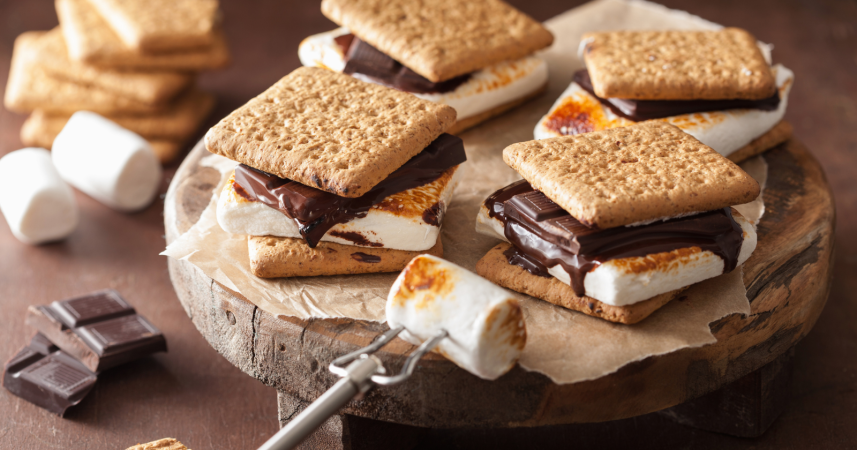
For me, they were just part of camping. Graham crackers, chocolate, marshmallows toasted over fire—it wasn’t something to question.
But when I explained them in France, I hit a wall. Marshmallows weren’t common, and graham crackers were nonexistent. Trying to define a graham cracker abroad is surprisingly tricky. “It’s like a cookie but not sweet, like a biscuit but not savory.” Cue confusion.
And yet, thanks to Hollywood, everyone knows s’mores. They’ve seen them in campfire scenes. They know kids roasting marshmallows on sticks and sandwiching them into gooey treats. It’s a food people recognize through story before taste.
That’s what makes s’mores so interesting from a cultural perspective: they’re an edible myth. Even if someone has never had one, they know exactly what it represents—childhood, outdoors, friendship, warmth.
5) Sloppy joes
Sloppy joes are one of those dishes Americans rarely think about unless they’re staring at them in a school cafeteria line.
Basically, it’s just saucy ground meat (or in my case now, lentil-based vegan versions) on a bun. Messy, quick, cheap. Nothing groundbreaking.
But abroad, the very name is almost comedic. A German friend once laughed and said, “That’s the most American food I’ve ever heard of—chaotic, simple, and big.”
And she had a point. Sloppy joes embody a particular stereotype of America: big portions, easy meals, and a bit of chaos.
They also tie into a bigger idea—what psychologists call “cultural scripts.” Every culture has a mental image of what food from another country “should” look like. For the U.S., the script includes casual, family-style, slightly over-the-top meals. Sloppy joes fit the bill perfectly.
6) Biscuits and gravy
If you want to see foreigners truly puzzled, mention biscuits and gravy.
In the U.S., it’s diner breakfast 101. Soft, fluffy biscuits smothered in thick gravy. Familiar, filling, no big deal.
But outside the U.S., the dish bends categories. In the UK, biscuits are cookies. Gravy goes with roast meat, not breakfast. So when you put the two together, it feels like a category error. “Cookies with meat sauce?!” That’s the reaction I’ve gotten more than once.
And yet, biscuits and gravy is one of those foods that’s instantly stamped “American” in the foreign imagination. They might not get it, but they know it belongs to us.
I’d argue part of the fascination comes from how context-heavy the dish is. To really understand biscuits and gravy, you need the whole Southern diner experience.
Food psychology tells us taste isn’t just about flavor—it’s about setting, memory, and ritual. Without that context, the dish seems strange, but with it, it makes perfect sense.
7) Grits
Finally, grits.
If you’ve spent time in the South, you know they’re everywhere. Creamy, boiled cornmeal—sometimes plain, sometimes dressed up with cheese or butter. To Southerners, it’s basic food. To Americans outside the South, it’s at least familiar.
But abroad? Total mystery. Even the word “grits” throws people off. Is it plural? Is it crunchy? Is it breakfast? Lunch? Dinner?
When I was living abroad for a few months, grits came up in conversation more than I expected. Friends who had never tried them still recognized them from movies or books set in the American South. They’d ask, “What do they actually taste like?”
That’s when it clicked for me: grits are less about flavor and more about identity. They symbolize the South itself. Psychologists sometimes talk about “identity foods”—the dishes so tied to a region or group that they carry meaning far beyond taste. For the South, grits are exactly that.
Wrapping it up
The funny part about all this is how invisible these foods feel to most Americans. They’re just… there. Lunchbox fillers, diner plates, camping snacks. Nothing exotic.
But when you step outside the U.S., you see them differently. They’re cultural markers. They’re shorthand for “American life” in the eyes of the world.
That gap—between what we overlook and what others recognize—says a lot about how culture works. We live inside it so deeply we forget it’s there. Sometimes it takes a friend abroad or a meal served in a different context to remind us.
So next time you casually make a PB&J, grab some mac and cheese, or hear someone talk about grits, pause for a second. That dish might not mean much to you—but to the rest of the world, it’s a little symbol of America.